


The Masada Siege
The Roman assault on Herod’s desert fortress
Masada—for many, the name evokes the image of a cliff rising dramatically above an austere desert landscape. The name is famously associated with the Masada siege, the final stand between the Jewish rebels and the relentless Roman army at the end of the First Jewish Revolt in 73/74 C.E. Trapped in the desert fortress-palace Herod built in the previous century, the rebels chose—as Jewish historian Josephus tells us—to commit mass suicide rather than be captured and enslaved by the Romans.

The Romans waged both literal and psychological warfare on the Jewish rebels in the siege of Masada. Evidence of the large-scale siege works, including the great assault ramp on the western slope of the cliff of Masada, reflects this strategy. Photo: Werner Braun.
This final scene in the siege of Masada has been celebrated and immortalized as an act of heroic resistance on the part of the Jewish rebels. But what do we know about the Roman siege itself? In “The Masada Siege—From the Roman Viewpoint” in the July/August 2014 issue of Biblical Archaeology Review, Gwyn Davies examines the assault from the Roman perspective.
After the fall of Jerusalem in 70 C.E., the Romans turned their attention to stamping out the last of the rebels holding out at the fortresses of Herodium and Machaerus as well as in the “Forest of Jardes” (which has not yet been identified). The last remaining site occupied by the Jewish rebels was at Herod’s desert fortress-palace on the cliff-top of Masada.
Led by Roman general Flavius Silva, the Legio X Fretensis—a veteran military unit—began the siege operation against the rebels in 72 or 73 C.E.

FREE ebook: Masada: The Dead Sea’s Desert Fortress. Discover what archaeology reveals about the Jewish rebels’ identity, fortifications and arms before their ultimate sacrifice.
Archaeological investigations of the Roman siege works at Masada have been much more limited in scope than those conducted on the cliff-top fortress. According to author Gwyn Davies, we must therefore consider both the account given by Josephus and the surviving archaeological evidence in order to reconstruct what happened in the Masada siege.
The Roman army began their assault, as described by Josephus, by throwing up “a wall all around the fortress to make it difficult for any of the besieged to escape, and posted sentinels to guard it” (The Jewish War VII.276). Archaeological investigations reveal that a 2.5-mile circumvallation wall ringed the area around the desert fortress. The wall, composed of rough stone blocks with a rubble core, measured more than 5 feet wide and 10 feet high. Fifteen towers lined the eastern and northern stretches of the circumvallation wall, while eight camps laid down around the wall served as bases and garrison points for the troops.
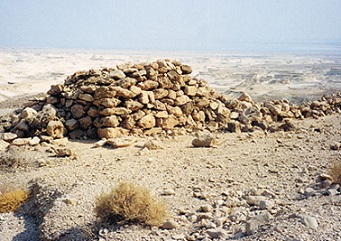
Fifteen towers, including the one pictured, were mounted with catapults and positioned along the Roman circumvallation wall. Photo: Gwyn Davies.
The most conspicuous surviving evidence of the Roman siege of Masada is the great assault ramp on the western slope of the cliff. The Romans constructed on a natural spur (which Josephus calls the “Leuke,” or “white promontory”) that abuts the mountain a ramp composed of stone and earth reinforced with timber bracings. Josephus tells us that an ironclad siege tower housing a battering ram was hoisted up the ramp and placed into position to strike against the rebels’ casemate wall. Indeed, the location of the breached defense wall lies directly above the modern summit of the ramp. Furthermore, the distribution of stone ballista projectiles discovered within the desert fortress suggests that they were fired from catapults mounted on a siege tower. Setting fire to the wood-and-earth defense wall, the Romans at last made it to the top of Masada.
For a deeper probe into how the Romans waged both literal and psychological warfare on the besieged rebels, read the full article “The Masada Siege—From the Roman Viewpoint” by Gwyn Davies in the July/August 2014 issue of Biblical Archaeology Review.
Subscribers: Read the full article “The Masada Siege—From the Roman Viewpoint” by Gwyn Davies as it appears in the July/August 2014 issue of Biblical Archaeology Review.
Not a BAS Library or All-Access Member yet? Join today.
Related reading in Bible History Daily:
Coins Celebrating the Great Revolt Against the Romans Unearthed near Jerusalem
All-Access members, read more in the BAS Library:
It’s a Natural: Masada Ramp Was Not a Roman Engineering Miracle
This Bible History Daily feature was originally published on June 13, 2014.
Related Posts




Must-Read Free eBooks

Want more Bible history?
Sign up to receive our email newsletter and never miss an update.
Unlock Unlimited Access to the Bible's Past

Unlock Unlimited Access to the Bible's Past
Become an All-Access Member to explore the Bible's rich history. Get Biblical Archaeology Review in print, full online access, and FREE online talks. Plus, enjoy special Travel/Study discounts. Don't miss out—begin your journey today!

Wonder if Herod would have stood a better chance if he hadn’t slaughtered so many male children.
Beat Slayer
That wall he builds is too small
For the anger he keeps inside
Is greater than himself
And those cold stone statues
That stand behind that wall too small
Cast a shadow
That hurts the hearts
And enslaves the minds
Of many poor souls
Far beyond
Those great angry walls
Re: suicide of the Jews at Masada.
I agree with the comment that suicide runs counter to Jewish beliefs. Is it possible that many, if not most, of the inhabitants of Masada had simply walked away? The Roman guards had reason to allow this as every escapee is one less fighter. Perhaps, when the Romans finally breached the defenses, they found virtually nobody there and claimed the inhabitants had committed suicide so that the long siege would not become a laughing stock. Josephus was not at Masada, so his account is dubious at best.
I recall reading about Josephus sevral years ago of his method of interviewing people who were there, or knew someone
who was and constuling millitary maps for the lay of the land to lend accruacy to the report(?). Also that when he and his men were faceing capture some years befor his writing histories, he propsed suicide to elude slavery, but none of his men agreed.
Nothing about any Jewish Slaves used in the building of the ramp or dragging the Ram up the incline?
About 15 years ago, our tour guide at Masada said there was only one suicide; that the people selected 3 men to kill all of them, and then one of them killed the two, thus only the remaining 1 committed suicide. Not stating this as fact, just what our guide told us.
We’re still paying taxes to Rome. It’s called religion today. Let’s all get together and finish off Rome; put it out of its misery. They never were that great. Gifted students in Italy when Rome was at its prime had to travel to university in Greece. Did they develop radio, the diesel engine, electric power, aircraft?
Masada was built by the ancient Kings of the Jewish people! (“The Wars of the Jews” Book 4, Chapter 7, Paragraph 2) Start digging BAR!
The historian Josephus Flavius was much like CNN reporter in fabricating the events and exaggerating the history
If the Jews had the wisdom to build Masada, The Jews had a way out Masada.