


Alternative Facts: Domitian’s Persecution of Christians
Was Roman emperor Domitian really the great persecutor of Christians?
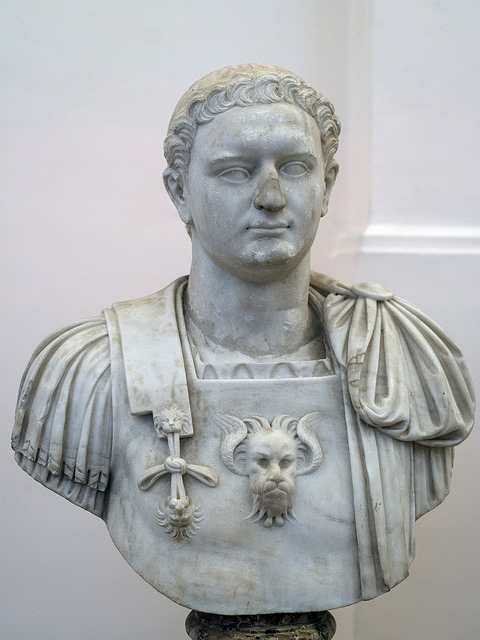
Ancient portrait of Roman emperor Domitian (r. 81–96 C.E.) set into a bust by Guglielmo della Porta (16th c. C.E.) at the National Archaeological Museum, Naples. Photo: Dan Diffendale/CC BY-SA 2.0.
As I revisited a critical biography of the Roman emperor Domitian by the scholar Brian W. Jones recently,1 I was reminded that “alternative facts” and “fake news” are not just a contemporary phenomenon. On occasion ancient writers similarly tried to spin their version of the truth. Jones tackles the familiar line that Domitian, who reigned between 81 and 96 C.E., was a great persecutor of Christians. This “fact” is now standard stock in much popular writing on the book of Revelation and is even found in some scholarly tomes. In his discussion, Jones carefully rehearses how this “fact” developed.
Eusebius in his Church History (CH) provides the first reference to Domitian persecuting the church. Writing over three centuries later in the early fourth century C.E., this ancient Christian historian first quotes Melito of Sardis, who mentioned that Domitian brought slanderous accusations against Christians (CH 4.26.9). He also cites Tertullian, who claimed that Domitian was cruel like the emperor Nero (r. 54–68 C.E.), but that Domitian was more intelligent, so he ceased his cruelty and recalled the Christians he had exiled (CH 3.20.9). Eusebius also quotes Irenaeus, who claimed Domitian’s persecution consisted only of John’s banishment to Patmos and the exile of other Christians to the island of Pontia (CH 3.18.1, 5).
Despite these cautious statements by three earlier authors, Eusebius then spun his own alternative fact by claiming that Domitian, like Nero, had “stirred up persecution against us” (“anekinei diōgmon”; CH 3.17). From here the tradition was enlarged by Orosius (d. 420 C.E.), who, in his History Against the Pagans, wrote that Domitian issued edicts for a general and cruel persecution (7.10.5). Despite a lack of evidence, Jones observes that the tradition concerning Domitian’s persecution persists: “From a frail, almost non-existent basis, it gradually developed and grew large.”2 Thus the alternative facts sown by these ancient historians grew to a truism of Christian history.

FREE ebook: Paul: Jewish Law and Early Christianity. Paul’s dual roles as a Christian missionary and a Pharisee.
No pagan writer of the time ever accused Domitian, as they had Nero, of persecuting Christians. Pliny, for example, served as a lawyer under Domitian and wrote in a letter to Trajan (r. 98–117 C.E.) that he was never present at the trial of a Christian (Letters 10.96.1). This is a strange claim for one of Domitian’s former officials if Christian persecution were so prevalent. The archaeologist Julian Bennett, who has written a biography of Trajan, also fails to mention any general persecution of Christians at this time. Domitian’s execution of Clemens has sometimes been linked to the senator’s apparent “atheism,” a term sometimes given to Christians. However, there is no “smoking gun” linking Clemens’s death to Christian persecution.3 So Jones concludes, “No convincing evidence exists for a Domitianic persecution of the Christians.”4
Become a BAS All-Access Member Now!
Read Biblical Archaeology Review online, explore 50 years of BAR, watch videos, attend talks, and more

A related “fact” is that Domitian claimed the title Dominus et Deus (“Lord and God”). The evidence here is mixed. The poet Statius (Silvae 1.6.83–84) states that Domitian rejected the title Dominus as his predecessor Augustus (the first Roman emperor) had done. The historian Suetonius (Life of Domitian 13.2) does report that Domitian dictated a letter that began, “Our Lord and Master orders…,” but it was only his sycophantic officials who began to address him in this way. The story was again embellished by later historians to the point that Domitian is said to have ordered its use. Jones thinks the story incredible because Domitian was known for his habitual attention to theological detail in traditional Roman worship, so he would not have adopted such inflammatory divine language. After their deaths, the best that emperors could hope for was to be called Divus (Divine), not Deus (God). If Domitian were such a megalomaniac who ordered worship to himself, why haven’t any inscriptions been found using this formula? In fact, no epigraphic evidence exists attesting to Christians being forced to call him “Lord and God.”
Why is Domitian’s legacy so clouded in the ancient sources? Domitian’s assassination in 96 C.E. brought an end to the Flavian dynasty, and the dynasty founded by Nerva, the next Roman emperor, lasted into the third century C.E. Because Domitian had offended the aristocratic elite, the Senate ordered the damnation of his memory. Even though Suetonius (Domitian 8.1) stated that Domitian carefully and conscientiously administered justice, later writers such as Dio Chrysostom (67.2.4) perpetuated his damaged reputation using alternative facts.
Jones writes as a Roman historian outside of Biblical studies, but a New Testament scholar has similarly articulated this view. Leonard Thompson notes that a more critical reading of Eusebius raises doubts about a widespread persecution of Christians under Domitian. He concludes that “most modern commentators no longer accept a Domitianic persecution of Christians.”5 Some writers consider Revelation as a source for a persecution by Domitian, although John never identifies a specific emperor. If so, then Revelation would be the only ancient source pointing to such a persecution.
Over two decades since two Roman historians and a Revelation scholar have pronounced a Domitianic persecution moribund, such claims continue to circulate in articles, books and sermons. This shows how long it takes to repudiate “alternative facts” that have circulated for over 1,500 years in Christendom. Literary texts may sow alternative facts, but archaeological realia, such as inscriptions and coins, have assisted in discrediting those alleged facts. The “fake news” that Domitian instigated a severe persecution of Christians and that his claim to be “Master and God” provoked this persecution needs to be removed from our “facts” about the early church.
 Mark Wilson is the director of the Asia Minor Research Center in Antalya, Turkey, and is a popular teacher on BAS Travel/Study tours. Mark received his doctorate in Biblical studies from the University of South Africa (Pretoria), where he serves as a research fellow in Biblical archaeology. He is currently Associate Professor Extraordinary of New Testament at Stellenbosch University. He leads field studies in Turkey and the eastern Mediterranean for university, seminary and church groups. He is the author of Biblical Turkey: A Guide to the Jewish and Christian Sites of Asia Minor and Victory through the Lamb: A Guide to Revelation in Plain Language. He is a frequent lecturer at BAS’s Bible Fests.
Notes
1. Brian W. Jones, The Emperor Domitian (New York: Routledge, 1992).
2. Jones, Emperor Domitian, p. 114.
3. Julian Bennett notes that the charge against Clemens and his family was that they had adopted Jewish religious ways. He then considers whether Judaism or Christianity is meant and opts for the latter as “more likely.” See Julian Bennett, Trajan: Optimus Princeps (London: Routledge, 1997), p. 68.
4. Jones, Emperor Domitian, p. 117.
5. Leonard L. Thompson, The Book of Revelation: Apocalypse and Empire (Oxford: Oxford Univ. Press, 1990), p. 16.
Related reading in Bible History Daily
All-Access members, read more in the BAS Library
Not a BAS Library or All-Access Member yet? Join today.
This Bible History Daily feature was originally published on July 24, 2017.
Related Posts


Must-Read Free eBooks
Want more Bible history?
Sign up to receive our email newsletter and never miss an update.
Unlock Unlimited Access to the Bible's Past

Unlock Unlimited Access to the Bible's Past
Become an All-Access Member to explore the Bible's rich history. Get Biblical Archaeology Review in print, full online access, and FREE online talks. Plus, enjoy special Travel/Study discounts. Don't miss out—begin your journey today!

Playing the “victim card” about history is particularly effective if you are trying to demonstrate the potency of your movement and/or belief system. It can attract sympathy for the plight, admiration for effectiveness, and contempt for the cruel oppressor of your virtuous struggle.
Judging by Gibbon, the authorities were thoroughly justified in suppressing the terrorist adherents of this new cult, who would keep rioting and trying to burn down other peoples’ temples.
Only the “broken reed” Christians were spared. Domitian was a vicious persecutor. Indeed,it was the Roman Empire that judicially murdered Yeshua.
Awesome. Its enough of portray the most wonderful civilization of human era, as corrupt psychopaths. Thats all lies. Romans were magnificents.
“Judging by Gibbon”
The easiest way to tell how illiterate someone is concerning Roman History. Gibbon was a notorious hack with an axe to grind.
No one thinks this about Gibbon. He was the first great English historian of antiquity. Every scholar on Gibbon takes into account his bias and snide remarks about Christianity. He was not a Christian! Notorious hack? He was a tremendous writer and scholar. With a great sense of humor! Which volumes have you read? Any?
Christians were mostly used as scapegoats by the Romans. When events or plagues spread it was the Christians who were responsible for it. It was a common occurrence that was later filled by the Jews in Europe. Bad news Christians caused it. What singled them out was they refused to burn incense to Caesar. this made them outlaws and they were condemned to death.
The problem with recent revisionist history regarding persecution of Christians under Domitian and others is that Pliny the Younger’s letter to Trajan makes no sense apart from a long-standing, Empire-wide ban on Christianity. Pliny knows well that Christinaity is illegal, and has been for some time, and he testifies that he executed Christians who refused to recant their Christianity, as was in keeping with Roman law and custom. To cite this letter as evidence against widespread Roman persecution of Christians is ridiculous, and it shows a strong bias against established historical tradition, likely for the sake of political agenda.
Wilson’s conclusions are faulty. First, his citations show consistency on Eusebius’ part, not false assumptions or slander by Eusebius, whose histories records reports what was written by others in various areas at various times. Second, empires can continue to operate as “business as usual” without needing specific edicts. Third, the argument of silence does not prove that Domitian was innocent of persecution; being “not present” at trials hardly shows his lack of endorsement. Wilson shows his connection in the execution of Clemens but tells us it wasn’t for persecution. Is the death sentence for “antisocialism and a decline in support for idols and temples” not a sign of persecution? Trajan’s letter shows that he shares in Domitian’s wisdom of restraint in persecution (see Tertullian), but that doesn’t mean persecution was rare or non-existent during this time. Agreed that later writers may have embellished on the persecution, but it seems false to say that persecution of Christians was not an issue in Domitian’s reign.
Rev 1:9 “I John, who also am your brother, and companion in tribulation, and in the kingdom and patience of Jesus Christ, was in the isle that is called Patmos, for the word of God, and for the testimony of Jesus Christ.” Yes John was there because of persecution against the church and christians. Notice he siad “companion in tribulation” menaing others were experinecing the tribulation as well as him. This was all under Domitian’s reign. Domitian truly allowed it and encouraged it. This was somewhere beween 90-95 A.D.
The problem with using the Revelation as evidence of persecution in the reign of Domitian is that to do so one must assume that the Revelation was written during Domitian’s reign. The reason for doing this is that the Revelation seems to indicate a background of persecution. This reasoning is circular. If Domitian did not engage in an enhanced persecution of Christianity (and a mere exile is not really enhanced persecution) then the Revelation would need to be dated to a different period.
The persecution of Christianity seems to have been an ever-present background condition after the reign of Nero; Pliny’s letter to Trajan presumes that Christianity is an illegal religion and is to be persecuted in some way, but the response of Trajan, while he agrees with this, is lukewarm about the persecution. Some emperors, however, seem to have undertaken major persecutions of Christianity, for example the Decian persecution or the Great Persecution.
It would seem that Christianity was never really free from persecution from the time of Nero to that of Constantine, but that there were definite periods of enhanced persecution when an emperor ordered active measures to be taken against it.
It is my opinion that Revelation was written in the days of Nero. There being proof the he persecuted the Christians.
A careful reading of Revelation along with knowledge of the ancient Roman world would actually suggest that the work, as it exists today, was written by at least three authors writing at different times. The first edition might well have been written as early as the 30’s CE, with a second edition in the late 60’s or early 70’s and the final version being written in the 90’s. The second and third editions merely reworked the previous editions but could not totally eliminate portions that were already knows, just modify them slightly in an attempt to make a coherent whole.