


Alternative Facts: Domitian’s Persecution of Christians
Was Roman emperor Domitian really the great persecutor of Christians?
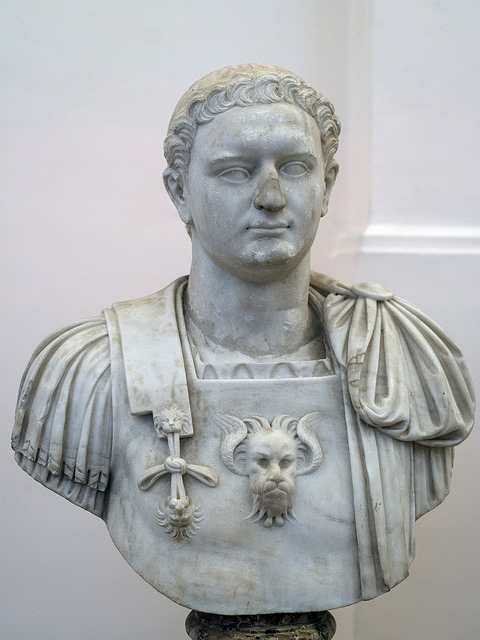
Ancient portrait of Roman emperor Domitian (r. 81–96 C.E.) set into a bust by Guglielmo della Porta (16th c. C.E.) at the National Archaeological Museum, Naples. Photo: Dan Diffendale/CC BY-SA 2.0.
As I revisited a critical biography of the Roman emperor Domitian by the scholar Brian W. Jones recently,1 I was reminded that “alternative facts” and “fake news” are not just a contemporary phenomenon. On occasion ancient writers similarly tried to spin their version of the truth. Jones tackles the familiar line that Domitian, who reigned between 81 and 96 C.E., was a great persecutor of Christians. This “fact” is now standard stock in much popular writing on the book of Revelation and is even found in some scholarly tomes. In his discussion, Jones carefully rehearses how this “fact” developed.
Eusebius in his Church History (CH) provides the first reference to Domitian persecuting the church. Writing over three centuries later in the early fourth century C.E., this ancient Christian historian first quotes Melito of Sardis, who mentioned that Domitian brought slanderous accusations against Christians (CH 4.26.9). He also cites Tertullian, who claimed that Domitian was cruel like the emperor Nero (r. 54–68 C.E.), but that Domitian was more intelligent, so he ceased his cruelty and recalled the Christians he had exiled (CH 3.20.9). Eusebius also quotes Irenaeus, who claimed Domitian’s persecution consisted only of John’s banishment to Patmos and the exile of other Christians to the island of Pontia (CH 3.18.1, 5).
Despite these cautious statements by three earlier authors, Eusebius then spun his own alternative fact by claiming that Domitian, like Nero, had “stirred up persecution against us” (“anekinei diōgmon”; CH 3.17). From here the tradition was enlarged by Orosius (d. 420 C.E.), who, in his History Against the Pagans, wrote that Domitian issued edicts for a general and cruel persecution (7.10.5). Despite a lack of evidence, Jones observes that the tradition concerning Domitian’s persecution persists: “From a frail, almost non-existent basis, it gradually developed and grew large.”2 Thus the alternative facts sown by these ancient historians grew to a truism of Christian history.
FREE ebook: Paul: Jewish Law and Early Christianity. Paul’s dual roles as a Christian missionary and a Pharisee.
No pagan writer of the time ever accused Domitian, as they had Nero, of persecuting Christians. Pliny, for example, served as a lawyer under Domitian and wrote in a letter to Trajan (r. 98–117 C.E.) that he was never present at the trial of a Christian (Letters 10.96.1). This is a strange claim for one of Domitian’s former officials if Christian persecution were so prevalent. The archaeologist Julian Bennett, who has written a biography of Trajan, also fails to mention any general persecution of Christians at this time. Domitian’s execution of Clemens has sometimes been linked to the senator’s apparent “atheism,” a term sometimes given to Christians. However, there is no “smoking gun” linking Clemens’s death to Christian persecution.3 So Jones concludes, “No convincing evidence exists for a Domitianic persecution of the Christians.”4
Become a BAS All-Access Member Now!
Read Biblical Archaeology Review online, explore 50 years of BAR, watch videos, attend talks, and more

A related “fact” is that Domitian claimed the title Dominus et Deus (“Lord and God”). The evidence here is mixed. The poet Statius (Silvae 1.6.83–84) states that Domitian rejected the title Dominus as his predecessor Augustus (the first Roman emperor) had done. The historian Suetonius (Life of Domitian 13.2) does report that Domitian dictated a letter that began, “Our Lord and Master orders…,” but it was only his sycophantic officials who began to address him in this way. The story was again embellished by later historians to the point that Domitian is said to have ordered its use. Jones thinks the story incredible because Domitian was known for his habitual attention to theological detail in traditional Roman worship, so he would not have adopted such inflammatory divine language. After their deaths, the best that emperors could hope for was to be called Divus (Divine), not Deus (God). If Domitian were such a megalomaniac who ordered worship to himself, why haven’t any inscriptions been found using this formula? In fact, no epigraphic evidence exists attesting to Christians being forced to call him “Lord and God.”
Why is Domitian’s legacy so clouded in the ancient sources? Domitian’s assassination in 96 C.E. brought an end to the Flavian dynasty, and the dynasty founded by Nerva, the next Roman emperor, lasted into the third century C.E. Because Domitian had offended the aristocratic elite, the Senate ordered the damnation of his memory. Even though Suetonius (Domitian 8.1) stated that Domitian carefully and conscientiously administered justice, later writers such as Dio Chrysostom (67.2.4) perpetuated his damaged reputation using alternative facts.
Jones writes as a Roman historian outside of Biblical studies, but a New Testament scholar has similarly articulated this view. Leonard Thompson notes that a more critical reading of Eusebius raises doubts about a widespread persecution of Christians under Domitian. He concludes that “most modern commentators no longer accept a Domitianic persecution of Christians.”5 Some writers consider Revelation as a source for a persecution by Domitian, although John never identifies a specific emperor. If so, then Revelation would be the only ancient source pointing to such a persecution.
Over two decades since two Roman historians and a Revelation scholar have pronounced a Domitianic persecution moribund, such claims continue to circulate in articles, books and sermons. This shows how long it takes to repudiate “alternative facts” that have circulated for over 1,500 years in Christendom. Literary texts may sow alternative facts, but archaeological realia, such as inscriptions and coins, have assisted in discrediting those alleged facts. The “fake news” that Domitian instigated a severe persecution of Christians and that his claim to be “Master and God” provoked this persecution needs to be removed from our “facts” about the early church.
 Mark Wilson is the director of the Asia Minor Research Center in Antalya, Turkey, and is a popular teacher on BAS Travel/Study tours. Mark received his doctorate in Biblical studies from the University of South Africa (Pretoria), where he serves as a research fellow in Biblical archaeology. He is currently Associate Professor Extraordinary of New Testament at Stellenbosch University. He leads field studies in Turkey and the eastern Mediterranean for university, seminary and church groups. He is the author of Biblical Turkey: A Guide to the Jewish and Christian Sites of Asia Minor and Victory through the Lamb: A Guide to Revelation in Plain Language. He is a frequent lecturer at BAS’s Bible Fests.
Notes
1. Brian W. Jones, The Emperor Domitian (New York: Routledge, 1992).
2. Jones, Emperor Domitian, p. 114.
3. Julian Bennett notes that the charge against Clemens and his family was that they had adopted Jewish religious ways. He then considers whether Judaism or Christianity is meant and opts for the latter as “more likely.” See Julian Bennett, Trajan: Optimus Princeps (London: Routledge, 1997), p. 68.
4. Jones, Emperor Domitian, p. 117.
5. Leonard L. Thompson, The Book of Revelation: Apocalypse and Empire (Oxford: Oxford Univ. Press, 1990), p. 16.
Related reading in Bible History Daily
All-Access members, read more in the BAS Library
Not a BAS Library or All-Access Member yet? Join today.
This Bible History Daily feature was originally published on July 24, 2017.
Related Posts


Must-Read Free eBooks
Want more Bible history?
Sign up to receive our email newsletter and never miss an update.
Unlock Unlimited Access to the Bible's Past

Unlock Unlimited Access to the Bible's Past
Become an All-Access Member to explore the Bible's rich history. Get Biblical Archaeology Review in print, full online access, and FREE online talks. Plus, enjoy special Travel/Study discounts. Don't miss out—begin your journey today!

One glaring omission from the sources utilized in this article are the stories of the early martyrs & confessors from the reign of Domitian, not to mention the writings of the ante-Nicene fathers. These early accounts clearly document what was perhaps the worst persecution since the time of Nero. It should also be noted that no edict is necessary for persecution to occur (cf Acts of the Apostles).
There is zero actual evidence for any martyrdom’s under Domitian. The martyrdom stories are late 2nd and 3rd Century legends with no genuine historicity attached to them. You should look for a book called *The Myth of Persecution* by Candida Moss (A New Testament scholar at Notre Dame).
Really it was Christians who persecuted people after Constantine, when Christian began conversion by the sword (something the Pagans never did).
What cracks me up, is everyone’s assumption that John was a “Christian.” John (like the other apostles) were NOT Christian’s, they were Jews. Christianity did not begin until Constantine. There was a sect called “Chrestians” that dated back to 470BCE, mentioned by Homer, and they were Coptics that later adopted Gnosticism. It was THIS heretical sect that Constantine adopted as his “state religion,” and it is the very same sect that are now called “Catholics.” Chrestians were priests, and had altar boys, that were brought in to “service the priests,” and this practice is still visible in the Catholic churches today. Do your research people. You have been fed “fake news, and falsified facts” for the past 2,000 years. Yahoshoa Messiah was a Jew, not a “Christos,” He is the Messiah. “Christos” is a Latin interpretation, invented by the Catholics.
This is ridiculous. “Messiah” is the Hebrew word for “anointed,” while “Christ” is the Greek word for “anointed.” So, if Jesus is the Messiah in Hebrew, he is the Christ in Greek, and the Anointed One in English. They were first called “Christians” at Antiocheia during the time of the apostles, and the Christians continued to use this title since then, which can be seen in the letters of the 12 apostles’ own disciples. You honestly have absolutely no idea what you are talking about. So whoever told you that information (since you wouldn’t have come to that conclusion had you actually read history yourself), is 100% wrong.
One other glaring omission in this article is the fact that the issues with regard to the Fiscus Judaicus under Domitian between 85 and his death in 96 are not even mentioned. See my “The Fiscus Judaicus and the Parting of the Ways” (WUNT 277) from 2010. Domitian may not have targeted Christians specifically, but Jewish Christians and non-Jewish Christians may well have been victims in this period.
Eusebius was not the earliest reference to Domitian being against Christianity (or possibly Jews), Cassius Dio c mid second century mentions In 95 he executed Clemens his fellow consul for atheism which was the reference to him either being a convert to Judaism or Christianity. Whilst it does not mean that Domitian initiated a widespread persecution of the church, he was not well disposed to it.
Jon
There isn’t the slightest shred of evidence that Clemens was executed for being a Christian.
When I finished Jones’ article I was about to go back and pull out the sources that have been so well brought forth by those who were equally as puzzled by Jones’ editorial as I was. Maybe BAR just wants to give platforms to sketchy articles like this just to capitalize on the controversy, but I do enjoy the superior quality of the rebuttals that my peers respond with. They are ALWAYS my favorite reads, and I find them encouraging in a cynical world that seeks to rewrite history well after firmly stablished facts.
What’s sketch about it? If you have some contrary evidence, let;s see it.
They were all Jews and Jesus was a Jew and none of them would have ever thought they were anything else.
I agree totally that the comments on this page about Domitian by Wilson is obtuse and false. Tacitus several times in his annals, history, and life of Agricola, describe his suspiciousness and bloodthirsty ways of charging any number of senators, noblemen, his own family members, with treason and conspiring to kill him. These historians were not Christians. Wilson must not have any knowledge of Roman and Greek writers, let alone Christian leaders (such as the lay Christian Roman lawyer, Tertullian). HIs assertions are laughable. Domitian was frequently called Nero redivivus or come back to life because of his insecurity, inability to keep friends, hated by much of the Roman aristocracy, and after a courtier’s wife was discovered to be a Christian, he did begin a program of executing Christians. The date can’t be before 95 AD, because no Christian or Roman ever claimed this. And Revelation, or better the Apocalypse, describes what will happen in Western Asia Minor, when the executions ordered by Domitian are readied for other areas of the Empire beyond the Capitol. What stopped this happened quickly, when Roman aristocratic, military, and senators assassinated Domitian in 96AD. Just as Nero had been assassinated. Nerva, followed peacefully for two years, then Trajan, just as peacefully. With no purges Christians or Jews, or high Roman leaders. There is no evidence whatsoever this New Testament writing occurred in 68 AD. None. It was not known in circulation by early Christian Bishops until after 95AD.
“The Second Persecution, Under Domitian, A.D. 81
Bible / Our Library / History / Fox’s Book of Martyrs / The Second Persecution, Under Domitian, A.D. 81
The First Persecution, Under Nero, A.D. 67 The Third Persecution, Under Trajan, A.D. 108
The Second Persecution, Under Domitian, A.D. 81
The emperor Domitian, who was naturally inclined to cruelty, first slew his brother, and then raised the second persecution against the Christians. In his rage he put to death some of the Roman senators, some through malice; and others to confiscate their estates. He then commanded all the lineage of David be put to death.
Among the numerous martyrs that suffered during this persecution was Simeon, bishop of Jerusalem, who was crucified; and St. John, who was boiled in oil, and afterward banished to Patmos. Flavia, the daughter of a Roman senator, was likewise banished to Pontus; and a law was made, “That no Christian, once brought before the tribunal, should be exempted from punishment without renouncing his religion.”
A variety of fabricated tales were, during this reign, composed in order to injure the Christians. Such was the infatuation of the pagans, that, if famine, pestilence, or earthquakes afflicted any of the Roman provinces, it was laid upon the Christians. These persecutions among the Christians increased the number of informers and many, for the sake of gain, swore away the lives of the innocent.
Another hardship was, that, when any Christians were brought before the magistrates, a test oath was proposed, when, if they refused to take it, death was pronounced against them; and if they confessed themselves Christians, the sentence was the same.
The following were the most remarkable among the numerous martyrs who suffered during this persecution.
Dionysius, the Areopagite, was an Athenian by birth, and educated in all the useful and ornamental literature of Greece. He then travelled to Egypt to study astronomy, and made very particular observations on the great and supernatural eclipse, which happened at the time of our Savior’s crucifixion.
The sanctity of his conversation and the purity of his manners recommended him so strongly to the Christians in general, that he was appointed bishop of Athens.
Nicodemus, a benevolent Christian of some distinction, suffered at Rome during the rage of Domitian’s persecution.
Protasius and Gervasius were martyred at Milan.
Timothy was the celebrated disciple of St. Paul, and bishop of Ephesus, where he zealously governed the Church until A.D. 97. At this period, as the pagans were about to celebrate a feast called Catagogion, Timothy, meeting the procession, severely reproved them for their ridiculous idolatry, which so exasperated the people that they fell upon him with their clubs, and beat him in so dreadful a manner that he expired of the bruises two days later.”
Simply because the record of preserved history doesn’t fit our expectations (or preconceived ideas) of what “persecution” looks like does not justify dismissing the claims of those much closer to the events than we are. Why would Tertullian compare him to Nero in cruelty if this cruelty did not affect Christians? It is presumptuous to accuse Eusebius (who had far more access to the records of Roman history than we do) of having “spun” his own alternative picture of events. If the claim is that it was not an empire-wide persecution, fair enough. If the claim is there was no persecution, that takes it too far. The evidence clearly proves there was a persecution of Christians that was broader than that of Nero.
So being referred to as ‘Divine’ is not implying godhood?? Really?? Banishing John and others believers to Patmos isn’t reeealy persecution now. How ridiculous. This guy is all over the place and clearly has lost credibility by virtue of his softness of what IS persecution. This is what little he chose to include in this piece of work. Have you ever looked at the Ten Commandments and seen your heart, according to what Jesus Himself said and seen where you are really at and where you are heading?