


Alternative Facts: Domitian’s Persecution of Christians
Was Roman emperor Domitian really the great persecutor of Christians?
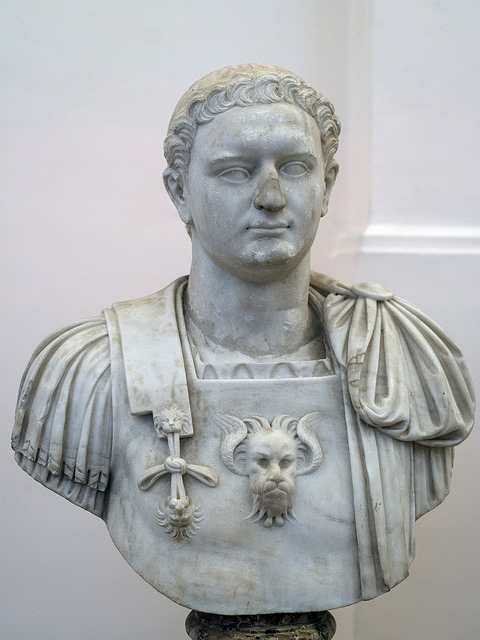
Ancient portrait of Roman emperor Domitian (r. 81–96 C.E.) set into a bust by Guglielmo della Porta (16th c. C.E.) at the National Archaeological Museum, Naples. Photo: Dan Diffendale/CC BY-SA 2.0.
As I revisited a critical biography of the Roman emperor Domitian by the scholar Brian W. Jones recently,1 I was reminded that “alternative facts” and “fake news” are not just a contemporary phenomenon. On occasion ancient writers similarly tried to spin their version of the truth. Jones tackles the familiar line that Domitian, who reigned between 81 and 96 C.E., was a great persecutor of Christians. This “fact” is now standard stock in much popular writing on the book of Revelation and is even found in some scholarly tomes. In his discussion, Jones carefully rehearses how this “fact” developed.
Eusebius in his Church History (CH) provides the first reference to Domitian persecuting the church. Writing over three centuries later in the early fourth century C.E., this ancient Christian historian first quotes Melito of Sardis, who mentioned that Domitian brought slanderous accusations against Christians (CH 4.26.9). He also cites Tertullian, who claimed that Domitian was cruel like the emperor Nero (r. 54–68 C.E.), but that Domitian was more intelligent, so he ceased his cruelty and recalled the Christians he had exiled (CH 3.20.9). Eusebius also quotes Irenaeus, who claimed Domitian’s persecution consisted only of John’s banishment to Patmos and the exile of other Christians to the island of Pontia (CH 3.18.1, 5).
Despite these cautious statements by three earlier authors, Eusebius then spun his own alternative fact by claiming that Domitian, like Nero, had “stirred up persecution against us” (“anekinei diōgmon”; CH 3.17). From here the tradition was enlarged by Orosius (d. 420 C.E.), who, in his History Against the Pagans, wrote that Domitian issued edicts for a general and cruel persecution (7.10.5). Despite a lack of evidence, Jones observes that the tradition concerning Domitian’s persecution persists: “From a frail, almost non-existent basis, it gradually developed and grew large.”2 Thus the alternative facts sown by these ancient historians grew to a truism of Christian history.
FREE ebook: Paul: Jewish Law and Early Christianity. Paul’s dual roles as a Christian missionary and a Pharisee.
No pagan writer of the time ever accused Domitian, as they had Nero, of persecuting Christians. Pliny, for example, served as a lawyer under Domitian and wrote in a letter to Trajan (r. 98–117 C.E.) that he was never present at the trial of a Christian (Letters 10.96.1). This is a strange claim for one of Domitian’s former officials if Christian persecution were so prevalent. The archaeologist Julian Bennett, who has written a biography of Trajan, also fails to mention any general persecution of Christians at this time. Domitian’s execution of Clemens has sometimes been linked to the senator’s apparent “atheism,” a term sometimes given to Christians. However, there is no “smoking gun” linking Clemens’s death to Christian persecution.3 So Jones concludes, “No convincing evidence exists for a Domitianic persecution of the Christians.”4
Become a BAS All-Access Member Now!
Read Biblical Archaeology Review online, explore 50 years of BAR, watch videos, attend talks, and more

A related “fact” is that Domitian claimed the title Dominus et Deus (“Lord and God”). The evidence here is mixed. The poet Statius (Silvae 1.6.83–84) states that Domitian rejected the title Dominus as his predecessor Augustus (the first Roman emperor) had done. The historian Suetonius (Life of Domitian 13.2) does report that Domitian dictated a letter that began, “Our Lord and Master orders…,” but it was only his sycophantic officials who began to address him in this way. The story was again embellished by later historians to the point that Domitian is said to have ordered its use. Jones thinks the story incredible because Domitian was known for his habitual attention to theological detail in traditional Roman worship, so he would not have adopted such inflammatory divine language. After their deaths, the best that emperors could hope for was to be called Divus (Divine), not Deus (God). If Domitian were such a megalomaniac who ordered worship to himself, why haven’t any inscriptions been found using this formula? In fact, no epigraphic evidence exists attesting to Christians being forced to call him “Lord and God.”
Why is Domitian’s legacy so clouded in the ancient sources? Domitian’s assassination in 96 C.E. brought an end to the Flavian dynasty, and the dynasty founded by Nerva, the next Roman emperor, lasted into the third century C.E. Because Domitian had offended the aristocratic elite, the Senate ordered the damnation of his memory. Even though Suetonius (Domitian 8.1) stated that Domitian carefully and conscientiously administered justice, later writers such as Dio Chrysostom (67.2.4) perpetuated his damaged reputation using alternative facts.
Jones writes as a Roman historian outside of Biblical studies, but a New Testament scholar has similarly articulated this view. Leonard Thompson notes that a more critical reading of Eusebius raises doubts about a widespread persecution of Christians under Domitian. He concludes that “most modern commentators no longer accept a Domitianic persecution of Christians.”5 Some writers consider Revelation as a source for a persecution by Domitian, although John never identifies a specific emperor. If so, then Revelation would be the only ancient source pointing to such a persecution.
Over two decades since two Roman historians and a Revelation scholar have pronounced a Domitianic persecution moribund, such claims continue to circulate in articles, books and sermons. This shows how long it takes to repudiate “alternative facts” that have circulated for over 1,500 years in Christendom. Literary texts may sow alternative facts, but archaeological realia, such as inscriptions and coins, have assisted in discrediting those alleged facts. The “fake news” that Domitian instigated a severe persecution of Christians and that his claim to be “Master and God” provoked this persecution needs to be removed from our “facts” about the early church.
 Mark Wilson is the director of the Asia Minor Research Center in Antalya, Turkey, and is a popular teacher on BAS Travel/Study tours. Mark received his doctorate in Biblical studies from the University of South Africa (Pretoria), where he serves as a research fellow in Biblical archaeology. He is currently Associate Professor Extraordinary of New Testament at Stellenbosch University. He leads field studies in Turkey and the eastern Mediterranean for university, seminary and church groups. He is the author of Biblical Turkey: A Guide to the Jewish and Christian Sites of Asia Minor and Victory through the Lamb: A Guide to Revelation in Plain Language. He is a frequent lecturer at BAS’s Bible Fests.
Notes
1. Brian W. Jones, The Emperor Domitian (New York: Routledge, 1992).
2. Jones, Emperor Domitian, p. 114.
3. Julian Bennett notes that the charge against Clemens and his family was that they had adopted Jewish religious ways. He then considers whether Judaism or Christianity is meant and opts for the latter as “more likely.” See Julian Bennett, Trajan: Optimus Princeps (London: Routledge, 1997), p. 68.
4. Jones, Emperor Domitian, p. 117.
5. Leonard L. Thompson, The Book of Revelation: Apocalypse and Empire (Oxford: Oxford Univ. Press, 1990), p. 16.
Related reading in Bible History Daily
All-Access members, read more in the BAS Library
Not a BAS Library or All-Access Member yet? Join today.
This Bible History Daily feature was originally published on July 24, 2017.
Related Posts


Must-Read Free eBooks
Want more Bible history?
Sign up to receive our email newsletter and never miss an update.
Unlock Unlimited Access to the Bible's Past

Unlock Unlimited Access to the Bible's Past
Become an All-Access Member to explore the Bible's rich history. Get Biblical Archaeology Review in print, full online access, and FREE online talks. Plus, enjoy special Travel/Study discounts. Don't miss out—begin your journey today!

Hello,
Glad you are here 😊
The Apostles were all Jews. They went to the temple at the appointed times that God commanded in His Word. They did not change that. Jesus kept these times as well. You are right, they followed Jesus.
The Flavian emperors were responsible for the creation of Christianity. Read Joseph Atwill’s CAESAR’S MESSIAH for the skinny on this.
It appears to me, that the primary reason for making out that Domitian was a significant persecutor of Jews/Christians is to validate the idea that Revelation was written after the destruction of Jerusalem so that other interpretations can be applied. But then people who believe this, want to argue that the persecution has not been fulfilled yet. Hmmm.
I am a relaxed preterist that acknowledges that history repeats itself, and I still think there is a simpler and more obvious interpretation, even if it doesn’t generate the same hype.
I’m curious about the reasoning behind this line:
“No pagan writer of the time ever accused Domitian, as they had Nero, of persecuting Christians.”
This appears to be referring to the single mention by Tacitus? I think there are solid arguments that this is a Christian alteration of a passage about Chrestians, as argued in this 2014 paper:
https://brill.com/view/journals/vc/68/3/article-p264_2.xml?language=en
To summarise my perception of the important points:
– The passage is in the wrong place to fit the chronology of Jesus.
– Tacitus said it was a name, which matches Chrestus but not Jesus.
– We know Christians forged passages in contemporary texts, with one obvious example being the Testimonium Flavianum.
– We know Christians weren’t associated with the fire of Rome, because there’s no way Pliny the Younger wouldn’t have heard of that.
– Suetonius attests to a rebel Chrestus in Rome in this period.
– Suetonius separately attests to Christians and makes no connection to the fire.
– Acts has no knowledge of the fire being related to Christianity.
– We have direct manuscript evidence that an earlier passage was about Chrestians, not Christians.
– Tacitus was a snob about spelling and grammar, so claims of other misspellings of Christians as “Chrestians” don’t apply to his own words.
– We know that Chrestus was a common slave name at the time.
– Tacitus uses the past tense: meaning the group he was referring to didn’t exist in his own time. This matches Chrestians but does not match Christians.
– Tacitus mentions “a huge multitude”, which doesnt match Christians at that time, but would match the entire Jewish population of Rome.
– The phrase “not so much for the crime of burning the city as because of the hatred of mankind” doesn’t match Christian doctrine, but could match a violent rebel group with a history of crimes.
– Most importantly: there is no evidence that Christians were connected to the fire until hundreds of years later. The earliest link between Christians and the fire comes from the 4th century Christian forgery of letters between Paul and Seneca. This might even be the inspiration for the Christian interpolation in Tacitus.
In Aramaic Christian tradition, as opposed to the Latin Rite, Nero is considered the persecutor of John the Apostle. Although Revelation as a book is not canonized in the Assyrian Church of the East, it is in the Syrian Orthodox Church and Chaldean Catholic Church. Since 616 CE, when Thomas of Harkel did his revision to the Aramaic Peshitta New Testament text, Revelation has been part of the canon in these churches. The scribes who wrote those manuscripts also left behind notes of various traditions in their churches.
In the late 19th century Irish scholar John Gwynn wrote about a manuscript that he believed was the lost earlier Philoxenian Revision of 508. It is now called the Crawford Codex. Dated to the 12th century, Gwynn believed the text actually went back to the early 6th century and this Crawford Codex is today the only Aramaic manuscript containing all 27 NT books under a single cover. One of these books is known as Crawford Revelation, and its text is markedly different from the other Peshitta Revelation as well as the Greek version. Written in red ink is the following Aramaic declaration:
“Again we have recorded the Revelation concerning the Set-apart Yochanan the Evangelist while on the island of Patmos, which he was sent to by him who was Nero Caesar.”
There are a number of reasons why Nero is a better candidate as Yochanan’s persecutor. For one thing, his name adds up to 666 in Hebrew. For another, Like John 5:2, the Temple is described as still standing in Jerusalem in Revelation 11. These and other factors put Yochanan’s text before the Second Temple’s destruction in 70 CE.
I think as time goes on, the Domitian theory will become less of a default and more of a minority view.
Andrew Gabriel Roth
Author and Translator of the Aramaic English New Testament (AENT)
www. onefaithonepeopleministries .com
Please read Thomas S. Kepler, The book of Revelation: a commentary for laymen (New York: Oxford University Press) I know of no other commentary that knows the historical period and takes the historical situation in which John wrote and interprets Rev in light of that, as well as using other scripture to do so.