


What Happened to the Canaanites?
DNA study links ancient Canaanites to their modern descendants

What happened to the Canaanites? DNA sequencing was conducted on five skeletons from Canaanite Sidon, including this one. The results indicate that there is a “genetic continuity” between the Canaanites at Sidon and the modern Lebanese. Photo: Courtesy of Claude Doumet-Serhal.
What happened to the Canaanites? Researchers conducted DNA sequencing on ancient Canaanite skeletons and have determined where the Canaanites’ descendants can be found today.
The Canaanites were a Semitic-speaking cultural group that lived in Canaan (comprising Lebanon, southern Syria, Israel and Transjordan) beginning in the second millennium B.C.E. and wielded influence throughout the Mediterranean.
In the Hebrew Bible, the Canaanites are described as inhabitants of Canaan before the arrival of the Israelites (e.g., Genesis 15:18–21, Exodus 13:11). Little of the Canaanites’ textual records remain, perhaps because they used papyrus instead of the more durable clay for writing. Much of the Canaanites’ history is reconstructed through the writings of contemporary peoples in addition to archaeological examinations of the material record.
FREE eBook: Life in the Ancient World.
Craft centers in Jerusalem, family structure across Israel and ancient practices—from dining to makeup—through the Mediterranean world.
Marc Haber, Claude Doumet-Serhal, Christiana Scheib and a team of 13 other scientists recently published their DNA findings in The American Journal of Human Genetics (AJHG). The researchers sequenced the genomes of five individuals who were buried in the Canaanite city of Sidon in Lebanon around 1700 B.C.E. as well as the genomes of 99 individuals from Lebanon today.
The results of their study demonstrated a connection: “We show that present-day Lebanese derive most of their ancestry from a Canaanite-related population, which therefore implies substantial genetic continuity in the Levant since at least the Bronze Age,” wrote the researchers in AJHG.
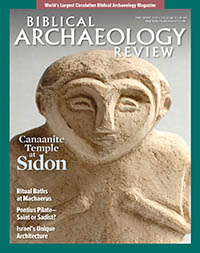
A painted limestone figurine of a human-ram deity from Canaanite Sidon appears on the cover of the July/August 2017 issue of BAR. Photo: Courtesy of Claude Doumet-Serhal.
In the July/August 2017 issue of Biblical Archaeology Review, Claude Doumet-Serhal provides a glimpse of Canaanite Sidon in the Middle Bronze Age:
At the dawn of the second millennium B.C.E., the site was covered by a thick layer of deliberately cleaned sand between 3 and 4.6 feet deep, brought from the nearby seashore. This “purifying” activity must have taken weeks of hard labor. At this point Sidon became a burial site. To date, 142 burials have been found in this sand and in subsequent layers on top of it dating until around 1500 B.C.E. A funerary feasting tradition took place at the time of burial. High-ranking individuals were buried with objects indicating their power, rank and reputation, such as a Minoan cup (1984–1859 B.C.E.) from Phaistos, Crete, which was found inverted, as was the common Aegean practice.
The DNA study conducted on the skeletons from Sidon is part of the researchers’ larger effort to understand population histories in the Levant.

FREE ebook: Cyber-Archaeology in the Holy Land — The Future of the Past. Modern archaeological methods help create a new and objective future of the past.
“Many of our inferences rely on the limited number of ancient samples available, and we are only just beginning to reconstruct a genetic history of the Levant or the Near East as thoroughly as that of Europeans who, in comparison, have been extensively sampled,” the researchers wrote in AJHG.
Related reading in Bible History Daily
Hazor Excavations’ Amnon Ben-Tor Reveals Who Conquered Biblical Canaanites
Canaanite Worship? 3,400-Year-Old Figurine Found at Tel Rehov
This Bible History Daily feature was originally published on August 9, 2017.
Related Posts




Must-Read Free eBooks


Want more Bible history?
Sign up to receive our email newsletter and never miss an update.
Unlock Unlimited Access to the Bible's Past

Unlock Unlimited Access to the Bible's Past
Become an All-Access Member to explore the Bible's rich history. Get Biblical Archaeology Review in print, full online access, and FREE online talks. Plus, enjoy special Travel/Study discounts. Don't miss out—begin your journey today!

Someone above asked, “How are Canaanites connected to Africans?”
Probably many way if there is a shared heritage between residents of Sidon (and Tyre) and the overseas colonies these cities established and the people of
Canaan.
Carthage, for example, was a Phoenician colony. Hiram of Tyre was a contemporary of Solomon, but the Carthage located in present day Tunisia probably was founded after the 10th century BC. Moreover, it’s not the only Phoenician colony that was established in the western Mediterranean. A number of them, such as Cartagena in Spain were founded by Phoenicians or else became colonies of Carthage. Marseille,( I just thought I’d check first) as it turns out was founded by Greeks in the 7th century BC.
Analogous to England and its New World colonies, Carthage expanded on the
north coast of Africa into a number of coastal settlements, plus southern Spain.
We know little ( or else little survives) about the Carthaginians save through the eyes of Roman historians such as Livy an Polybius who chronicled the Punic Wars and their roots. But the bottom line from the wikipedia was this:
“The Carthaginians were Phoenician settlers originating in the Mediterranean coast of the Near East. They spoke Canaanite, a Semitic language, and followed a local variety of the ancient Canaanite religion.”
Having recently read an account of the Battle of Cannae, Carthaginian names
drives the point home: Hannibal, Hamilcar, Hasdrubal, Hanno… Contemplating the issue of links even closer to the Bible, such as Hebrew, I was inclined to ask myself: Just what does that prefix “Ha” denote?
Evidently it is not a definite article. Hannibal roughly means “the grace of Baal”.
But the Barca family ( Note: Barcelona – possibly named by Hamilcar, but Romans claim differently) can be connected with other East Mediterranean root languages, for example, as follows:
“Barca (, QRB) was the surname of his aristocratic family, meaning “shining” or “lightning”, thus equivalent to the Arabic name Barq or the Hebrew name Barak.
Hamilcar, Hannibal’s father: his name is a reference to someone else too, “brother of Melqart”.
Paradoxically, we have an one side an argument for the stability for gene pools in the Mediterranean East based on population studies in Lebanon. But on the other hand, we have linguistic evidence for dispersion based on establishment of colonies in west on the coasts of Africa and Europe.
I have also read that the Canaanites were black. DNA results would certainly have indicated that.
I’m confused. If they came from Ham, how could they be other then black? Is it being said that the Bible is wrong?
Cannanites were not semitic people as your article says. Remember Canaan is the son of Ham, not Shem. Semitic people emanate from the lineage of Shem and not Ham. Canaanites are what we refer to as Hamites. Ham had 4 sons Mizraim (Egyptians), Phut (Lybians), Cush (Ethiopia) and Canaan (Original inhabitants of the land of Israel). The Zondervan Bible Dictionary tells us that Ham was the progenitor of Black people but not the Negros. Therefore all Ham’s lineage is traced through his 4 sons who are all Black people.
The reason why the Bible Dictionary differentiates between the Hamites and the Negroes is because they are Shemites from the line of Shem. Yes both groups are Black people but with a different progenitor.
The reason why you find a mixed race of people in Egypt and in all other countries of the sons of Ham today is because one of the policies of Alexandra the Greek after he conquers a country, he would flood that country with his own people, the Romans in order to enforce racial intermingling. I am sure in his mind, he was eradicating the original Black inhabitants of such countries. So that when you look at it independently, you begin to think about this as genocide.
The Shemites/Hebrews/Israelites eventually took over the land of Canaan. The land of the son of Ham called Canaan. In this case it was one race of black people taking the land of another race of black people. And eventually a race of white people Eastern European Khazars, took over the land of the Shemites and under false pretenses called themselves Shematic/Jewish/Israeli. The reason why they do not call themselves Israelites is because they are not the descendants of Abraham. They just stole that identity from the real Shemites.
It seems that you are copying and pasting a view of race which did exist during the time you are talking about
To make it explicit, those we call Phoenician are identical to those we call Canaanites, we have no real idea what they called themselves.
There are actually people in 2018 who think human races are descended from the sons of Noah?? Come on, this “Arthur” must be an atheist who wrote this post to make religious people look like idiots!
Why is my Sept. 3 comment still “awaiting moderation” on Sept. 5?
There is a problem with all of the articles relating the recent dna analysis of Lebanese and its relevance to the story of the conflict between the ancient Israelitses and Canaanites in the Bible. Ancient Canaan encompassed the whole of the Levant between Asia Minor and Egypt and all the inhabitants called themselves Canaanite (kn’ni). But the Bible story relates only the southern half of Canaan, called “Palestine” by the Greeks but not the natives, where Israel and Judah were located. It has nothing to say about the northern half, called “Phoenicia” by the Greeks but not the natives, which is roughly modern Lebanon. To the extent that it the Bible has anything to say or indicates much knowledge of northern Canaan, its inhabitants are not seen as enemies to be exterminated. On the contrary, the Canaanite ruler of Tyre, Hiram, is an ally of Soloman who helped in the building of the Temple. So the fact that they were not exterminated by the Israelites tells us nothing. More to the point is the genetic evidence that present-day Jews, like present-day Palestinians, are descended from the previous inhabitants of “Palestine” – that is, Canaanites. The “Children of Israel” were in fact Canaanites who for some reason wished to radically differentiate themselves from their own ancestors and did so by calling themselves Hebrews who originated elsewhere and claiming to have been brought out of Egypt by their god, IHWH, and conquered the land he promised them. The Hebrews were most likely themselves Canaanites, but nomadic pastoralists rather than settled farmers or townspeople who regarded them rather as nomadic Gypsies and Travellers are now regarded. It seems likely that this was their way of establishing themselves as a nation, separate from (and superior to) all others, bolstered by their adoption of a new religion profoundly different from that of their Canaanite ancestors.
Caanan was a descendant of Ham and his descendants are Caananites.
Abram was a descendant of Shem and jouneyed to Caanan, his descents went Egypt and exodet from there to Canan, where they were known as Yisralites
Japhet was brother to Ham and Shem , all are sons of Noa that came through the Flood.