


How the Serpent in the Garden Became Satan
Adam, Eve and the serpent in the Garden of Eden
Shawna Dolansky
July 15, 2025
183 Comments
520815 views
Introduced as “the most clever of all of the beasts of the field that YHWH God had made,” the serpent in the Garden of Eden is portrayed as just that: a serpent. Satan does not make an appearance in Genesis 2–3, for the simple reason that when the story was written, the concept of the devil had not yet been invented. Explaining the serpent in the Garden of Eden as Satan would have been as foreign a concept to the ancient authors of the text as referring to Ezekiel’s vision as a UFO (but Google “Ezekiel’s vision” now, and you’ll see that plenty of people today have made that connection!). In fact, while the word satan appears elsewhere in the Hebrew Bible/Old Testament, it is never a proper name; since there is no devil in ancient Israel’s worldview, there can’t yet have been a proper name for such a creature.
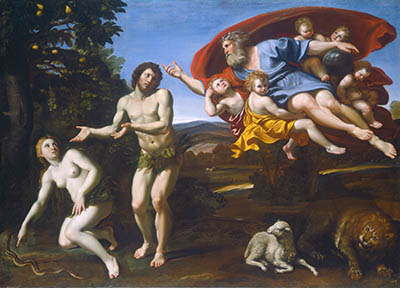
Depicted here are God the Father, cherubim, angels, Adam, Eve and the serpent in the Garden of Eden in Domenichino’s painting The Rebuke of Adam and Eve (1626). Photo: Patrons’ Permanent Fund, National Gallery of Art.
The noun satan, Hebrew for “adversary” or “accuser,” occurs nine times in the Hebrew Bible: five times to describe a human military, political or legal opponent, and four times with reference to a divine being. In Numbers 22, the prophet Balaam, hired to curse the Israelites, is stopped by a messenger from Israel’s God YHWH, described as “the satan” acting on God’s behalf. In Job, “the satan” is a member of God’s heavenly council—one of the divine beings, whose role in Job’s story is to be an “accuser,” a status acquired by people in ancient Israel and Mesopotamia for the purposes of particular legal proceedings.
In Job’s case, what’s on trial is God’s assertion that Job is completely “blameless and upright” vs. the satan’s contention that Job only behaves himself because God has rewarded him. God argues that Job is rewarded because he is good, and not good because he is rewarded. The satan challenges God to a wager that if everything is taken away from poor Job, he won’t be so good anymore, and God accepts. Though a perception of “the satan” as Satan would make this portrait of God easier to swallow, the story demonstrates otherwise; like Yahweh’s messenger in Numbers 22, this satan acts on YHWH’s instructions (and as a result of God’s braggadocio) and is not an independent force of evil.
In Zechariah 3, the prophet describes a vision of the high priest Joshua standing in a similar divine council, also functioning as a tribunal. Before him stand YHWH’s messenger and the satan, who is there to accuse him. This vision is Zechariah’s way of pronouncing YHWH’s approval of Joshua’s appointment to the high priesthood in the face of adversarial community members, represented by the satan. The messenger rebukes the satan and orders that Joshua’s dirty clothing be replaced, as he promises Joshua continuing access to the divine council. Once again, the satan is not Satan who we read about in the New Testament.
The word satan appears only once without “the” in front of it in the entire Hebrew Bible: in 1 Chronicles 21:1. Is it possible that we finally have Satan here portrayed? 1 Chronicles 21 parallels the story of David’s census in 2 Samuel 24, in which God orders David to “go number Israel and Judah” and then punishes king and kingdom for doing so. The Chronicler changes this story, as he does others, to portray the relationship between God and David as uncompromised; he writes that “a satan stood up against Israel and he provoked David to number Israel” (1 Chronicles 21:6–7; 27:24). Although it is possible to read “Satan” here instead of “a satan” (Hebrew uses neither uppercase letters, nor indefinite articles, e.g., “a”), nothing else in this story or in any texts for another 300 years indicates that the idea of an evil prince of darkness exists in the consciousness of the Israelites.
FREE ebook: Exploring Genesis: The Bible’s Ancient Traditions in Context Mesopotamian creation myths, Joseph’s relationship with Egyptian temple practices and 3 tales of Ur, the birthplace of Abraham.
If there’s no Satan in the Hebrew Bible, how does the serpent in the garden become Satan?
The worldview of Jewish readers of Genesis 2–3 profoundly changed in the centuries since the story was first written. After the canon of the Hebrew Bible closed,1 beliefs in angels, demons and a final apocalyptic battle arose in a divided and turbulent Jewish community. In light of this impending end, many turned to a renewed understanding of the beginning, and the Garden of Eden was re-read—and re-written—to reflect the changing ideas of a changed world. Two separate things happened and then merged: Satan became the proper name of the devil, a supernatural power now seen to oppose God as the leader of demons and the forces of evil; and the serpent in the Garden of Eden came to be identified with him. While we begin to see the first idea occurring in texts two centuries before the New Testament, the second won’t happen until later; the serpent in the Garden is not identified with Satan anywhere in the Hebrew Bible or New Testament.
The concept of the devil begins to appear in second and first centuries B.C.E. Jewish texts. In 1 Enoch, the “angel” who “led Eve astray” and “showed the weapons of death to the children of men” was called Gadreel (not Satan). Around the same time, the Wisdom of Solomon taught that “through the devil’s envy death entered the world, and those who are on his side suffer it.” Though this may very well be the earliest reference to Eden’s serpent as the devil, in neither text, nor in any document we have until after the New Testament, is satan clearly understood as the serpent in Eden. At Qumran, though, Satan is the leader of the forces of darkness; his power is said to threaten humanity, and it was believed that salvation would bring the absence of Satan and evil.
By the first century C.E., Satan is adopted into the nascent Christian movement, as ruler over a kingdom of darkness, an opponent and deceiver of Jesus (Mark 1:13), prince of the devils and opposing force to God (Luke 11:15–19; Matthew 12:24–27; Mark 3:22–23:26); Jesus’ ministry puts a temporary end to Satan’s reign (Luke 10:18) and the conversion of the gentiles leads them from Satan to God (Acts 26:18). Most famously, Satan endangers the Christian communities but will fall in Christ’s final act of salvation, described in detail in the book of Revelation.
But curiously, although the author of Revelation describes Satan as “the ancient serpent” (Revelation 12:9; 20:2), there is no clear link anywhere in the Bible between Satan and the serpent in the garden. The ancient Near Eastern combat myth motif, exemplified in the battle between Marduk and Tiamat in Enuma Elish and Baal and Yam/Mot in ancient Canaan, typically depicted the bad guy as a serpent. The characterization of Leviathan in Isaiah 27 reflects such myths nicely:
On that day YHWH will punish
With his hard and big and strong sword
Leviathan the fleeing serpent,
Leviathan the twisted serpent,
And he will kill the dragon that is in the sea.
So the reference in Revelation 12:9 to Satan as “the ancient serpent” probably reflects mythical monsters like Leviathan rather than the clever, legged, talking creature in Eden.
In the New Testament, Satan and his demons have the power to enter and possess people; this is what is said to have happened to Judas (Luke 22:3; John 13:27; cf. Mark 5:12–13; Luke 8:30–32). But when Paul re-tells the story of Adam and Eve, he places the blame on the humans (Romans 5:18; cf. 1 Corinthians 15:21–22) and not on fallen angels, or on the serpent as Satan. Still, the conflation begged to be made, and it will seem natural for later Christian authors—Justin Martyr, Tertullian, Cyprian, Irenaeus and Augustine, for example—to assume Satan’s association with Eden’s talking snake. Most famously, in the 17th century, John Milton elaborates Satan’s role in the Garden poetically, in great detail in Paradise Lost. But this connection is not forged anywhere in the Bible.
 Shawna Dolansky is Adjunct Research Professor and Instructor in the program in Religion at the College of Humanities, Carleton University in Ottawa, Ontario. She coauthored the well-known The Bible Now (Oxford Univ. Press, 2011) with Richard Friedman.
Notes
1. The book of Daniel was the latest book to be included in the Hebrew Bible/Old Testament and dates to about 162 B.C.E.
This Bible History Daily feature was originally published on April 8, 2016.
Related reading in Bible History Daily
All-Access members, read more in the BAS Library
Not a BAS Library or All-Access Member yet? Join today.
Related Posts



Must-Read Free eBooks
Want more Bible history?
Sign up to receive our email newsletter and never miss an update.
Unlock Unlimited Access to the Bible's Past

Unlock Unlimited Access to the Bible's Past
Become an All-Access Member to explore the Bible's rich history. Get Biblical Archaeology Review in print, full online access, and FREE online talks. Plus, enjoy special Travel/Study discounts. Don't miss out—begin your journey today!

“braggadocio” I see that you are an atheist. This site has a cadre of atheists running it. Sorry but you have condemned yourselves. You are without excuse.
I’m curious about a couple of statements in this article. First, this one:
The noun satan, Hebrew for “adversary” or “accuser,” occurs nine times in the Hebrew Bible
And this one:
The word satan appears only once without “the” in front of it in the entire Hebrew Bible: in 1 Chronicles 21:1.
My Bible software (Accordance) shows 27 occurrences of satan, 19 of which have the article ha.
Would like to know how the author arrived at her statistics.
Just wondering: Strong’s Concordance shows #4567 (Satan) 36 times.
Original Word: Σατανᾶς, ᾶ, ὁ
Part of Speech: Noun, Masculine
Transliteration: Satanas
Phonetic Spelling: (sat-an-as’)
Short Definition: an adversary, Satan
Definition: an adversary, Satan.
Word Origin
of Hebrew origin satan
Definition
the adversary, Satan, i.e. the devil
NASB Translation
Satan (35), Satan’s (1).
I disagree, but am interested. The serpent speaks to Eve in the Bible, showing it is not an average animal. Then there is the prophecy of Eve’s offspring in Genesis 3:15, saying that a descendant of Eve will crush the head of the serpent and that the serpent will bruise his heel. If this is a prophecy of Jesus, and it seems to be, then it isn’t talking about a normal snake, but about Satan.
Satan’s appearance before God in the book of Job seems to be an exception rather than the normal routine, so much so that not only does the author say that the angels came and Satan came too, but that God confronted him specifically.
The serpent, dragon, etc imagery of and in the book of Revelation is clearly not hearkening back to prehistoric monsters or myths. Read in context it is clearly not some random, massive animal or sea monster, but an enemy of God and the spiritual order God has set up.
In short the author brings up problems, but not insurmountable ones. And we should never be surprised when our names for beings don’t match ones from thousands of years ago or that we have a name for something that once was not named, or was only mentioned obliquely. Further, the Bible is a book that focuses on the chosen people’s relationship with God, and not their relationship with his enemies.
The Leviathan of Job (41) is a beast that lives in the water, considered by many the hippopotamus of the Nile, and not merely a serpent (as in Isaiah) though they seem to share some physical features. In Job, it’s a behemoth – fearsome, ugly, vicious and recalcitrant. It would serve as a potent political metaphor for Hobbes many centuries later. “The accuser” in Job is a heavenly creature who appears in the company of YHWH. To conflate “the accuser” with Leviathan is a wild stretch of the imagination.
To understand the evolution of the devil as Satan is inalienable from our understanding of the evolution of evil in the two bibles (Old and New). The same is true of God. In Genesis he goes for a walk in the afternoon breeze. Clearly a very physical presence. Later, he would become only a name, so holy that people wouldn’t even utter it.
It’s important not to lose sight of the fact that as time passed and the Israelites gave shape to their myths in the light of their faith, newer concepts and images emerged to attribute identity and name to things that were nameless before.
satan is NOT a snake. He is a DRAGON!! That crap image is from Renaissance Art, not Biblical text.At the time the Bible was translated into KJ English, the word “serpent” was synonymous with “dragon.” Dragon is simply an ancient word for “dinosaur” which literally means, ” Terrible or terrifying serpent or lizard.”a term which wasn’t coined until the mid 1700s.
What this lady deems as “mythological” animals were real creatures. It is the world’s modern view of evolution and dinosaurs that has deceived these past recent generations into believing that dragons were never real, even though history amongst all peoples and nations has recorded them since the beginning of time.
Just go look at a pictorial glossary of known Dinosaurs. They ALL have their bellies off the ground, both quadrupeds and bipeds. But what do we see today with lizards? all their bellies are on the ground when they walk. Not just snakes.
“And the LORD God said unto the serpent, Because thou hast done this, thou art cursed above all cattle, and above every beast of the field; upon thy belly shalt thou go, and dust shalt thou eat all the days of thy life:”
Regardless of what our early Judaic fathers knew of satan, the Bible is clear that he was ALWAYS the serpent in the Garden of Eden.
Revelation 12;9 – And the great dragon was cast out, that old serpent, called the Devil, and Satan, which deceiveth the whole world: he was cast out into the earth, and his angels were cast out with him.’
Can it be any more clear or straightforward than that?
A proper realization of the pre-flood world and the union of Angels with humans in Genesis 6 that created the gods and heros of ancient so-called “myth” puts many things into a place of relevant understanding. Dragons were real, and large, and majestic. Google Marco Polo’s account with dragons. They are clearly what people regard today as dinosaurs. And their are many other “myths” of talking Dragons throughout history, which would make sense if the first recorded dragon in history could talk, that its offspring would have that ability too.
satan is a was/is a dragon, just like the Scriptures tell us.
I wonder how many of these people live in the real world
You obviously have never even looked at Strongs Concordance for the word, “serpent” of Genesis.
http://comparet.christogenea.org/content/adam-was-not-first-man
The ancient Egyptians possessed books on magic in which every known reptile was drawn from snakes to lizards all the way up the chain to crocodiles and this seems to have been known to the author of the book of Exodus where Moses throws down his staff in a dress rehearsal and it became a serpent (Heb. “nahas,” Exodus 4:3), but in the actual confrontation with the Pharaoh’s magicians it is Aaron who throws down his staff and it became a dragon (Heb. “tannin,” Exodus 7:9-12) that ate the dragons of the Pharaoh’s magicians. Afterward, Moses is instructed to take his staff that turned into a serpent and meet the Pharaoh at the edge of the Nile (Exodus 7:15) because the contest of the magicians involved the crocodile god Sobek which was a symbol of the Pharaoh’s control over the Nile which was ultimately the source of his power. In Genesis 10:7 the fifth son of Cush is Sab’te-ca, who was Pharaoh Shabitqo of the 25th Dynasty (702-690 B.C.E.) and whose name contains the name of the god Sobek, like Shabitqo’s brother and predecessor on the throne, Shabaqo (716-702 B.C.E.). In the “Shabaqo Stone,” (also known as the “Memphite Theology of Creation”) an effort was made by this Pharaoh to preserve an ancient writing “which the ancestors made but was worm-eaten,” during a period when the Memphite god Ptah was in the ascendant during the Old Kingdom. The text emphasis the plurality of the Egyptian gods who maintain the checks and balances necessary to restore civility following the murder of the god Osiris at the hands of the god Set (the biblical Satan) and the ensuing rivalry between Set and the offspring of the deceased Osiris, the god Horus, whose quarreling caused Egypt to be divided between north and south. So it really speaks volumes when Pharaoh Shabaqo the Crocodile-in-Chief endorses the rule of law especially when you consider the unflattering portrait of a Pharaoh about a century later in Ezekiel 29:3 that calls him “Pharaoh king of Egypt, the great dragon sprawling amidst his streams.” These streams or canals dominated by a dragon symbolize the demonic realm in the mystical book of Zohar that was written in the 13th century C.E., and this network of waterways is but a reflection of the heavenly realm as it is written, “…a well watered region…like the garden of Jehovah, like the land of Egypt” (Genesis 13:10). From the Nag Hammadi library dating to the mid-4th century C.E. we have a book named after the greek god of healing, “Asclepius,” whose symbol is a snake entwined around a pole like the bronze serpent of Moses (Numbers 21:9, John 3:14-15) and the book states that “Egypt is (the) image heaven…the dwelling place of heaven and all the forces that are in heaven,” and thus the forces that sustain creation are not unlike the gods of the Egyptians which are not really gods but divine qualities that are described in the Shabaqo Stone as emanating from the creator god Ptah-Tatenan, that is none other than the primordial word or “logos” of God in the prologue to the gospel of John:
“(Thus) it happened that the heart and tongue gained control over [every] (other) member of the body, by teaching that he [Ptah, as heart and tongue] is in every body and in every mouth of all gods, all men, [all] cattle, all creeping things, and (everything) that lives, by thinking and commanding everything that he wishes” (“The Ancient Near East, Vol. 1; An Anthology of Texts and Pictures” by James B. Pritchard, p.2).
“The Logos of the Gospel according to John is a term which has many meanings: Word, Intellect, Reason, and others. It is generally (and especially in literature) taken to mean ‘word’ (verbum), but it would be more exact to relate it to the term ‘weaving’ in its traditional symbolic sense. It stands for the intersection of complementary notions, as in the craft of weaving where intersection gives form to two threads which by themselves cannot be situated” (“Sacred Science; The King of Pharaonic Theocracy” by R.A. Schwaller de Lubicz, 167).
@Waldo #7; In addition to the sources cited in the above article, Dante’s “Divine Comedy” makes reference to the tempter from the biblical narrative in “Purgatorio” chapter 8:
“There was a snake, on that side, where the little valley has no barrier, perhaps such a one as gave Eve the bitter fruit. The evil reptile slid through the grass and flowers, now and again, twisting its head towards its tail, licking like a beast grooming itself.”
When I first read this decades ago I was high one night while listening to a classic rock radio station and I could perceive an entity behind the scenes whose skin was covered with scales consisting of compact disks (since they had become vogue at the time) even though this radio station’s format included music that was custom-made for vinyl and sounded better scratchy. I would refer this phenomenon as the “having the form of Godliness but denying its power” (2 Timothy 3:5) approach to introducing a style of music based on cutting-edge technology that tries to disguise that it’s not purely a marketing strategy. It was only 3 decades ago when a rock band depicted the record companies on album art as soulless artificial humanoids wearing business suits as they extend whatever record they’re promoting at any given time with endless radio play. Now-a-days an artist can simply rehash old music with a digitally remastered box set.