


The Adam and Eve Story: Eve Came From Where?
Adam and Eve in the Bible
“So the Lord God caused a deep sleep to fall upon the man, and he slept; then he took one of his ribs and closed up its place with flesh. And the rib that the Lord God had taken from the man he made into a woman and brought her to the man.”
—Genesis 2:21–22, NRSV
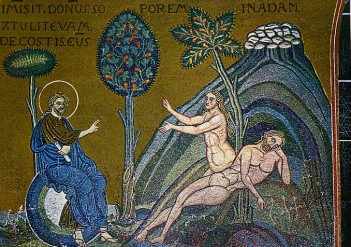
ADAM AND EVE IN THE BIBLE. This mosaic from the Cathedral of Monreale, Sicily, depicts the creation of woman in the Bible. Eve is shown emerging from Adam’s side. Most translations of the Adam and Eve story say that Eve was created from Adam’s rib, but Ziony Zevit contends that she was created from a very different part of Adam’s body.
According to the Bible’s creation account, after making the heavens and the earth, God created humankind. The Adam and Eve story in Genesis 2 states that God formed Adam out of the dust of the ground, and then Eve was created from one of Adam’s ribs. But was it really his rib?
The Hebrew word that is traditionally translated as “rib” is tsela‘. Ziony Zevit, Distinguished Professor of Biblical Literature and Northwest Semitic Languages at American Jewish University in Bel-Air, California, believes that this translation is wrong, as do many scholars. It was first translated as “rib” in the Septuagint, a Greek translation of the Hebrew Bible from the mid-third century B.C.E. However, a more careful reading of the Hebrew word for “rib” in the Adam and Eve story suggests that Eve was created from another, very different, part of Adam’s anatomy—his os baculum (penis bone).
Zevit carefully examines the account of the creation of woman in the Bible in his article “Was Eve Made from Adam’s Rib—or His Baculum?” which appears in the September/October 2015 issue of Biblical Archaeology Review.
FREE ebook: Exploring Genesis: The Bible’s Ancient Traditions in Context Mesopotamian creation myths, Joseph’s relationship with Egyptian temple practices and 3 tales of Ur, the birthplace of Abraham.
Of the 40 appearances of tsela‘ in the Bible, the Adam and Eve story is the only place where it is translated as “rib.” Usually it means the side of something. Zevit explains the nuance of this word:
This Hebrew word occurs some 40 times in the Hebrew Bible, where it refers to the side of a building or of an altar or ark (Exodus 25:12; 26:20, 26; 1 Kings 6:34), a side-chamber (1 Kings 6:8; Ezekiel 41:6), or a branch of a mountain (2 Samuel 16:13). In each of these instances, it refers to something off-center, lateral to a main structure. The only place where tsela‘ might be construed as referring to a rib that branches off from the spinal cord is in Genesis 2:21–22.
According to Zevit, “rib” is the wrong translation for tsela‘ in the Adam and Eve story in the Bible. Zevit believes that tsela‘ should be translated as “a non-specific, general term,” such as one of Adam’s lateral limbs, in the Adam and Eve story. Thus, it refers to “limbs lateral to the vertical axis of an erect human body: hands, feet, or, in the case of males, the penis.”
Our website, blog and email newsletter are a crucial part of Biblical Archaeology Society's nonprofit educational mission
This costs substantial money and resources, but we don't charge a cent to you to cover any of those expenses.
If you'd like to help make it possible for us to continue Bible History Daily, BiblicalArchaeology.org, and our email newsletter please donate. Even $5 helps:

Which of these lateral limbs lacks a bone? Human males do not have a penis bone, but many mammals do. Zevit concludes that in the story of Adam and Eve in the Bible, the woman was created from the man’s baculum to explain why this appendage does not have a bone.
To see Ziony Zevit’s full explanation of the Adam and Eve story in the Bible, read his article “Was Eve Made from Adam’s Rib—or His Baculum?” in the September/October 2015 issue of BAR.
BAS Library Members: Read the full article “Was Eve Made from Adam’s Rib—or His Baculum?” by Ziony Zevit in the September/October 2015 issue of Biblical Archaeology Review.
Not a BAS Library or All-Access Member yet? Join today.
This Bible History Daily feature was originally published on September 15, 2015.
Related reading in Bible History Daily
All-Access members, read more in the BAS Library
Not a BAS Library or All-Access Member yet? Join today.
Related Posts


Must-Read Free eBooks
Want more Bible history?
Sign up to receive our email newsletter and never miss an update.
Unlock Unlimited Access to the Bible's Past

Unlock Unlimited Access to the Bible's Past
Become an All-Access Member to explore the Bible's rich history. Get Biblical Archaeology Review in print, full online access, and FREE online talks. Plus, enjoy special Travel/Study discounts. Don't miss out—begin your journey today!

Actually it was sperm. It was all about DNA. And the dust was the second creation. The creation of flesh dwelling. We were first created in his image. Male and female he created them. Set them on earth, said be fruitful and multiply. however do not take to your selfs the tree of knowledge of good and evil. It says eat, however that’s wrong also. They took to themselves minerals and elements. They were first spirit, in the image of God. When they realized they were naked, it was the actual flesh that was new to them. It was refashioned with an anus and a few changes by God while they slept. Then DNA was transferred to eve. Meaning that Adam had XY and Eve was given an Y and told that now in flesh it would hurt to have babies. Now we are born in sin. Element and mineral. Corruption. God is smarter than you. Hahahaha. Let’s talk about it.
I wish I could “like” some of these comments, some of them are pretty good.
I don’t think we’re going to see an archeological resolution to this controversy.
It’s funny that this authors “interpretation” is almost identical to the Ancient Pagan creation myths… 1st warning sign. The phallus in the creation of Gods, demigods, humans, etc is a recurring theme throughout pagan religion. Two, the verse says GOD took “1” (Accad Tsela) One Rib… Not one penis bone. So for you to ridicule Someone for believing that GOD who creates something from nothing is bound by some type of natural law of reproduction is utterly ridiculous. Another point to consider… The Aramaic word “ala” is derived from the SAME root for Rib in both books of Daniel 7:5 & 1 Kings 6:15…
So are you really trying to convince everyone that it is also referring to a penis bone as well?
“Ala”… rib
(Aramaic) corresponding to tsela’; a rib — rib.
see HEBREW tsela’
Yes, not quite an archaeological issue, but one of textual criticism. I love both, though. What the author doesn’t understand is that his translation of a word cannot just make sense in one place and not all the others it occurs. Also – and even before the last principle – the translation has to make grammatical sense in the context of the sentence. There would way too much acrobatics involved to justify his translation of that word even in just this one place. I admit though, the translation of rib, despite its seeming acceptance as such in other ancient languages and cultures, in view of the other occurrences in the bible does seem quite not right. I propose this understanding: it refers to the “rib cage” of which there are 2. This would also explain why there is only one heart on one side: a mans wife has his other one. This also goes along with the other usages in the bible of the word as a metaphor for a set of support beams or a cage or a side of such.
The word “tsela” can be used of something that incases something, hence on the side. It can be used for the ribs of a ship and the rib cage because it incases the soft tissues. A better modern translation would be “cell.” Interestingly written thousands of years before we knew that humans were composed of cells and each cell has all the genetic information to make a duplicate, see cloning.
Interesting thoughts Alexander. .. I can see a possibility of “ribcage”… as it would also agree with the usage in Daniel denoting the three ribs in mouth of the bear.
Sorry for the typos brothers & sisters. .. I’m typing on my mobile and sometimes it is a bit screwey.
Just info for Michael (8): you may find the info needed in BBC Knowledge TV series. Btw how a dynamic discussion guys. Hello from Indonesia.
johanes i wouldnt be looking to bbc tv or any other worldly sourcers for any accurate answers on the bible