


The Animals Went in Two by Two, According to Babylonian Ark Tablet
Old Babylonian flood tablet describes how to build a circular ark

The so-called Ark Tablet, recently translated by Irving Finkel, is an Old Babylonian (1900-1700 B.C.E.) account of the flood in which the god Enki instructs Atrahasis—the Babylonian Noah—on how to build an ark. The twist? This Babylonian ark would have been circular.
We all know the story of Noah’s Ark. Ever since George Smith’s 1872 translation of Babylonian texts similar to the Biblical Deluge (see “George Smith’s Other Find” below), we’ve also known about echoes of the Genesis narrative in pre-Biblical Mesopotamian texts. A recently translated Old Babylonian (c. 1900–1700 B.C.E.) tablet has literally reshaped our vision of the Babylonian vessel used to weather the storm and builds bridges across the floodwaters dividing the Biblical and Mesopotamian accounts of the flood.
The Babylonian Flood Tradition
Babylonian flood traditions have been familiar material for BAR readers since the early days of our magazine. Tikva Frymer-Kensky’s 1978 feature “What the Babylonian Flood Stories Can and Cannot Teach Us About the Genesis Flood” introduced the Sumerian Flood Story, the eleventh tablet of the Gilgamesh Epic and the Atrahasis Epic:
The Babylonian flood stories contain many details which also occur in the flood story in Genesis. Such details in the story as the building of an ark, the placing of animals in the ark, the landing of the ark on a mountain, and the sending forth of birds to see whether the waters had receded indicate quite clearly that the Genesis flood story is intimately related to the Babylonian flood stories and is indeed part of the same “flood” tradition. However, while there are great similarities between the Biblical and Babylonian flood stories, there are also very fundamental differences, and it is just as important that we focus on these fundamental differences as on the similarities.
The Babylonian accounts differ from each other. In the Epic of Gilgamesh, the god Enki tasks Utnapishtim to save the world from the flood, and for his good deed, he is granted immortality (and subsequently, Gilgamesh’s envy). Later discoveries revealed that the account was an abridged and modified version of the Akkadian Atrahasis epic, a similar flood myth that was copied and adapted for centuries in the ancient Near East. Memories of an antediluvian (pre-flood) period were preserved throughout Mesopotamia: The Sumerian king list includes antediluvian kings, and reliefs of antediluvian sages known as apkallu figures (winged genies) lined the walls of Assyrian palaces and remain one of the most iconic forms of Mesopotamian art to this day.
FREE ebook: Exploring Genesis: The Bible’s Ancient Traditions in Context Mesopotamian creation myths, Joseph’s relationship with Egyptian temple practices and 3 tales of Ur, the birthplace of Abraham.
How to Build an Ark
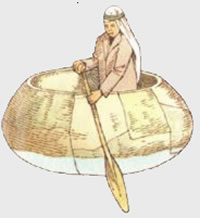
The Ark Tablet describes a gufa or coracle–a round boat that would have been familiar to Mesopotamian audiences. Unlike the boat shown above, Atrahasis’s gufa would have had a base area over 35,000 square feet, with 20-foot-high walls. Picture from Atlantic Ship Model.
With such a well-documented Mesopotamian flood tradition, why is this newly translated cuneiform tablet making waves in our understanding of the Babylonian flood myth? The so-called “Ark Tablet”—a cell-phone sized piece of clay inscribed on both sides—is essentially an ark builder’s how-to guide, according to its translator, British Museum scholar Irving Finkel. Enki gives Atrahasis instructions on how to build an ark, but the resulting boat isn’t what you’d expect. According to Irving Finkel, this boat was round. In an article in The Telegraph, Finkel writes:
The most remarkable feature provided by the Ark Tablet is that the lifeboat built by Atra-hasıs— the Noah-like hero who receives his instructions from the god Enki—was definitely, unambiguously round. “Draw out the boat that you will make,” he is instructed, “on a circular plan.”
The text describes the construction of a coracle or gufa, a traditional basket-like boat that would have been familiar to Mesopotamian audiences. Of course, this is no average coracle—Atrahasis is to build a boat with a diameter of close to 230 feet across and 20-foot-high walls. The boat is made out of a massive quantity of palm-fiber rope, sealed with bitumen. This isn’t exactly the same ark that Noah built—or Utnapishtim, for that matter:
| Epic of Gilgamesh Tablet XI, 54-65 On the fifth day I laid out her exterior. It was a field in area, its walls were each 10 times 12 cubits in height, the sides of its top were of equal length, 10 times It cubits each. I laid out its (interior) structure and drew a picture of it (?). I provided it with six decks, thus dividing it into seven (levels). The inside of it I divided into nine (compartments). I drove plugs (to keep out) water in its middle part. I saw to the punting poles and laid in what was necessary. Three times 3,600 (units) of raw bitumen I poured into the bitumen kiln, three times 3,600 (units of) pitch …into it… |
Genesis 6:14-15 Make yourself an ark of cypress wood; make rooms in the ark, and cover it inside and out with pitch. This is how you are to make it: the length of the ark three hundred cubits, its width fifty cubits, and its height thirty cubits. Make a roof for the ark, and finish it to a cubit above; and put the door of the ark in its side; make it with lower, second, and third decks. |
Listen to Irving Finkel on BBC Radio 4 discussing the 4,000 year old clay tablet that led him to discover the instructions for the building of an ark.
The Animals Went in Two by Two

This reconstruction accompanied the Telegraph article by Finkel. Photo: Stuart Patience @ Heart Agency.
At first glance, it would seem that the Ark Tablet, while extremely descriptive in its instructions—it features twenty lines just describing the waterproofing of the vessel—is describing an ark narrative that differs more from Noah’s than its other Babylonian counterparts. However, according to his Telegraph article, Finkel was shocked by the rare cuneiform signs sana in the passage describing the animals on the boat. Sana is listed in the Chicago Assyrian Dictionary as “Two each, two by two.” Compare this with the Biblical text:
And of every living thing, of all flesh, you shall bring two of every kind into the ark, to keep them alive with you; they shall be male and female. Of the birds according to their kinds, and of the animals according to their kinds, of every creeping thing of the ground according to its kind, two of every kind shall come in to you, to keep them alive.”
The cuneiform wedges were pressed into Babylonian Ark Tablet a full millennium before the Genesis narrative was written down, but the two bear a strong thematic resemblance in their treatment of the animals. However, this tablet describes how to build an ark, and the resulting vessel couldn’t be much more different from the Biblical boat. Would a round gufa-style boat weather the Deluge? Irving Finkel points out that a pointed ship may be easier to sail to a particular destination, but Atrahasis’s ark had nowhere to go—it merely needed to support its human and animal occupants for the duration of the flood. He told The Guardian:
In all the images ever made people assumed the ark was, in effect, an ocean-going boat, with a pointed stem and stern for riding the waves – so that is how they portrayed it. But the ark didn’t have to go anywhere, it just had to float, and the instructions are for a type of craft which they knew very well. It’s still sometimes used in Iran and Iraq today, a type of round coracle which they would have known exactly how to use to transport animals across a river or floods.
Click here to read his account in The Telegraph.
Learn more about Irving Finkel’s book The Ark Before Noah.
The harshness of the curse of Ham, his son Canaan and their descendants after the ark narrative has been a source of scholarly debate for millennia. A new reading of the Dead Sea Scroll 4Q180-4Q181 provides a fresh perspective on Canaan’s transgression.
George Smith’s Other Find: The Babylonian Flood Tablet
Originally published as the sidebar to “The Genesis of Genesis” by Victor Hurowitz in Bible Review‘s anniversary issue.

The Babylonian Flood Tablet translated by George Smith in the mid/late 19th century. The British Museum.
In 1866, George Smith, a British bank-note engraver, wrote a letter to the famed Assyriologist Sir Henry Rawlinson, asking if he might have a look at the fragments and casts of Assyrian inscriptions in the back rooms of the British Museum. Rawlinson agreed—thus initiating what would become an unusually fruitful friendship between an eager amateur and the man who had deciphered cuneiform.
Smith so impressed Rawlinson that the latter hired him in 1867 to help catalogue the museum’s cuneiform inscriptions, including those excavated by Austen Henry Layard at Kyunjik (ancient Nineveh) in the 1840s and 1850s.
In the accompanying article, Victor Hurowitz describes one of Smith’s most significant discoveries: the Babylonian poem Enūma Eliš. But Smith’s most famous “find” in the British Museum store rooms was undoubtedly the Epic of Gilgamesh, with its dramatic account of a Great Deluge that threatened to wipe out humankind.
In his popular book The Chaldean Account of Genesis, Smith described the discovery: “I soon found half of a curious tablet which had evidently contained originally six columns of text; two of these (the third and fourth) were still nearly perfect; two others (the second and fifth) were imperfect, about half remaining, while the remaining columns (the first and sixth) were entirely lost. On looking down the third column, my eye caught the statement that the ship rested on the mountains of Nizir, followed by the account of the sending forth of the dove, and its finding no resting-place and returning. I saw at once that I had here discovered a portion at least of the Chaldean [Babylonian] account of the Deluge.”
According to a later source, Smith then “jumped up and rushed about the room in a great state of excitement, and, to the astonishment of those present, began to undress himself.” The British Museum has dubbed Smith’s Tablet 11, shown, “the most famous cuneiform tablet from Mesopotamia.”
After he calmed down, Smith scoured the museum’s holdings for further fragments, and soon found that his Flood tablet was the 11th tablet in a 12-tablet epic poem. On December 3, 1872, he presented his findings to the newly founded British Society of Biblical Archaeology and speculated that more of these tablet fragments remained buried in the sands of Nineveh.
Soon after, Edwin Arnold, owner of London’s Daily Telegraph, proposed that his paper sponsor renewed excavations at Nineveh, with Smith at the helm. Smith, and the museum, agreed.
Smith later wrote, “Soon after I commenced excavating at Kouyunjik, on the site of the palace of Assurbanipal, I found a new fragment of the Chaldean account of the Deluge belonging to the first column of the tablet, relating the command to build and fill an ark, and nearly filling up the most considerable blank in the story.”

FREE ebook: Ten Top Biblical Archaeology Discoveries. Finds like the Pool of Siloam in Israel, where the Gospel of John says Jesus miraculously restored sight to a blind man.
The copies of the Gilgamesh Epic discovered by Layard and Smith came from the world-class library of the Assyrian king Assurbanipal (668–627 B.C.E.). The tales of Gilgamesh, the bold warrior-king of Uruk, are much older, however; many of them date back to the Sumerian period (third millennium B.C.E.). In the Old Babylonian Period (early second millennium B.C.E.), the various adventures of Gilgamesh were strung together in a cohesive narrative, which was rewritten many times. By the 12th century B.C.E., an 11-tablet version of the epic had emerged. In the eighth century B.C.E., a 12th tablet describing the death of Gilgamesh was added to the series.
The Flood story does not number among the original Sumerian tales of Gilgamesh. Rather, it was inserted into the narrative in about the 12th century, and thus appears only in the 11- and 12-tablet versions of the tale (called the Standard Babylonian versions).
In the free eBook Exploring Genesis: The Bible’s Ancient Traditions in Context, discover the cultural contexts for many of Israel’s latest traditions. Explore Mesopotamian creation myths, Joseph’s relationship with Egyptian temple practices and three different takes on the location of Ur of the Chaldeans, the birthplace of Abraham.
According to the tale, after the death of his beloved friend Enkidu, a disconsolate Gilgamesh searches for ways to live forever. His quest leads him, on Tablet 11, to the immortal Utnapishtim—often referred to as the Mesopotamian Noah, because he saved his family from a devastating worldwide Flood. Utnapishtim tells Gilgamesh that he, too, was once a mere a mortal and a king, of Shuruppak-on-the-Euphrates. In his day, five of the gods plotted to send a Flood to destroy humankind. One of the gods, Ea, surreptitiously informed the king, whispering, “Quickly, quickly tear down your house and build a great ship, leave your possessions, save your life … Then gather and take aboard the ship examples of every living creature.” Utnapishtim finishes the ship and loads his family and animals just in time: “Ninurta opened the floodgates of heaven, the infernal gods blazed and set the whole land on fire. A deadly silence spread through the sky and what had been bright now turned to darkness. The land was shattered like a clay pot. All day, ceaselessly, the storm winds blew, the rain fell, then the flood burst forth, overwhelming the people like war … For six days and seven nights, the storm demolished the earth. On the seventh day, the downpour stopped. The ocean grew calm. The land could be seen, just water on all sides, as flat as a roof. There was no life at all.” The boat runs aground on Mount Nimush. Utnapishtim sends out a dove, which flies right back, having failed to find land; he sends a swallow with similar results. Finally, he sends a raven, which never returns. The waters have begun to recede.
The gods convene and offer Utnapishtim and his family immortality. Having heard this tale, Gilgamesh recognizes he has little chance of being offered the same, and he returns home to Uruk to die.—Molly Dewsnap Meinhardt
Passages from Gilgamesh come from Stephen Mitchell’s new translation Gilgamesh: A New English Version (New York: Free Press, 2004).
This Bible History Daily article was originally published on January 29, 2014.
Related reading in Bible History Daily
All-Access members, read more in the BAS Library
Biblical Views: Noah, Enoch and the Flood: The Bible Meets Hollywood
Not a BAS Library or All-Access Member yet? Join today.
Related Posts


Must-Read Free eBooks
Want more Bible history?
Sign up to receive our email newsletter and never miss an update.
Unlock Unlimited Access to the Bible's Past

Unlock Unlimited Access to the Bible's Past
Become an All-Access Member to explore the Bible's rich history. Get Biblical Archaeology Review in print, full online access, and FREE online talks. Plus, enjoy special Travel/Study discounts. Don't miss out—begin your journey today!

As I recall, there is nothing in the Biblical account about Noah’s ark being pointed. Rather, it’s a rectangular box whose purpose is also to float on the flood waters.
God is merciful. While the Bible recounts a flood story believed by many to be true, those believers – myself included – have tended to also believe that Noah’s was the only ark. Could it be that a merciful God provided direction and inspiration to others throughout the world so that they too might be saved?
This is another evidence among hundreds that the Hebrew biblical tradition is based on Mesopotamian historical accounts. That being said, we conclude even more than before that the Semitic Hebrew people were not but Babylonians basically from the city of Ur. Hence, Jews were Iraqis.
A Whole World Destroyed!
Look at the world around you, with its cities, its culture, its scientific achievements, its population of billions. It is easy to be impressed by its apparent permanence, is it not? Do you think that some day this world could completely disappear? That may be difficult to envision. However, did you know that according to a very good source, a world existed before this one and it was completely destroyed?
WE ARE not talking of a world of primitive tribes. The world that perished was civilized, with cities, artistic achievements, scientific knowledge. Yet, the Bible record tells us that suddenly, on the 17th day of the 2nd month, 352 years before the patriarch Abraham was born, a deluge began that swept away a whole world.*
Is that record correct? Did such a thing really happen? Was there really an ancient world before the present one that flourished and was then destroyed? If so, why did it end? What went wrong? And is there any lesson that we can draw from its demise?
Was an Ancient World Really Destroyed?
Such an awesome catastrophe, if it really happened, would never have been completely forgotten. Hence, in many nations there are reminders of that destruction. Consider, for example, the precise date recorded in the Scriptures. The second month of the ancient calendar ran from what we now call mid-October to mid-November. So the 17th day corresponds approximately to the first of November. It may not be a coincidence, then, that in many lands, festivals for the dead are celebrated at that time of year.
Other evidences of the Deluge linger in mankind’s traditions. Practically all ancient peoples have a legend that their ancestors survived a global flood. African Pygmies, European Celts, South American Incas—all have similar legends, as do peoples of Alaska, Australia, China, India, Lithuania, Mexico, Micronesia, New Zealand, and parts of North America, to mention only a few.
Of course, over time the legends have been embellished, but they all include several details indicating a common source narrative: God was angered by mankind’s wickedness. He brought a great flood. Mankind as a whole was destroyed. A few righteous ones, however, were preserved. These built a vessel in which humans and animals were saved. In time, birds were sent out to search for dry land. Finally, the vessel came to rest on a mountain. Upon disembarking, the survivors offered a sacrifice.
What does this prove? The similarities cannot possibly be coincidental. The combined evidence of these legends corroborates the Bible’s ancient testimony that all humans descend from the survivors of a flood that destroyed a world of mankind. Hence, we do not need to rely on legends or myths to know what happened. We have the carefully preserved record in the Hebrew Scriptures of the Bible.—Genesis, chapters 6-8.
The Bible contains an inspired record of history extending back to the dawn of life. Evidence proves that it is more than mere history, however. Its unfailing prophecy and deep wisdom demonstrate that it is what it claims to be—God’s communication to mankind. Unlike myths, the Bible includes names and dates as well as genealogical and geographical details in its historical accounts. It gives us a picture of what life was like before the Flood and reveals why a whole world came to a sudden end.
What went wrong with that antediluvian society? The following article considers that question. It is an important question for those who may wonder just how secure the future of our present civilization is.
Genesis 7:11; 11:10-25, 32; 12:4.
Flood Legends Worldwide
Country Correspondencies 1 2 3 4 5 6 7 8 9 10
Greece 7 ◆ ◆ ◆ ◆ ◆ ◆ ◆
Rome 6 ◆ ◆ ◆ ◆ ◆ ◆
Lithuania 6 ◆ ◆ ◆ ◆ ◆ ◆
Assyria 9 ◆ ◆ ◆ ◆ ◆ ◆ ◆ ◆ ◆
Tanzania 7 ◆ ◆ ◆ ◆ ◆ ◆ ◆
India – Hindu 6 ◆ ◆ ◆ ◆ ◆ ◆
New Zealand – Maori 5 ◆ ◆ ◆ ◆ ◆
Micronesia 7 ◆ ◆ ◆ ◆ ◆ ◆ ◆
Washington U.S.A. – Yakima 7 ◆ ◆ ◆ ◆ ◆ ◆ ◆
Mississippi U.S.A. – Choctaw 7 ◆ ◆ ◆ ◆ ◆ ◆ ◆
Mexico – Michoacan 5 ◆ ◆ ◆ ◆ ◆
South America – Quechua 4 ◆ ◆ ◆ ◆
Bolivia – Chiriguano 5 ◆ ◆ ◆ ◆ ◆
Guyana – Arawak 6 ◆ ◆ ◆ ◆ ◆ ◆
1: God angered by wickedness
2: Destruction by a flood
3: Ordered by God
4: Divine warning given
5: Few of mankind survive
6: Saved in a vessel
7: Animals saved
8: Bird or other creature sent out
9: Finally comes to rest on a mountain
10: Sacrifice offered
http://wol.jw.org/en/wol/d/r1/lp-e/2002160
Flood Legends
Samples from six continents and the islands of the sea; hundreds of such legends are known
Australia – Kurnai
Destruction by Water
Humans Spared
Animals Spared
Preserved in a Vessel
Babylon – Berossus’ account
Destruction by Water
Warning Given
Humans Spared
Animals Spared
Preserved in a Vessel
Babylon – Gilgamesh epic
Destruction by Water
Divine Cause
Warning Given
Humans Spared
Animals Spared
Preserved in a Vessel
Bolivia – Chiriguano
Destruction by Water
Divine Cause
Warning Given
Humans Spared
Preserved in a Vessel
Borneo – Sea Dayak
Destruction by Water
Humans Spared
Animals Spared
Preserved in a Vessel
Burma – Singpho
Destruction by Water
Humans Spared
Animals Spared
Preserved in a Vessel
Canada – Cree
Destruction by Water
Divine Cause
Humans Spared
Animals Spared
Preserved in a Vessel
Canada – Montagnais
Destruction by Water
Divine Cause
Warning Given
Humans Spared
Animals Spared
Preserved in a Vessel
China – Lolo
Destruction by Water
Divine Cause
Humans Spared
Animals Spared
Preserved in a Vessel
Cuba – original natives
Destruction by Water
Warning Given
Humans Spared
Animals Spared
Preserved in a Vessel
East Africa – Masai
Destruction by Water
Divine Cause
Warning Given
Humans Spared
Animals Spared
Preserved in a Vessel
Egypt – Book of the Dead
Destruction by Water
Divine Cause
Warning Given
Humans Spared
Preserved in a Vessel
Fiji – Walavu-levu tradition
Destruction by Water
Divine Cause
Humans Spared
Preserved in a Vessel
French Polynesia – Raïatéa
Destruction by Water
Divine Cause
Warning Given
Humans Spared
Animals Spared
Greece – Lucian’s account
Destruction by Water
Humans Spared
Animals Spared
Preserved in a Vessel
Guyana – Macushi
Destruction by Water
Divine Cause
Humans Spared
Animals Spared
Preserved in a Vessel
Iceland – Eddas
Destruction by Water
Divine Cause
Humans Spared
Preserved in a Vessel
India – Andaman Islands
Destruction by Water
Divine Cause
Humans Spared
Preserved in a Vessel
India – Bhil
Destruction by Water
Warning Given
Humans Spared
Animals Spared
Preserved in a Vessel
India – Kamar
Destruction by Water
Divine Cause
Warning Given
Humans Spared
Preserved in a Vessel
Iran – Zend-Avesta
Destruction by Water
Warning Given
Humans Spared
Animals Spared
Italy – Ovid’s poetry
Destruction by Water
Divine Cause
Humans Spared
Preserved in a Vessel
Malay Peninsula – Jakun
Destruction by Water
Divine Cause
Humans Spared
Preserved in a Vessel
Mexico – Codex Chimalpopoca
Destruction by Water
Warning Given
Humans Spared
Preserved in a Vessel
Mexico – Huichol
Destruction by Water
Warning Given
Humans Spared
Animals Spared
Preserved in a Vessel
New Zealand – Maori
Destruction by Water
Divine Cause
Humans Spared
Preserved in a Vessel
Peru – Indians of Huarochirí
Destruction by Water
Warning Given
Humans Spared
Animals Spared
Russia – Vogul
Destruction by Water
Warning Given
Humans Spared
Preserved in a Vessel
U.S.A. (Alaska) – Kolusches
Destruction by Water
Warning Given
Humans Spared
Animals Spared
Preserved in a Vessel
U.S.A. (Alaska) – Tlingit
Destruction by Water
Divine Cause
Humans Spared
Animals Spared
Preserved in a Vessel
U.S.A. (Arizona) – Papago
Destruction by Water
Warning Given
Humans Spared
Animals Spared
Preserved in a Vessel
U.S.A. (Hawaii) – legend of Nu-u
Destruction by Water
Divine Cause
Humans Spared
Animals Spared
Preserved in a Vessel
Vanuatu – Melanesians
Destruction by Water
Humans Spared
Animals Spared
Preserved in a Vessel
Vietnam – Bahnar
Destruction by Water
Humans Spared
Animals Spared
Preserved in a Vessel
Wales – Dwyfan/Dwyfach legend
Destruction by Water
Humans Spared
Animals Spared
Preserved in a Vessel
http://wol.jw.org/en/wol/d/r1/lp-e/1200000758?q=flood legends&p=par
http://wol.jw.org/en/wol/s/r1/lp-e?q=flood legends
a round ark? sure, whatever… first wave comes along and spins that ark and everyone else in it and you’ll then see why God didn’t instruct Noah to build it round. Be for real people. Satan is always trying to distract from the truth
And if it was the other way, if the sumerians took the flood story of residents nearby to Noah, since biblical times are calculated fom Abraham about 2000 years BC, and not from Noah…That have been found sumerian stories from 3000 years BC not mean they are the oldest, but simply the oldest found.
Interesting article. Interesting subject.
The comet that hit the ice sheet on Canada about11500bc explains the flood
Interesting. Your comment, Ken, is compatible with the Biblical account. The Bible does not say that the 40 days of rain caused the flood. It says that the water “came from the depths” (paraphrase).
In his booklet, “Hurrian Hebrews; Ea as Yahweh,” Forrest Reinhold points out the similarities between the epic of Gilgamesh flood narrative and the account given in the book of Genesis (p.72, 73), and the fact that the god of wisdom, Ea, who warned Utnapishtim of the impending disaster, had the sacred number of 40 (40 days and nights of the flood, Gen. 7:4,12, 17). The mountains of Ararat where the ark rested was the kingdom of Urartu, whose inhabitants spoke Hurrian. It is likely the Hebrews recieved these Mesopotamian traditions from the Hurrians.
As for the dimesions of the ark being 300 cubits long, it is worth noting that in the Ethiopic book of Enoch (1 Enoch 7:2) the height of the pre-diluvian giants were also 300 cubits. In his “Cipher Genesis,” Carlos Suarez states that the number 300 symbolizes cosmic fertility, and we find a hint of this in the book of Baruch 3:24-26:
” O Israel, how vast is the house of God, how broad the scope of his dominion. Vast and endless, high and immeasurable! In it were born the giants, renowned at the first, stalwarts, skilled in war.”
The Dead Sea Scrolls contain fragments of a lost Book of Giants (http://www.gnosis.org/library/dss/dss_book_of_giants.htm) and a giant named Gilgamesh is mentioned. The king of Uruk fits the description of the Nephilm who were “heroes of old, the men of renown” (Genesis 6:4). It seems this fictional account of giants is really an invectivtive againts the abusive power of temporal rulers. Gilgamesh was said to be 2/3 god and 1/3 human, and this also places him with the sons of God who conspired to enter the daughters of humanity, as it is related in an older version of Gilgamesh. Gilgamesh, like “Caligula,” expands his rule to include being the first to copulate with the bride before the groom:
“He has [intruded] into the meeting place that is set aside for the people…for brideship. He has heaped [defilement] on the city, imposing on the unlucky city strange customs” (“Gilgamesh”, by John Gardiner and John Maier, p.96).
A literary “giant” by the name of Frank Herbert co-wrote a sci-fi book with Bill Ransom entitled, “The Jesus Incident.” Years ago I read this while listening to “Tales From Topographical Oceans” and “Close to the Edge” by Yes. It is set far in the future with a type of Noah’s ark bringing humanity to colonize a planet inhabited by predators which made it uninhabitable for humans. The space vessel which brought the cargo had an artififical intelligence and thought that it was God. The ship’s Chaplain/Psychiatrist, who was awakened out of suspended animation and sent on a mission to save the colony, is wondering if the ship really is God. His name was Raja Thomas and this invokes the image of the disciple of Jesus, otherwise known as” Doubting Thomas” (John 21:24-29). Ironically, though equipped with advanced technology, the humans bring to this new world their own shortcomings, particularly at the management level, which succumbs to an attitude of bigotry and sexism.
An older version of Gilgamesh portrays the king as a maniac hacking his way through the cedar forest with an axe and felling trees until he reaches the abode of the sky gods, like the enviromental destruction depicted in the film “Avatar.” Raja Thomas learns that the oceanic kelp that holds the ecosystem together is sentient, and its destruction will affect the whole planet. The kelp forms a telepathic bond with the ship’s computer, which enables Raja Thomas to be transported in a vision to a place where people had gathered who wore ragged clothing and had a strong body odor to witness the crucifixion of Jesus.
In the 11th tablet of the epic of Gilgamesh, composed by the Babylonian shaman/exorcist priest Sin-Leeqi-Unnini, Gigamesh is instructed by Utnapishtim (whose name contains the word “napishtu” meaning “life-breath”) to obtain a hard to find plant that grows under water, (the domain of the god Ea) and when he obtains it, Gilgamesh declares:
“This is the plant of Openings, by which a man can get life within. I will carry it to Uruk of the Sheepfold; I will give it to the elders to eat; they will divide the plant among them. Its name is The-Old-Man-Will-Be-Made-Young, I too will eat it, and I will return to what I was in my youth” (Gilgamesh, p.249).
“The-Old-Man-Will-Be-Made-Young” reminds me of an episode of “The Simpsons” entitled “Dohin’ In the Wind” which features two old men under the influence of peyote uncontrollably laughing. .
It wasn’t my intention to mislead, but I think was off about the number 300 symbolizing cosmic fertility, when it’s more like cosmic germanation and such was Noah’s ark; an experiment in the implementation of the seeds of life with the blessing of divinity. The number 600 would symbolize cosmic fertility, the blessing being transmitted through divinely inspired tradition. I do know that the Hebrew letter mem has a numerical value of 40 (like that of the god Ea) and the final letter mem is 600. Such is the case in the word for Egypt; Mizraim, as in “you were strangers in the land of Egypt” (Exodus 22:20). This would refer to the tribes of Joseph, of whom it it written that he was the elect (nazir) of his brothers (Genesis 49:26, Dueteronomy 33:16). You’ll recall the tradition of the Nazirites abstaining from wine and letting their hair grow long like Enkidu in his natural state before being given wine by the prostitute and having his hair shaved.
“Gilgamesh is also the story of the double. If Gilgamesh is two-thirds god and only one-third human, his double, Enkidu, seems to reverse the ratio. If Gilgamesh is outwardly the same at the beginnig and the end of the work, the story of Enkidu everywhere emphasizes change … It is the story of Everyman. It is also the story of the emergence of mankind from the wild, a parable of culture, the best worked out Mesopotamian speculation about lullu-amelu, the First Man” (Gilgamesh, p.15).
Joseph married the daughter of the priest of On (Genesis 41:45), this being Heliopolis, where there was an ancient tradition where the company of the gods originated there, emerging out of the Great Egg, the offspring of the earth god Geb or Seb:
“Seb was the god of the earth, and the Heliopolitans declared that he represented the very ground upon which their city stood, meaning that Heliopolis was the birthplace of the company of the gods, and in fact that the work of creation began there” (“The Gods of the Egyptians vol. 2” by E.A. Wallis Budge, p.97).
I remember reading about a prehistoric goose (Geb is sometimes represented as a goose) that lived 30 million years ago in southern France that could swim underwater. It was in Provence, France in the late 12th century that the Kabbalah began to take it egg-like form:
“In this generation in France and especially in its southern part we hear with increasing frequency of scholars called by the epithet ha-perush, the ascetic, or ha-nazir, the Nazirite … There it is said that ‘one should appoint scholars whose vocation it is to occupy themselves incessantly with the Torah, so that the community might fulfill the duty of the study of the Torah, and in order that the reign of heaven sustain no loss'” (“Origins of the Kabbalah” by Gershom Scholem, p,229).