


Should We Take Creation Stories in Genesis Literally?
Finding multiple truths in biblical myths

What purpose did creation stories in Genesis serve? Were they Biblical myths? Pictured here is The Garden of Eden with the Fall of Man (c. 1617) by Flemish painters Peter Paul Rubens and Jan Brueghel the Elder.
Were the creation stories in Genesis meant to be taken literally?
Maybe not, says biblical scholar Shawna Dolansky in her Biblical Views column “The Multiple Truths of Myths” in the January/February 2016 issue of Biblical Archaeology Review.
Our world is very different from the world in which the Biblical authors lived over 2,000 years ago. The ancient world did not have Google, Wikipedia and smartphones—access to information on human history and scientific achievements developed over millennia at the touch of their fingertips.
Many scholars believe that the ancient Israelites had creation stories that were told and retold; these stories eventually reached the Biblical authors, who wrote them down in Genesis and other books of the Bible. Creation stories in Genesis were etiological, Shawna Dolansky and other Biblical scholars argue.1 That is, the creation stories in Genesis served to provide answers to why the world was the way it was, such as why people wear clothes and why women experience pain during childbirth.
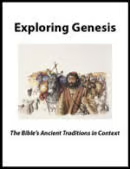
FREE ebook: Exploring Genesis: The Bible’s Ancient Traditions in Context Mesopotamian creation myths, Joseph’s relationship with Egyptian temple practices and 3 tales of Ur, the birthplace of Abraham.
Creation stories in Genesis were among the many myths that were told in the ancient Near East. Today we may think of myths as beliefs that are not true, but as a literary genre, myths “are stories that convey and reinforce aspects of a culture’s worldview: many truths,” writes Dolansky. So to call something a myth—in this sense—does not necessarily imply that it is not true.
Scholars argue that Biblical myths arose within the context of other ancient Near Eastern myths that sought to explain the creation of the world. Alongside Biblical myths were Mesopotamian myths in which, depending on the account, the creator was Enlil, Mami or Marduk. In ancient Egyptian mythology, the creator of the world was Atum in one creation story and Ptah in another.

Shawna Dolansky
“Like other ancient peoples, the Israelites told multiple creation stories,” writes Shawna Dolansky in her Biblical Views column. “The Bible gives us three (and who knows how many others were recounted but not preserved?). Genesis 1 differs from Genesis 2–3, and both diverge from a third version alluded to elsewhere in the Bible, a myth of the primordial battle between God and the forces of chaos known as Leviathan (e.g., Psalm 74), Rahab (Psalm 89) or the dragon (Isaiah 27; 51). This battle that preceded creation has the Mesopotamian Enuma Elish as its closest analogue. In Enuma Elish, the god Marduk defeats the chaotic waters in the form of the dragon Tiamat and recycles her corpse to create the earth.”
In what other ways do Biblical myths parallel ancient Near Eastern myths? What can we learn about the world in which the ancient Israelites lived through the creation stories in Genesis? Learn more by reading the full Biblical Views column “The Multiple Truths of Myths” by Shawna Dolansky in the January/February 2016 issue of BAR.
BAS Library Members: Read the full Biblical Views column “The Multiple Truths of Myths” by Shawna Dolansky in the January/February 2016 issue of Biblical Archaeology Review.
Not a BAS Library or All-Access Member yet? Join today.
Notes
1. For example, see Ziony Zevit, “Was Eve Made from Adam’s Rib—or His Baculum?” BAR, September/October 2015; Mary Joan Winn Leith, “ReViews: Restoring Nudity,” BAR, May/June 2014.
Related reading in Bible History Daily
The Animals Went in Two by Two, According to Babylonian Ark Tablet
All-Access members, read more in the BAS Library
Not a BAS Library or All-Access Member yet? Join today.
This Bible History Daily feature was originally published on January 31, 2016.
Related Posts


Must-Read Free eBooks
Want more Bible history?
Sign up to receive our email newsletter and never miss an update.
Unlock Unlimited Access to the Bible's Past

Unlock Unlimited Access to the Bible's Past
Become an All-Access Member to explore the Bible's rich history. Get Biblical Archaeology Review in print, full online access, and FREE online talks. Plus, enjoy special Travel/Study discounts. Don't miss out—begin your journey today!

I guess I don’t understand why an article like this one is so threatening to belief. I love the old stories but understand that the stories are within a historical context that I don’t live in. When we as Christians become fearful of solid academic research, then we limit God; making Diety very small,
I am also thinking on same lines as Francois comment above.
You can have this article but why mock the story, it’s so simple, the authors shared Creation story from God’s point of view in Genesis 1 and Man’s point of view in Genesis 2–3, we basically drop down to Day #6 as it’s of utmost import to look deeper.
So there is not contradiction whatsoever here…
And you mentioned fleetingly below verses without even saying what they are talking about: Can you please read below verses quoted in above article and tell me what it has about Creation controversy?
Psalm 74 Psalm 89 Isaiah 27; 51
Comeon we can do better than this, please don’t put something just because it would look different. Are you expecting Creation story to be told in 2016 style and format, remember this is written 4000 years ago to people who can understand in that setting and everything written only Glorified God by attributing Creation to Him but not primordial soup 🙂
Please review the article in details and correct where you think needs attention.
Simple: the Bible is the Inspire Word of God. I’ll take it as literally as the Spirit says. End of discussion.
I am interested in whatever ACTUAL ARCHEOLOGICAL EVIDENCE that you happen to find in various sources, but i am sick and tired of you finding people who claim to be educated in various liberal theological strains they chase after, who come up with their own theories of why we should not believe the Bible, as it is plainly written. Either get back to actual archeology or I will have to unsubscribe.
This forum needs an edit button: first paragraph should say “who either haven’t studied the ancient texts, or who parrot…”
Science? It was invented by Christians who saw God’s design in creation and sought to “think His thoughts after Him”. You look for evidence and follow where it leads. You theorize and test it. Why are we finding soft and liquid tissue in dinosaur bones? Why are the oldest living Bristlecone Pines only 4,000 years old? If you extrapolate current trends between the Earth, Sun, and Moon forward or backward in time, life becomes impossible outside of a relatively small timeframe. Earth cannot be as old as it is currently supposed. Indeed, the 19th century writings of early evolutionists indicate that their intent was to supplant the God of Moses and reject His laws. A long period of time would make any process plausible. They didn’t know how long. Our people still don’t when pressed. The only reason for not believing the God of the Bible is that you do not wish to be subject to His instruction. I assumed “Biblical Archaeology” meant He was respected here. Was I incorrect?
I am historian with a special emphasis on Religious Studies from Regis University and Arizona State University, and a graduate of a religious seminary. The life-long study of the Bible from both theological (doctrinal) and historical (scientific) viewpoints based on ancient manuscripts, cultural tradition, archaeology, and the study of ancient languages has given me a clear insight into Genesis and the Bible. The Book of Genesis was not a series of myths handed down generation to generation as many have been taught to believe. Moses was the author of Genesis, which he wrote after God showed him in vision the history of the earth from its very creation to its final end, making it much more accurate and literal than skeptics would care to believe. The book as we have it today is a diluted version filled with errors, mistranslations, and blatant omissions by scribes over the past 3,500 years, which leave many with questions over Adam and Eve, The Flood, the age of man, and doctrinal teachings no longer found in it, but are found in other texts. However, as pointed out by another comment, Jesus and his apostles did verify many aspects of accounts in Genesis as being true. How would they know? Again, the key is revelation from God through the Holy Spirit. God has spoken many times over the ages to men and women whom he chose to reveal his mysteries and will to, often to re-state truth formerly provided but lost through human error and willful apostasy from the truth. The Bible is full of accounts by many of these prophets whom God called for his special purposes to teach those who would listen the true word of God and obey it. What the world needs is fewer skeptics and more believers. Such belief is unpopular among liberal scholars, atheists, secular humanists, and others more interested politically correctness than divine truth, and they go great lengths to undermine that truth to maintain the establishment agenda of academia. Even though many have seen evidence to support the truth, they have no interest in letting the rest of the world know about it, allowing them to maintain control over what people believe and who they should follow. Anything or anyone who attempts to refute the truth of the Bible is either ignorant of the truth or is doing the bidding of a another master to deceive mankind.
Uhm another “myth” advocate. I find it difficult to know when the myth stuff turns to true stuff. Like is the creation story a myth but the Abraham’s offering his son a myth or true. Is the flood a myth but David’s temple a myth it truth. Did the Israelites captivity to Babylon actually happen or is it a myth. What principle guide lines a inherent in the text to plainly show what is and what isn’t?
I also have difficulty with genealogies. Are they myth, or truth. Is the nt genealogies true or myth? If myth, at what person does the mythical list become true. Rather than give an explanation to secularism, stating this is myth but then at this point to turns true but then these are mythical figures but then next one is true etc makes scripture a joke, but worse unbelievable. But after all that us probably the intended purpose for this line of thought.
I will unsubscribe after this comment.This is pure speculation and trash.
“I warn everyone who hears the words of the prophecy of this scroll: If anyone adds anything to them, God will add to that person the plagues described in this scroll. And if anyone takes words away from this scroll of prophecy, God will take away from that person any share in the tree of life and in the Holy City, which are described in this scroll. He who testifies to these things says, “Yes, I am coming soon.” Amen. Come, Lord Jesus.”
Revelation 22:18-20 NIV
[Broken URL removed by site admin]
Very disappointed, people take portions ofwhat they want to believe so they don’t have to be accountable to God. This comes from a lack of an intimate relationship with God. They don’t know HIM. Get to know God read the Bible, pray and listen you might get some wisdom.