


The Washington Post’s Gene Weingarten Discovers the True Adam and Eve Story
Was Eve made from Adam’s rib or some other part?
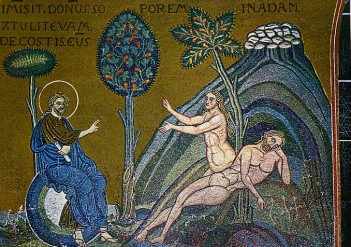
This mosaic from the Cathedral of Monreale, Sicily, depicts the creation of woman in the Bible. Eve is shown emerging from Adam’s side.
Pulitzer Prize-winning journalist Gene Weingarten has discovered the true origin of the story of Eve. In his latest weekly humor column “Below the Beltway” featured in the Washington Post Magazine and newspapers around the country, Weingarten discusses Ziony Zevit’s article “Was Eve Made from Adam’s Rib—or His Baculum?” from the September/October 2015 issue of Biblical Archaeology Review.
According to the Bible’s creation account, after making the heavens and the earth, God created humankind. The story of Adam and Eve in Genesis 2 states that God formed Adam out of the dust of the ground, and then Eve was created from one of Adam’s ribs. But was it really his rib? Ziony Zevit, Distinguished Professor of Biblical Literature and Northwest Semitic Languages at American Jewish University in Bel-Air, California, examines this question in his BAR article. And the answer is “No.”
FREE ebook: Exploring Genesis: The Bible’s Ancient Traditions in Context Mesopotamian creation myths, Joseph’s relationship with Egyptian temple practices and 3 tales of Ur, the birthplace of Abraham.
The Hebrew word traditionally translated “rib” is tsela‘. Biblical scholar Ziony Zevit says that this translation is clearly wrong, and many scholars agree. It was first translated as “rib” in the Septuagint, a Greek translation of the Hebrew Bible from the mid-third century B.C.E. However, a more careful reading of the supposed Hebrew word for “rib” in the Adam and Eve story indicates that Eve was created from another, very different, part of Adam’s anatomy—his os baculum (penis bone).
“Instantly, I knew this article was important,” writes Weingarten. “That is because it finally explained the origin of a common fallacy, a spectacularly stupid bit of scientific misinformation under which I had labored for the first 16 years of my life until a high school bio class set me straight: Men are not short one rib, as the creation myth implies. Men and women have the same number.”
Related reading in Bible History Daily:
The Adam and Eve Story: Eve Came From Where?
The Creation of Woman in the Bible
Should We Take Creation Stories in Genesis Literally?
Cain and Abel in the Bible
Bible Review’s Supporting Roles by Elie Wiesel
What Happened to Cain in the Bible?
Related Posts


Must-Read Free eBooks

Want more Bible history?
Sign up to receive our email newsletter and never miss an update.
Unlock Unlimited Access to the Bible's Past

Unlock Unlimited Access to the Bible's Past
Become an All-Access Member to explore the Bible's rich history. Get Biblical Archaeology Review in print, full online access, and FREE online talks. Plus, enjoy special Travel/Study discounts. Don't miss out—begin your journey today!

Like most of the ancient scriptures, this idea is mostly allegorical or metaphorical, with lessons to be garnered.
If rendered in 20th Century anthropological lingo, the translation would say that the original Australopithecus and Homoerectus human ancestors had a penis bone, useful for procreation in awkward positions.
However, the first homosapiens endowed with infuse science, had his natural prosthesis divinely (that is surgically) removed, in order to provide him with a desired companion assembled from it.
The absence of such a useful procreating bone from all subsequent homoerectus males eventually led the species to develop chemical substitutes, such as sildenafil, but such a recent application of infuse science took almost a million years to acccomplish.
if you were 16 in HS Biology class and still thought men were one rib short….. you have other problems! If a man loses his arm in an accident, is his son born with one arm? A little common sense goes a long way.
Let the writer have his 15 minutes in the spotlight with his not so clever theory and then let him fade away.
If we believe the creation account in Genesis 1, man and woman were created simultaneously. “Male and female, created he them.”
Genesis 2 appears to be a later (and much more fanciful account.
Genesis 1 makes much more sense than Genesis 2. I believe this puts the “rib story” in the area of Hebraic legend.
Really, what is most important, how God made woman or the fact He did indeed make woman? I think the latter.
On a serious note, I think this article was a waste of space. On a humorous note, my first thought was, ‘So is that why men need Viagra?’
Don’t you get it, the people back then were ignorant, and did the best that they could do, while making up the story!.
Aaron is correct and Shirley’s comment has merit. As a biology major, I learned that many placental mammals are endowed with a baculum (penis bone)…except humans! Shirley’s comment would tend to uphold that biologic fact.
What is “on the side”, but the testes?
Woman is flesh of the flesh, and bone of the bone, is she not? What is sperm, but strictly DNA in a protein sheath, with a flagellum for motion and some sugars for energy attached?
You are not penetrating deeply enough below the surface, for the origin of all of this…
Look to the double helix of all information, encircling the Tree of Life, rooted within in the clay of the Garden of Eden. From this stump, Living Waters pour forth. From this root, a Green Branch arises.
You have to understand the overall context of Parsha Bereshit, and all of Genesis, really. It is all about birth, fruition, and growth.
It is the first honeymoon, of the bride and the Groom. This origin, is the end of all religious experience, of the Revelation; the Alpha, which is the Omega, are the Origin, are positive and negative infinity; are the Mobius strip of Torah, white and black sides merged; all, are One.
In Genesis, it’s says that Eve was formed from one of the tselas of Adam. The 3rd century BC Greek Septuagint translates this as ribs. Apparently neighboring languages also contain early forms of this word that mean rib; but with a much earlier date for Genesis, which I strongly favor, it can be argued that this is due to the influence of this single most famous occurrence of the word.
Especially, because there are 43 other occurrences of this word in the Bible, none of which would make sense to be translated as rib.
An excerpt from the article:
“This Hebrew word occurs some 40 times in the Hebrew Bible, where it refers to the side of a building or of an altar or ark (Exodus 25:12; 26:20, 26; 1 Kings 6:34), a side-chamber (1 Kings 6:8; Ezekiel 41:6), or a branch of a mountain (2 Samuel 16:13). In each of these instances, it refers to something off-center, lateral to a main structure. The only place where tsela might be construed as referring to a rib…is in Genesis 2:21–22.”
The author proposes that tsela should be translated baculum, which is a penis bone, present in other mammals, but lacking in humans. There are several good arguments against this, including that this would’ve been an imperceptible anatomical feature (mere mm.) in an unlikely region of dissection, in the animals that anyone, back then, would’ve been likely to dissect, assuming that anyone was dissecting animals, at all: moreover, it would also assume knowledge of the human lack of one.
But conclusive evidence against this hypothesis is found in the Biblical context itself: it reads that “one of Adam’s tselas” was taken from him. Humans would have only had one baculum; and if not, since only “one” was taken, where is the other?
I propose another translation, which would make sense literally here and metaphorically in every other occurrence in the Bible, where it refers to “a side or half of a frame or set of slats;” and it would explain all the early mistaken renderings as rib, as being only slight off. It means ribcage.
This would also explain why there is only one heart on one side of man: his wife has his other one.
Finally, it captures perfectly the closeness and depth of the relationship of the man and woman of whom the first Adam and Eve were only types: Jesus and Mary, who were truly of the same flesh and of one set of hearts.