


The Washington Post’s Gene Weingarten Discovers the True Adam and Eve Story
Was Eve made from Adam’s rib or some other part?
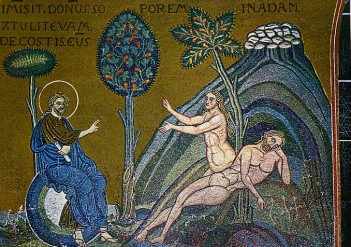
This mosaic from the Cathedral of Monreale, Sicily, depicts the creation of woman in the Bible. Eve is shown emerging from Adam’s side.
Pulitzer Prize-winning journalist Gene Weingarten has discovered the true origin of the story of Eve. In his latest weekly humor column “Below the Beltway” featured in the Washington Post Magazine and newspapers around the country, Weingarten discusses Ziony Zevit’s article “Was Eve Made from Adam’s Rib—or His Baculum?” from the September/October 2015 issue of Biblical Archaeology Review.
According to the Bible’s creation account, after making the heavens and the earth, God created humankind. The story of Adam and Eve in Genesis 2 states that God formed Adam out of the dust of the ground, and then Eve was created from one of Adam’s ribs. But was it really his rib? Ziony Zevit, Distinguished Professor of Biblical Literature and Northwest Semitic Languages at American Jewish University in Bel-Air, California, examines this question in his BAR article. And the answer is “No.”
FREE ebook: Exploring Genesis: The Bible’s Ancient Traditions in Context Mesopotamian creation myths, Joseph’s relationship with Egyptian temple practices and 3 tales of Ur, the birthplace of Abraham.
The Hebrew word traditionally translated “rib” is tsela‘. Biblical scholar Ziony Zevit says that this translation is clearly wrong, and many scholars agree. It was first translated as “rib” in the Septuagint, a Greek translation of the Hebrew Bible from the mid-third century B.C.E. However, a more careful reading of the supposed Hebrew word for “rib” in the Adam and Eve story indicates that Eve was created from another, very different, part of Adam’s anatomy—his os baculum (penis bone).
“Instantly, I knew this article was important,” writes Weingarten. “That is because it finally explained the origin of a common fallacy, a spectacularly stupid bit of scientific misinformation under which I had labored for the first 16 years of my life until a high school bio class set me straight: Men are not short one rib, as the creation myth implies. Men and women have the same number.”
Related reading in Bible History Daily:
The Adam and Eve Story: Eve Came From Where?
The Creation of Woman in the Bible
Should We Take Creation Stories in Genesis Literally?
Cain and Abel in the Bible
Bible Review’s Supporting Roles by Elie Wiesel
What Happened to Cain in the Bible?
Related Posts


Must-Read Free eBooks



Want more Bible history?
Sign up to receive our email newsletter and never miss an update.
Unlock Unlimited Access to the Bible's Past

Unlock Unlimited Access to the Bible's Past
Become an All-Access Member to explore the Bible's rich history. Get Biblical Archaeology Review in print, full online access, and FREE online talks. Plus, enjoy special Travel/Study discounts. Don't miss out—begin your journey today!

I have never once believed that woman came from man. Women are the part of the species that is capable of reproduction. I believe in God and science and I’ve come to see Genesis 1 and 2 as the best way people in that time could interpret the wonders or God and science. For me 6 days could be the equal of 60 million years. For a thousand years in thy sight are but as yesterday when it is past, and as a watch in the night
The Hebrew, as it comes down to us, is interpreted by prior interpretations. For instance, the assumption that whatever was taken from Adam’s body was a “tzelah” whatever that meant to the writer of that statement, it never states in the Hebrew “from the side,” nor does it mean that “tzelah” is a rib, but might have a more generalized definition, even though other Hebrew Biblical and post-Biblical texts might use the term metaphorically to describe a dimension of an inanimate object, so Ziony Zevit’s interpretaton cannot be dismissed without a more substantive argument other than to dismiss this interpretation as salacious or sinful or whatever.
Zevit brings into the discussion the inherent basic level of understanding a herding people who have butchered meat and dissected the bodies of their livestock in the process and therefore were aware of the existence of a penis bone while other experiences involving human dead made them aware of the lack of a human baculum. So, for them, the “tzelah” in vss. 21-22 in Genesis II could just be a baculum.
I think it all boils down to the fact that Ziony Zevit is a product of a westernized university, namely Berkeley. He has probably been taught evolution, that man came from monkeys, monkeys have a baculum. I think it is just another devious way to mock the creation story and to promote evolution instead or at least to put the idea in some people’s minds anyway.
Good references to Australeopithicus and Homo Erectus, Ladislao #11, as the former are meantioned in Genesis 1:26-29 while the latter is mentioned crypticly in Genesis 2:5; “there was no man to cultivate the ground.’ The ground, or ” adamah,” is described as dry clods of packed dust, which best describes the condition of the soil in the Negev desert. We know that the migration route of Homo Erectus passed out of Africa and into Asia that passed through the same route as the Israelites out of Egypt. The reference to the first Adamic prototype in Genesis 2:5 can also refer to the settlement phase of the Negev before they were abandoned in the mid-27th century B.C.E., after the Egyptians abandoned their pursuit of copper mines and opted for an alternative source of copper through trade with Bibylos having also become dependant on lumber from the merchants of Bibylos to fuel their ruler’s obsession with mortuary monuments. The Negev wasn’t re-settled until the establishment of the Davidiic monarchy in 1000 B.C.E.
I heard in the comments a reference to Viagra and I think a good analogy of a “penis crutch” would be this ancient network of settlements that were dependent on the Egyptian monarchy. Another type of crutch is a rock musician who depends on his guitar.
Australopithicus would likely be founf in Genesis 1:28, where Adam has the manual dexterity to to subdue and exploit the resources within their grasp or “rule.” This coming after a gestation period of approximately 30 million years, symbolized by the 3 times the word for create, “bara,” appears in Genesis 1:27, when primates evolved into an upright bipedal creature who risked the relative safety of the tree-dwelling life with all its amenities like Egypt (Hebrew “Mitzrayim,’ meaning ‘wealthy ones”), in exchange for a risky investment in the land of Canaan.
More on the mystety of Adam and Eve: http://www.biblicalarchaeology.org/daily/biblical-topics/bible-interpretation/the-adam-and-eve-story-eve-came-from-where/
Oops, wrong link: http://www.biblicalarchaeology.org/daily/biblical-topics/bible-interpretation/everyday-eves/
Evidence of possible Homo Erectus found near Tel Aviv: http://nytimes/2014/12/02/world/lessons-from-an-ancient-time-when-recyclers-walked-the-earth.html
One more time: http://www.nytimes.com/2014/12/02/world/lessons-from-an-ancient-time-when-recyclers-walked-the-earth.html
The flow that is described in Genesis 2:6 as rising up from the ground is the source of water that the earliest settlements in the northern Negev were built around, as the archaeological evidence has shown:
“Clusters of sites have been found along wadi banks in peripheral areas of Palestine. The best example is perhaps the northern Negev, where a comprehensive survey and excavations have revealed over seventy Chalcolithic settlements over a distance of 110 km along the banks of the Beersheba Brook and its continuation, the Besor Brook. Another concentration is to be found farther northward, on the banks of the Gerar Brook. This is a region of loess soil, in which winter floods have carved deep wadi courses. The floodwaters comprised a periodic source of water, which was made available year round by digging shallow pits in the wadi beds. The region was entirely uninhabited in Neolithic times, and the Chalcolithic inhabitants found here a primeval land that was ideal for widespread settlement based on herding and agriculture” (“Archaeology of the Land of the Bible: 10,000-586 B.C.E.” by Amihai Mazar, p.60).
See also Isaac’s ordeal squabbling over wells with bedouin shepherds in the Gerar Brook, Genesis 26:17-22.