


The Virgin Mary and the Prophet Muhammad
Mediating the Word of God in Christian and Islamic traditions
Mary Joan Winn Leith
May 14, 2024
36 Comments
48915 views
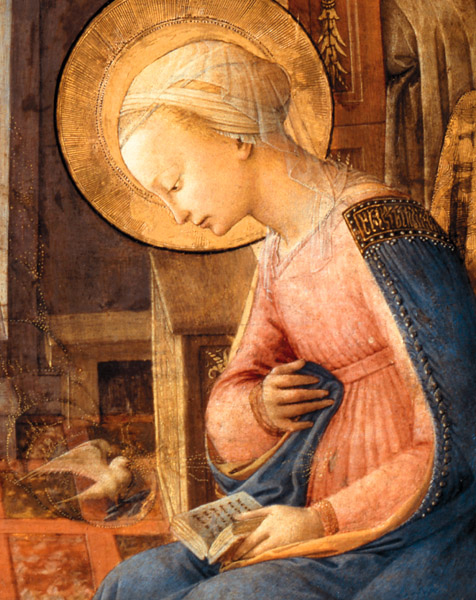
The Virgin Mary and the prophet Muhammad have a lot in common within their respective Christian and Islamic traditions, according to author Mary Joan Winn Leith. Photo: Detail of Fra Filippo Lippi’s “The Annunciation,” courtesy National Gallery, London.
With another Christmas season upon us and Christmas carols in the air, I am struck anew at how much, within their respective traditions, the Virgin Mary and the prophet Muhammad have in common. I hasten to note that I am not suggesting that Mary and Muhammad are of equal importance in their traditions—just that there are some interesting commonalities; and, of course, both Islam and Christianity honor Mary as the virgin who miraculously conceived and gave birth to Jesus, but I want to pursue a different angle here.
The similarities I have in mind first occurred to me when I was teaching the Qur’an’s Sura 97 (al-Qadr, “Destiny”). This is the Sura that extolls the holiest night of the Muslim calendar, the Laylat al-Qadr (Night of Destiny) when Muhammad received the first revelation of the Qur’an. The connection I see between Mary and Muhammad centers on the significance of the Word of God in Christianity, Islam and Judaism. Basic to all three religious traditions is the understanding that God, impelled by compassion, reveals to humans the way to salvation. The traditions use different theological terminology (redemption, salvation, eternal life, etc.), but in essence, God’s revelation gives humans the knowledge and means to overcome the sorrow, pain and death that constitute the human condition. All three traditions describe this revelation as the Word of God.

FREE ebook: Islam in the Ancient World. Explore Islam’s biblical history and sites.
From the Jewish and Muslim perspective, this is quite straightforward. Both the Torah, given by God to Moses on Mt. Sinai, and the Qur’an, disclosed by God in visions to Muhammad, are literally words from God. The Christian revelation is also the Word of God, but in Christianity the Word of God happens not to be a text but a person—Jesus. For example, the Gospel of John famously opens with the explanation, “In the beginning was the Word, and the Word was with God, and the Word was God … and the Word became flesh and dwelt among us” (John 1:1, 14). For Christians, Jesus is the “Word” that became flesh, or, to use another Christian term, Jesus is the “incarnation” (the “enfleshment”) of God. In a very real sense, then, both Mary and Muhammad are the mediators, the “middle person” (“middleman” doesn’t work here) between God and humanity.
Both are the bearers of a message from God that cannot be delivered to humans on earth without the agency of a human body. Mary literally bears the Word of God in her womb and—to use the archaic sense of the word—Mary is “delivered” of the Word of God when she gives birth to Jesus. Similarly, the earthly human capacity for hearing and speech allows Muhammad to bear and deliver the Word of God to the people of Mecca and Medina. It is significant, I think, that neither “deliverer” is considered to be divine, yet, from the earliest centuries of their respective religions, each was accorded a unique status hovering in the liminal area between human and divine.

FREE ebook: The First Christmas: The Story of Jesus’ Birth in History and Tradition. Download now.

In a detail of Jean Patinir’s “Rest on the Flight to Egypt,” the farmer, the soldiers and both the bare and the wheat-filled field are seen. The soldiers, looking for Mary, Joseph and the baby Jesus, believed no one was hiding in the wheat-filled field.
Because Mary and Muhammad in their roles as mediators by definition experienced a direct encounter with the divine, both faiths came to believe that they must have enjoyed an exceptional degree of purity. Mary’s purity of course, is her virginity, a physical state which Christians, under the influence of Greco-Roman thought, associated with spiritual perfection and sinlessness. As for Muhammad, his purity had nothing to do with sexuality; after all, he married a number of wives, including even some widows. Muhammad’s exceptional purity has to do with knowledge, which initially may seem to be a peculiar form of purity. However, it is an article of faith in Islam that the words of the Qur’an are God’s, not Muhammad’s, and the proof of this among Muslims is the conviction that Muhammad could not read or write; he was, so to speak, a virgin from the point of view of education. No human father contributed to the incarnation of Jesus, and no human artistry had any role in the creation of the Qur’an.
Beyond the complexities of theology and belief, surprisingly similar legends—neither story is in the Bible or the Qur’an—arose around Mary and Muhammad stemming from the fact that both had to flee for their lives. According to medieval tradition, as Mary, Joseph and the baby Jesus fled from King Herod barely ahead of his soldiers, they came upon a farmer sowing his field. “Please don’t tell the soldiers you saw anyone come by,” they begged. The farmer, however, was too frightened to help them. When the soldiers arrived and asked whether the farmer had seen the fugitives, the farmer told the truth; “I saw them as I was sowing this field.” The soldiers, seeing the field, turned back. The wheat field was ready for harvest so they concluded that no one could have passed by anytime recently (see image above). Muhammad had to elude Meccan authorities who wanted to prevent him from making the Hijra (emigration) to Medina where he would found the first fully Muslim community (and whose date serves as the zero point on the Muslim calendar). Muslims love to tell the story of Muhammad and his companion Abu Bakr who had scarcely entered a cave to hide when the Meccans rode up. Having inspected the cave entrance, the pursuers rode on; the huge spider web across the mouth of the cave told them that no one had entered it in years.

This illustration depicts the Muslim tradition of the “Miracle of the Cave,” when Muhammad and Abu Bakr hid in a cave to elude Meccan authorities during the Hijra. The spider webs covering the cave entrance led the authorities to believe no one was in the cave. Photo: Desmond Stewart, Early Islam (Great Ages of Man), (New York: Time, Inc., 1967).
Finally, let me return to the Christmas carols and to Sura 97 that I mentioned at the start of this essay. Consider these lines from “Silent Night”:
Silent night, Holy Night
All is calm, all is bright…
Sleep in heavenly peace…
Heavenly hosts sing alleluia.
Or these from “Little Town of Bethlehem”:
Oh Little Town of Bethlehem, how still we see thee lie…
But in those dark streets shineth the everlasting light
The hopes and fears of all the years are met in thee tonight.
Here is how the Qur’an describes the Night of Destiny:
Lo! We revealed it on the Night of Destiny.
Ah, what will convey unto thee what the Night of Destiny is!
The Night of Destiny is better than a thousand months.
The angels and the Spirit descend therein, by the permission of their Lord, with all decrees.
(The night is) Peace until the rising of the dawn.
The peace of the season to all!
 Mary Joan Winn Leith is chair of the department of religious studies at Stonehill College in Easton, Massachusetts. At Stonehill, she teaches courses on the Bible and the religion, history and culture of the Ancient Near East and Greece. In addition, she offers a popular course on the Virgin Mary. Leith is a regular Biblical Views columnist for Biblical Archaeology Review.
This Bible History Daily article was originally published on December 16, 2014.
Related reading in Bible History Daily:
Is the Earliest Image of the Virgin Mary in the Dura-Europos Church?
Mary, Simeon or Anna: Who First Recognized Jesus as Messiah?
Related Posts

Mar 8
Deborah in the Bible


Mar 5
Tabitha in the Bible

Must-Read Free eBooks
Want more Bible history?
Sign up to receive our email newsletter and never miss an update.
Unlock Unlimited Access to the Bible's Past

Unlock Unlimited Access to the Bible's Past
Become an All-Access Member to explore the Bible's rich history. Get Biblical Archaeology Review in print, full online access, and FREE online talks. Plus, enjoy special Travel/Study discounts. Don't miss out—begin your journey today!

Wow, do any of you realize that the Father uses the whole world? Do you realize he uses each Nation and all peoples? There might be a Nation he uses once or twice. He may use them constantly. The World is his footstool not what any of your religions dictate. Your vain imagination leads you to believe he is yours and yours alone. Kurt, you said a mouthful. Now I ask you, do you follow all the Livitical Laws? Repeating words written is easy. Understanding is easy. But do you REALIZE, REVELATIONS? The ONLY one to open the scrolls is the Christ.
There is a truism I learned fm a priest friend of mine who put it thus: you become like the God you worship. Spiritually, it’s like the “you are what you eat.”
This world has a plethora of spiritual traditions and practices. Some are henotheistic as some Hindus worship only one god but acknowledge there are many. Some are non-theistic like textbook Buddhism. Some are polytheistic such as Hinduism, practical Buddhism in some areas of the world that tie it with ancestor veneration/worship as well as animist groups primarily in Africa.
Then there are the monotheistic religions: Judaism and its offspring Christianity, Islam and its offspring Sikhism, Baha’i, as well as sects within Islam viewed as heretical.
Just because you are a monotheist does not mean you worship the same deity. This is especially true for Biblical religious traditions and Koranic traditions. All Jews & Christians share with Muslims is a belief that there is only one deity. They do not share the same ethical traditions nor the same world outlook. Islam reserves justice and mercy only for other Muslims while the Biblical tradition claims equal rights for all humanity.
There are two different deities here. There is the deity of the Bible whom Jews and Christians call the LORD (YHVH). Christians depart fm Judaism by calling Jesus (Yeshua) the Incarnate YHVH who bestows the ever-living Shekinah (Holy Spirit) to believers.
The deity of the Koran does not act the same as the Biblical deity and thus must be deduced as a different deity, named Allah. Over the centuries, Arabic superimposed the name Allah with the general concept of deity (god). Without upper and lower case letters, there was no way to differentiate between God and god as in the Latin or Greek character based languages. Without being able to distinguish betw common nous and proper nouns, Semitic languages can muddle the distinction betw God and god or in the case of Arabic — Allah and allah.
Just because you worship only one deity and claim that the world has only one deity, does not make you identical or even similar by any stretch of the imagination. Saying that Allah is the same deity as the Bible does not make it so. By the time Mohammad reaches Medina, his god is quite different. This can be clearly seen in the marked differences betw the Meccan and Medinan suras. Meccan suras are for the most part peaceful, spiritually oriented while the Medinan suras are marked by radical violence and political conquest of a universal nature employing religious language.
Herein lies the difference betw the Biblical and Koranic traditions — two different Spiritual Beings are claiming to be God. YHVH and Allah are not the same.
Who Really Controls the World?
Do you think it is . . .
God?
humankind?
someone else?
WHAT THE BIBLE SAYS
“The Evil One controls the whole world.”—1 John 5:19.
Luke 4:6 Then the Devil said to him (Jesus) “I will give you all this authority and their glory, because it has been handed over to me, and I give it to whomever I wish.
You see who Really Controls the World?
“The Son of God came . . . to destroy the devil’s work.”—1 John 3:8, New Century Version.
WHAT THAT CAN MEAN FOR YOU
Logical explanations for the world’s problems.—Revelation 12:12.
Reason to believe that our world will change for the better.—1 John 2:17.
CAN WE REALLY BELIEVE WHAT THE BIBLE SAYS?
Yes, for at least three reasons:
Satan’s rulership is doomed. Jehovah is determined to bring Satan’s control over mankind to an end. He promises to “bring to nothing . . . the Devil” and undo all the damage that Satan has caused.—Hebrews 2:14
God has chosen Jesus Christ to rule the world. Jesus is the complete opposite of this world’s present cruel, selfish ruler. Concerning Jesus’ kingship, God promises: “He will have pity on the lowly and the poor . . . From oppression and from violence he will rescue them.”—Psalm 72:13, 14.
God cannot lie. The Bible plainly states: “It is impossible for God to lie.” (Hebrews 6:18) When Jehovah promises to do something, it is as good as done! (Isaiah 55:10, 11) “The ruler of this world will be cast out.”—John 12:31.
TO THINK ABOUT
What will the world be like after its ruler is removed?
The Bible answers that question at PSALM 37:10, 11 and REVELATION 21:3, 4.
Do you follow all the Livitical Laws?The answer is no!
But the real purpose of the Law was, as stated by the apostle Paul, “to make transgressions manifest, until the seed should arrive.” It was a “tutor leading to Christ.” It pointed to Christ as the objective aimed at (“Christ is the end of the Law”). It revealed that all humans, including the Jews, are under sin and that life cannot be obtained by “works of law.” (Ga 3:19-24; Ro 3:20; 10:4) It was “spiritual,” from God, and “holy.” (Ro 7:12, 14) At Ephesians 2:15 it is called “the Law of commandments consisting in decrees.” It was a standard of perfection, marking the one who could keep it as perfect, worthy of life. (Le 18:5; Ga 3:12) Since imperfect humans could not keep the Law, it showed that “all have sinned and fall short of the glory of God.” (Ro 3:23) Only Jesus Christ kept it blamelessly.—Joh 8:46; Heb 7:26.
http://wol.jw.org/en/wol/d/r1/lp-e/1200273380
A very interesting article and an interesting debate! Though commentator Kurt provides clarity with thoughtful scriptural references, commentator Colette raises the issue of the plan of the pre-existing Father for all nations, so as an archaeology geek, I also have stumbled upon information in which these different viewpoints don’t necessarily cancel each other out. To wit: Mary’s giving birth to Jesus is similar to Rachel giving birth to Benjamin, both occurring in the vicinity of Bethlehem. Mary’s name recalls the kingdom of Mari on the Euphrates River, from which we have cuneiform tablets in the Akkadian language that mention a tribe of Benjamin that date to a time in the first half of the 18th century B.C.E. (possibly during the time of Abraham). One letter was written by an official warning of communications in the form of fire signals sent between the cities of Benjamin; “… and so far I have not ascertained the meaning of those signals. Now I shall determine the meaning, and I shall write to my lord whether it is thus or not. Let the guard of the city of Mari be strengthened, and let my lord not go outside the gate” (ANET, pp.482-483).
“The explanation given in Genesis 35:18 for the name Benjamin is ‘son of the right hand’, so that it was regarded as a name of good omen. The primitive meaning, however, is ‘son of the south’ (yamin). A very close parallel exists in the Mari texts of the seventeenth [?] century B.C., in which a tribe called the ‘sons (written ideographically and with the plural sign) of Yamina’ (south) and another tribe known as ‘sons of Shimal’ (north) are both mentioned. Each of these two names correspond to the place where each group lived. It is, however, generally accepted that these Benjaminites of Mari had only their name in common with the Israelite tribe” (“The Early History of Israel” by Roland De Vaux, p. 641).
I see the two copper mountains in Zechariah 6:1 as a metaphor of the ancient schism between Jews and Samaritans, and there is a character in the Koran 20:85 named al-Samiri who makes the golden calf for the Israelites while Moses is on Mount Sinai, and he’s like Simon the sorcerer from Samaria (Act 8:9).
“What was the root for ‘Simiri’? If we look to old Egyptian, we have Shemer=A stranger, foreigner (Sir E.A. Wallis Budge’s Egyptian Hieroglyphic Dictionary, 1920, p.815 b). As the Israelites had just left Egypt, they might quite well have among them an Egyptianized Hebrew bearing that nickname. That the name Shemer was subsequently not unknown among the Hebrews is clear from the Old Testament. In 1 Kings, xvi. 21 we read that Omri, king of Israel, the northern portion of the divided kingdom, who reigned about 903-896 B.C., had built a city, Samaria, on a hill which he bought from Shemer, the owner of the hill, for two talents of silver” (“The Holy Qur-an; English Translation of the Meanings and Commentary” by King Fahd Holy Qur-an Printing Complex, p.898).
This Koranic version borrows from extra-biblical Jewish sources, examples of which have been discovered in Genizah, Egypt, and include a variant interpretation by the authors of the Aggadah concerning the the golden calf which mirror almost word for word the Koranic version, like when al-Samiri says to Moses, “I saw what they saw not: so I took a handful (of dust) from the footprint of the Messenger, and threw it (into the calf): thus did my soul suggest to me” (Koran 20:96) and also like when “out came this calf” in the account of Exodus 32:24, in addition to its making an animal sound as described in the Rabbinical sources (Koran 20:88).
“The Faces of the Chariot” by David J. Halperin is a helpful guide and writes that “some Jews in Arabia early in the seventh century were evidently familiar with it, and they passed on what they knew to the prophet Muhammed” (p.181). Basicaly this tradition involves chariot mysticism based on Ezekiel’s visions in which the Hebrew scriptures themselves become the vehicle(s) through which God interacts with humans.
Correction: The Cairo Genizah, Egypt.
In Jewish lore there was an angel named “Samael” who is also associated with evil and likened to Satan and in Gnostic lore his name is interpreted as “blind god.” As the celestial representative of the kingdom of Rome, he is the “prince of this world” (John 14:30). Samael also has chariots in the mystic realm and is credited in Jewish lore with using the serpent as a vehicle to seduce Eve with alcohol:
“It is called sometimes – as we have seen – the fruit of the vine, that is to say, grapes; but this is a veil also and is to be understood as the explanation of a certain Mystery of Knowledge, which Knowledge belongs to the dominion of sex. These are the fruits that are said elsewhere to be agreeable, on the authority of Genesis, but they trouble the spirits of those who make bad use of them, as Noah did in the case of his own vine. He who rode upon the serpent, the Tempter-Spirit or Samael, who is said also to have descended from heaven so mounted, as if he were an accredited messenger…” (“The Holy Kabbalah” by A.E. Waite, p.280).
As I’ve mentioned in a previous comment, the early Muslims had access to portions of the Jewish mysticism that survived the Rabbinical authorities’ censorship and the account of the calf idol in the Koran 20:77-97 is an actual reference to the practice of sorcery. In this case al-Simiri takes a handful of dust from under the footsteps of Moses who makes the symbolic mystical ascent into the heavenly realms. Then takes the dust and throws it into the molten metal which gives the idol the appearance of being alive. These types are like the imitators of the apostle Paul who twist his teachings around to their own destruction (2 Peter 3:16). The word “pantomime” (all mime) applies to them like the artificial life form they mimic while engaged in other pursuits.
http://www.english.imjnet.org.il/popup?c0=13565
What madness?
Reader “Ahmed” agrees, not surprisingly. To compare the Virgin Mother to Muhammed is the worst blasphemy I have ever hears.
IIt does appear that the author of this BAS article did her homework, in that the compilers of the Koran relied on the Diatessaron version of the gospels. According to an essay by Ibn Rawandi entitled, “On Pre-Islamic Christian Strophic Poetic Texts,” in addition to the Diatessaron borrowing from the canonical gospels, it also borrows from the lost “Gospel of the Hebrews,” A Jewish-Christian work cited by the church father Origen in his commentary on the gospel of John 1:3:
“If anyone accepts the Gospel according to the Hebrews where the Savior himself says, ‘My mother, the Holy Spirit, took me just now by one of my hairs and carried me off to the great Mount Tabor’, this will raise the further problem how the Holy Spirit who was brought into being through the Word can be mother of Christ” (“Documents in Early Christian Thought” by Maurice Wiles and Mark Santer, p.80).
Rawandi explains that this reference to the holy mother/spirit (that was based on the Hebrew word for spirit or “ruach,” the word being a feminine form), was the source incorporated into the Diatressaron from which “the Koranic notion of tritheism in the form of God, Jesus, and Mary most probably derives, since it is in this gospel that an assimilation of Mary to the Holy Spirit took place.”
“The Diatessaron sets sections of Matthew, Mark, and Luke into John’s framework. It begins with the Johannine prologue about the Word, continues with Luke’s account of the angelic annunciations to Zechariah and Mary, and follows with Matthew’s report of how Mary was found to be pregnant by the Holy Spirit. This is similar to the Koran’s view of Jesus as God’s Word, which he casts into Mary, and with the apparent identification of the angel Gabriel with the Holy Spirit. It is also worthy of note that the Diatessaron says of Mary that no man had known her, rather than that she did not know a man (Luke 1:34), making the male the active partner, reflected in {suras] III.47 and XIX.20” (“What the Koran Really Says” p.706).