


The Virgin Mary and the Prophet Muhammad
Mediating the Word of God in Christian and Islamic traditions
Mary Joan Winn Leith
May 14, 2024
36 Comments
48916 views
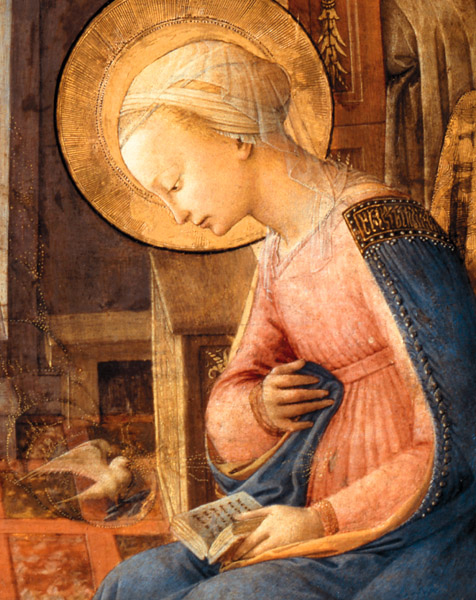
The Virgin Mary and the prophet Muhammad have a lot in common within their respective Christian and Islamic traditions, according to author Mary Joan Winn Leith. Photo: Detail of Fra Filippo Lippi’s “The Annunciation,” courtesy National Gallery, London.
With another Christmas season upon us and Christmas carols in the air, I am struck anew at how much, within their respective traditions, the Virgin Mary and the prophet Muhammad have in common. I hasten to note that I am not suggesting that Mary and Muhammad are of equal importance in their traditions—just that there are some interesting commonalities; and, of course, both Islam and Christianity honor Mary as the virgin who miraculously conceived and gave birth to Jesus, but I want to pursue a different angle here.
The similarities I have in mind first occurred to me when I was teaching the Qur’an’s Sura 97 (al-Qadr, “Destiny”). This is the Sura that extolls the holiest night of the Muslim calendar, the Laylat al-Qadr (Night of Destiny) when Muhammad received the first revelation of the Qur’an. The connection I see between Mary and Muhammad centers on the significance of the Word of God in Christianity, Islam and Judaism. Basic to all three religious traditions is the understanding that God, impelled by compassion, reveals to humans the way to salvation. The traditions use different theological terminology (redemption, salvation, eternal life, etc.), but in essence, God’s revelation gives humans the knowledge and means to overcome the sorrow, pain and death that constitute the human condition. All three traditions describe this revelation as the Word of God.

FREE ebook: Islam in the Ancient World. Explore Islam’s biblical history and sites.
From the Jewish and Muslim perspective, this is quite straightforward. Both the Torah, given by God to Moses on Mt. Sinai, and the Qur’an, disclosed by God in visions to Muhammad, are literally words from God. The Christian revelation is also the Word of God, but in Christianity the Word of God happens not to be a text but a person—Jesus. For example, the Gospel of John famously opens with the explanation, “In the beginning was the Word, and the Word was with God, and the Word was God … and the Word became flesh and dwelt among us” (John 1:1, 14). For Christians, Jesus is the “Word” that became flesh, or, to use another Christian term, Jesus is the “incarnation” (the “enfleshment”) of God. In a very real sense, then, both Mary and Muhammad are the mediators, the “middle person” (“middleman” doesn’t work here) between God and humanity.
Both are the bearers of a message from God that cannot be delivered to humans on earth without the agency of a human body. Mary literally bears the Word of God in her womb and—to use the archaic sense of the word—Mary is “delivered” of the Word of God when she gives birth to Jesus. Similarly, the earthly human capacity for hearing and speech allows Muhammad to bear and deliver the Word of God to the people of Mecca and Medina. It is significant, I think, that neither “deliverer” is considered to be divine, yet, from the earliest centuries of their respective religions, each was accorded a unique status hovering in the liminal area between human and divine.

FREE ebook: The First Christmas: The Story of Jesus’ Birth in History and Tradition. Download now.

In a detail of Jean Patinir’s “Rest on the Flight to Egypt,” the farmer, the soldiers and both the bare and the wheat-filled field are seen. The soldiers, looking for Mary, Joseph and the baby Jesus, believed no one was hiding in the wheat-filled field.
Because Mary and Muhammad in their roles as mediators by definition experienced a direct encounter with the divine, both faiths came to believe that they must have enjoyed an exceptional degree of purity. Mary’s purity of course, is her virginity, a physical state which Christians, under the influence of Greco-Roman thought, associated with spiritual perfection and sinlessness. As for Muhammad, his purity had nothing to do with sexuality; after all, he married a number of wives, including even some widows. Muhammad’s exceptional purity has to do with knowledge, which initially may seem to be a peculiar form of purity. However, it is an article of faith in Islam that the words of the Qur’an are God’s, not Muhammad’s, and the proof of this among Muslims is the conviction that Muhammad could not read or write; he was, so to speak, a virgin from the point of view of education. No human father contributed to the incarnation of Jesus, and no human artistry had any role in the creation of the Qur’an.
Beyond the complexities of theology and belief, surprisingly similar legends—neither story is in the Bible or the Qur’an—arose around Mary and Muhammad stemming from the fact that both had to flee for their lives. According to medieval tradition, as Mary, Joseph and the baby Jesus fled from King Herod barely ahead of his soldiers, they came upon a farmer sowing his field. “Please don’t tell the soldiers you saw anyone come by,” they begged. The farmer, however, was too frightened to help them. When the soldiers arrived and asked whether the farmer had seen the fugitives, the farmer told the truth; “I saw them as I was sowing this field.” The soldiers, seeing the field, turned back. The wheat field was ready for harvest so they concluded that no one could have passed by anytime recently (see image above). Muhammad had to elude Meccan authorities who wanted to prevent him from making the Hijra (emigration) to Medina where he would found the first fully Muslim community (and whose date serves as the zero point on the Muslim calendar). Muslims love to tell the story of Muhammad and his companion Abu Bakr who had scarcely entered a cave to hide when the Meccans rode up. Having inspected the cave entrance, the pursuers rode on; the huge spider web across the mouth of the cave told them that no one had entered it in years.

This illustration depicts the Muslim tradition of the “Miracle of the Cave,” when Muhammad and Abu Bakr hid in a cave to elude Meccan authorities during the Hijra. The spider webs covering the cave entrance led the authorities to believe no one was in the cave. Photo: Desmond Stewart, Early Islam (Great Ages of Man), (New York: Time, Inc., 1967).
Finally, let me return to the Christmas carols and to Sura 97 that I mentioned at the start of this essay. Consider these lines from “Silent Night”:
Silent night, Holy Night
All is calm, all is bright…
Sleep in heavenly peace…
Heavenly hosts sing alleluia.
Or these from “Little Town of Bethlehem”:
Oh Little Town of Bethlehem, how still we see thee lie…
But in those dark streets shineth the everlasting light
The hopes and fears of all the years are met in thee tonight.
Here is how the Qur’an describes the Night of Destiny:
Lo! We revealed it on the Night of Destiny.
Ah, what will convey unto thee what the Night of Destiny is!
The Night of Destiny is better than a thousand months.
The angels and the Spirit descend therein, by the permission of their Lord, with all decrees.
(The night is) Peace until the rising of the dawn.
The peace of the season to all!
 Mary Joan Winn Leith is chair of the department of religious studies at Stonehill College in Easton, Massachusetts. At Stonehill, she teaches courses on the Bible and the religion, history and culture of the Ancient Near East and Greece. In addition, she offers a popular course on the Virgin Mary. Leith is a regular Biblical Views columnist for Biblical Archaeology Review.
This Bible History Daily article was originally published on December 16, 2014.
Related reading in Bible History Daily:
Is the Earliest Image of the Virgin Mary in the Dura-Europos Church?
Mary, Simeon or Anna: Who First Recognized Jesus as Messiah?
Related Posts

Mar 8
Deborah in the Bible


Mar 5
Tabitha in the Bible

Must-Read Free eBooks
Want more Bible history?
Sign up to receive our email newsletter and never miss an update.
Unlock Unlimited Access to the Bible's Past

Unlock Unlimited Access to the Bible's Past
Become an All-Access Member to explore the Bible's rich history. Get Biblical Archaeology Review in print, full online access, and FREE online talks. Plus, enjoy special Travel/Study discounts. Don't miss out—begin your journey today!

It is surat ‘AlQadr’ ‘ the night of the Destiny’ and not surat ‘Al Qadir’ as Ahmed said. I am an arab and I speak and read arabic and I checked my own arabic version of the Qur’an before writing. This is an excellent article and it opens new perspectives especially that the Qur’an praises marie the mother of Issa (Jesus) in many surates. My remarks to Helen 12 is that historically muslims out of arabia and conquerering the middle east where considered as a newly christian sect by the conquered roman christian, arabic christian or jewish population and the first encounter of muslims with the true idea of Jihad was in their admiration of the European knights leaving their lands to fight and die for God so far away from their families. So believe me no religion has the monopole of violence.
1 Timothy 2:5 “For there is one God, and one mediator between God and men, the man Christ Jesus;” Not Mohammed nor Mary who are both in their graves where the scriptures tell us “the dead know nothing.”
Beautiful article, some see with His/Her light! I am Muslim by faith and we are told to make no distinction amongst the Prophets, of whom I believe Mary was one. Peace, Love and Light to all
Where do they find you people?? It would be refreshing to read articles written by people who actually read and know The Holy Bible aka: “The Word of God” which is Jesus, Elohim, LORD, Christ, Father, ……………
Try reading Genisis then Hebrews so you can determine the differences and why religion/law/Ishmael was separated by God from Promise/Truth and Grace/relationship/Isaac. You obviously speak/write what you have been told or taught by religious man, not by Who you should know. Jesus said “I am The Way, The Truth and The Life, no way to the Father but by Me”. Try and line that one up in the qwrong. Do you even know what they say about Jesus??
Degrees, titles and position are not entitlement, nor revelation to the Truth.
Couple of false assumptions made here- Quran is the word God- I am certain that if it was Gabriel who met with Mohammad to give revelation from God he wouldn’t contradict the teachings of Jesus. At the least he wouldn’t tell Mohammad that Jesus did not die but Allah made Him look like He was dead.
There are credible biographies and traditions from Muslim sources to know of the life of Mohammad. If as a historian the writer can’t tell the difference between the lives of these two, we can’t help but doubt the credibility and intentions of the writer.
These comments are way off base! I thought it was a decent article. I give two it points out of three.
The first point: Ok, yes, they were both conduits for divine communication, but that is common to many legendary, heroic and religious figures — noteworthy, but not indicative of a special connection. Half.
The second: Very interesting because it involves narrative details. Definitely a similarity there — a “trope” if you will. Call it the “they couldn’t possibly hide in there” trope. This is significant because narrative commonalities imply cultural connections. One.
The third: I see the connection as being that there are holy nights in each tradition, not so much in the language and imagery of the songs; and what similarities they may have are a result of that connection. Nor do I see those connections as being particularly associated with Mary and Mohammad. Half.
So I think the article is good basically. Whatever connection they do have, it is indicative of larger set of deeper connections between the two traditions. That’s the point.
Mohammad and the Virgin Mary? Sound like unlikely bedfellows to me.
On second thought, if Christ and Mohammad are both descended from Abraham, they are indeed cousins, but thru Christ’s father rather than his mother, I question.
To get away from all the pietistic harping and go back to the content of the article — it would have been even more interesting if the author had added the Jewish/Toraitic POV and further developed the comparison of the powerful revelation at midnight by including more of Moses and the Torah on Mt. Sinai. Moses too was a mediator of the divine word, was also rendered ritually pure in order to meet with God, and earlier in his life had to flee from danger to escape the wrath of Pharaoh for his role in God’s act of liberating Israel. Many of the later midrashic stories about the night of revelation also parallel those having to do with Jesus’ birth and Muhammed’s reception of the Qur’an.
God and Allah are different… The Holy Bible and Qur’an are not the same