


Lilith in the Bible and Mythology
Connections between Lilith, Adam’s first wife, and Jadis, the White Witch of Narnia

C.S. Lewis’s character Jadis, the White Witch of Narnia, in his The Chronicles of Narnia novels is said to have descended from Lilith, Adam’s first wife. Pictured here is Tilda Swinton as Jadis, the White Witch of Narnia, in the film adaptation The Chronicles of Narnia: The Lion, the Witch and the Wardrobe (2005).
C.S. Lewis, one of the most beloved authors of the 20th century, created a magical, fictional world called Narnia. The primary villain of the first book of this series, The Lion, the Witch, and the Wardrobe, is Jadis, the White Witch. Below is the character Edmund’s description of the White Witch when he first meets her:
A great lady, taller than any woman that Edmund had ever seen. She also was covered in white fur up to her throat and held a long straight golden wand in her right hand and wore a golden crown on her head. Her face was white—not merely pale, but white like snow or paper or icing-sugar, except for her very red mouth. It was a beautiful face in other respects, but proud and cold and stern.
(The Lion, the Witch, and the Wardrobe)
Jadis, the White Witch, is beautiful—and terrifying. Although she looks like a human, she is not. According to the character Mr. Beaver, the White Witch was descended from Lilith, Adam’s first wife, on one side and from giants on the other.
Who is Lilith? Is there any warrant for calling Lilith Adam’s first wife, or is this just the baseless chatter of woodland creatures? Are there appearances of Lilith in the Bible?
Dan Ben-Amos, Professor of Folklore and Asian and Middle Eastern Studies at the University of Pennsylvania, explores the figure of Lilith in the Bible and mythology in his article “From Eden to Ednah—Lilith in the Garden” in the May/June 2016 issue of Biblical Archaeology Review. His analysis shows that Lilith is an intriguing figure who has taken on many shapes over the millennia. From this, we see that Jadis, the White Witch, shares more than just lineage with her supposed ancestor.
FREE ebook: Exploring Genesis: The Bible’s Ancient Traditions in Context Mesopotamian creation myths, Joseph’s relationship with Egyptian temple practices and 3 tales of Ur, the birthplace of Abraham.
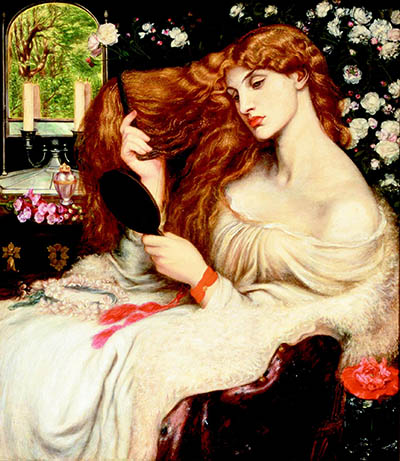
Who is Lilith: Beauty or horror? English painter Dante Gabriel Rossetti’s Lady Lilith (1866–68; altered 1872–73) depicts Lilith, Adam’s first wife, as a beautiful woman. Who is Lilith? According to Rossetti’s interpretation, she was a beauty. Photo: Delaware Art Museum
Lilith is first mentioned in ancient Babylonian texts as a class of winged female demons that attacks pregnant women and infants. From Babylonia, the legend of “the lilith” spread to ancient Anatolia, Syria, Israel, Egypt and Greece. In this guise—as a wilderness demoness—she appears in Isaiah 34:14 among a list of nocturnal creatures who will haunt the destroyed Kingdom of Edom. This is her only mention in the Bible, but her legend continued to grow in ancient Judaism.
During the Middle Ages, Jewish sources began to claim her as Adam’s first—and terrifying—wife. How did Lilith evolve from being a wilderness demoness to Adam’s first wife?
Interestingly enough, this story begins at the beginning—in Genesis 1.
The creation of humans is described in Genesis 1 and in Genesis 2. The first account is fairly straightforward: “So God created humankind in his image, in the image of God he created them; male and female he created them” (Genesis 1:27). The second account describes how God formed man out of the dust of the ground and then creates woman from the man: “Then the Lord God formed man from the dust of the ground, and breathed into his nostrils the breath of life; and the man became a living being. … So the Lord God caused a deep sleep to fall upon the man, and he slept; then he took one of his ribs and closed up its place with flesh. And the rib that the Lord God had taken from the man he made into a woman and brought her to the man” (Genesis 2:7, 21–22).
In the post-Biblical period, some ancient Jewish scholars took the stance that Genesis 1:27 and Genesis 2:21–22 must describe two separate events, since it appears that woman is created differently in these accounts. In her Bible Review article “Lilith” in the October 2001 issue, Professor Janet Howe Gaines explains this reasoning: “Considering every word of the Bible to be accurate and sacred, commentators needed a midrash or story to explain the disparity in the creation narratives of Genesis 1 and 2. God creates woman twice—once with man, once from man’s rib—so there must have been two women. The Bible names the second woman Eve; Lilith was identified as the first in order to complete the story.” Accordingly, Genesis 1:27 describes the creation of Adam and an unnamed woman (Lilith); Genesis 2:7 gives more details of Adam’s creation; and Genesis 2:21–22 describes the creation of Eve from Adam.

Who is Lilith: Beauty or horror? This Aramaic incantation bowl depicts Lilith as a demoness. A text that mentions Lilith and other evil spirits is written on the inside of the bowl in spiral concentric circles. Incantation bowls were meant to both capture and repel evil spirits. Who is Lilith? According to this representation, which is more consistent with the appearance of “the lilith” in the Bible, she was a horror. Photo: Courtesy V. Klagsbald, Jerusalem
Lilith’s creation is recounted in The Tales of Ben Sira, an apocryphal work from the tenth century C.E. Dan Ben-Amos explains that although this is the first extant text that records the legend of Lilith, her story probably existed earlier:
[Lilith’s] story seems to hover at the edges of literacy with sporadic references. … [I]n the post-Biblical period, the sages identify the lilith several times, not by name, but as “the First Eve,” indicating that her full story was well known in oral tradition, yet barred from the canonized Biblical text. Finally, in the tenth century C.E. in Babylon, an anonymous writer, who was not bound by normative traditional principles and who included in his book some other sexually explicit tales, spelled out the lilith’s adventures in paradise.
The Tales of Ben Sira relates that God created Lilith from the earth, just as he had created Adam. They immediately began fighting because neither would submit to the other. Recognizing that Adam would not listen to her, Lilith “pronounced the Ineffable Name and flew away into the air” (The Tales of Ben Sira). The angels Snvi, Snsvi and Smnglof were sent to pursue Lilith, but when they reached her, she refused to return with them to the Garden of Eden. “‘Leave me!’ she said. ‘I was created only to cause sickness to infants. If the infant is male, I have dominion over him for eight days after his birth, and if female, for twenty days’” (The Tales of Ben Sira). As a compromise, she promised that whenever she saw the angels’ names or forms on amulets, she would leave the child alone. She also agreed that 100 of her children—demons—would die every day.
Our website, blog and email newsletter are a crucial part of Biblical Archaeology Society's nonprofit educational mission
This costs substantial money and resources, but we don't charge a cent to you to cover any of those expenses.
If you'd like to help make it possible for us to continue Bible History Daily, BiblicalArchaeology.org, and our email newsletter please donate. Even $5 helps:

Janet Howe Gaines expounds the severity of Lilith’s sin and its consequences as described in the The Tales of Ben Sira:
Lilith sins by impudently uttering the sacred syllables, thereby demonstrating to a medieval audience her unworthiness to reside in Paradise. So Lilith flies away, having gained power to do so by pronouncing God’s avowed name. Though made of the earth, she is not earthbound. Her dramatic departure reestablishes for a new generation Lilith’s supernatural character as a winged devil.
Gaines also explains Lilith’s hatred for human babies: “Ben Sira’s story suggests that Lilith is driven to kill babies in retaliation for Adam’s mistreatment and God’s insistence on slaying 100 of her progeny daily.”
To learn more about Biblical women with slighted traditions, take a look at the Bible History Daily feature Scandalous Women in the Bible, which includes articles on Lilith, Mary Magdalene and Jezebel.
The Lilith legend continued to grow and change over the following centuries, which is reflected in various artistic depictions of her. While some portrayed Lilith as a beautiful woman, others showed her in a more sinister light. Some even depicted her as the serpent in the Garden of Eden who convinced Eve to eat the forbidden fruit.
Jadis, the White Witch of Narnia, shares similarities with Lilith. Not only are both of them strong, terrifying women, but they also seem bent on destroying human life. Both wield dark magic and are immortal beings. As revealed in C.S. Lewis’s The Magician’s Nephew, Jadis gains immortality by eating a silver apple inside a walled garden in Narnia. This episode has some obvious connections to the account of the Garden of Eden in the Bible. Additionally, both pronounce an ineffable word and suffer dire consequences as a result. The Magician’s Nephew tells how Jadis—before she became the White Witch—pronounced the Deplorable Word, which killed every living thing in her world, Charn, except for herself. So great was her desire for power and her refusal to submit, she spoke the Deplorable Word—knowing full well that it would kill every living person and thing in her world—rather than surrender her claim to the throne of Charn. These examples demonstrate that the character Jadis bears both the blood and the character of her foremother Lilith.
From demoness to Adam’s first wife, Lilith is a terrifying force. To learn more about Lilith in the Bible and mythology, read Dan Ben-Amos’s full article—“From Eden to Ednah—Lilith in the Garden”—in the May/June 2016 issue of Biblical Archaeology Review.
BAS Library Members: Read the full article “From Eden to Ednah—Lilith in the Garden” by Dan Ben-Amos in the May/June 2016 issue of Biblical Archaeology Review.
Not a BAS Library or All-Access Member yet? Join today.
This Bible History Daily feature was originally published on May 2, 2016.
Related reading in Bible History Daily
All-Access members, read more in the BAS Library
Not a BAS Library or All-Access Member yet? Join today.
Related Posts



Must-Read Free eBooks
Want more Bible history?
Sign up to receive our email newsletter and never miss an update.
Unlock Unlimited Access to the Bible's Past

Unlock Unlimited Access to the Bible's Past
Become an All-Access Member to explore the Bible's rich history. Get Biblical Archaeology Review in print, full online access, and FREE online talks. Plus, enjoy special Travel/Study discounts. Don't miss out—begin your journey today!

To all of you people out there freaking out about the mythological character of Lilith, understand you look childish.
It’s just an article that is exploring who this mythological persona is, her origins, and how it influenced people’s interpretations throughout millenia. It’s no big deal. Also, midrashic literature was not always a strictly literal process. Often times, it was intended to be interpreted as fables with a greater truth. These rabbis, scholars, and writers understood that it was the deeper meaning of parable that revealed more truth than anything. Did all of them believe she was real? Probably not. There were people of all stripes that used this folklore for rhetorical reasons just as one might find a teacher making an allegorical reference to Rumpelstiltskin.
The writer of the article never claims that Lilith is even in Genesis! They are just examining various fables throughout history.
Honestly, just because BAR does not tell you that literally every single thing that you want to be told, that does not mean it is not academic. You are allowed to have your theology just as I have my own theology. Go haunt some underground webpage of loons that post that they have found the Ark of the Covenant and etc.
Academia does not have to bow to every single fundamentalists’ theology. If your feelings are hurt, go somewhere else.
Exactly. The ones who comment here are mostly Christians and don’t understand this. They take everything literally.
I actually saw an old bible and read the story of Lilith in there, not just a curtain call about her. I only wish I knew the version (in old English). It was a friend’s family heirloom passed down several generations. I no longer know where this friend is at so I can’t get that info. But she invited me to read the story of Lilith from her family bible (a very large and very old copy). Strange, no one seems to mention that the Lilith story, which I read in full, is in some older version(s) of the bible.
The fact that God said all was good means sin had to enter the world. Genesis is very clear how that happened, disobedience. Eve was coaxed by the lying serpent into eating the forbidden fruit. Satin was cast out of heaven and given reign over the earth. .. so he had to cause sin in order to start his kingdom on earth to try to control humanity through out history, through empires, money, and food to devour as many souls as he can before Gods kingdom comes back to reign and ends his existence. Stick to the big picture of the gospel. Make disciples. That is our job as Christian believers, not to get caught up in fables and myths. The word of God the is infalable and more sure than the audible voice of God. It is true and can not be proven wrong. I agree that God will reveal all in his own time to our puny minds.
I am an avid learner of many things, and I have always said: There is a piece of the truth in every religion/faith. It is up to us to find it, pull it out and place it into a larger picture until we have the whole.
A Midrash is needed, to explain away every perceived discrepancy in the Tanakh. Lilith was piggybacked upon the two Genesis accounts, because she was already created in the mythos of the Age, was convenient, was available, and was known, at the time —
And, yes — Including her, was entirely logical —
For the cultural context, of the time.
From clay and spittle, Are we all Created. And Jesus Formed a New Seeing, From but clay, and the spittle of His mouth…
Just add, bubbling water.
We come from the clay…We return to the clay. What is required yet, To Bring Forth the Miracle of Life From the formed elements of the earth, is the spittle. And the spittle, is the Water; is the Breath; is the Fire…
And the Spirit, Descends As a Star, and Enters, Therein.
It is far easier to bring Lilith into the mix, then to fully deal with what is really meant by Adam’s rib.
The clay vessel, the carved rock, is the womb. What is placed in the clay vessel, is…
You get the idea.
But from inert, dead elements?
Comes Forth, the Miracle of the New Life!
The Star, Has Returned…
The analogy to Ishtar, cannot be overlooked.
You will not find this in any book, or on any webpage…
I will have to write it, I guess…
But if you were versed in the hidden iconography of Renaissance paintings?
You would be able to locate the bent-rimmed Cup, Hidden Within almost all of these paintings — Especially, the latter ones. And Within the Cup, To the Right Side of it, you always spot the head and the torso of the newborn, smiling babe, who is looking right at you. The Cup, Is the Vessel, Is the Womb, Is the Stone Formed, Is the Ark.
And a Moshe — A New Adam, Hidden Within — Is Always the Result.
Anyway; if you want a society, where the male has full dominion over the female?
Then the rib story, is far more attractive to you, than is the version of the story where they were both created equal and simultaneously, albeit with the male being mentioned first, in contraindication to what some other cultures of the time believed.
The moon, was male. The sun, the moon’s offspring, was male also, initially.
Think of Abram and Sarai, his sister-bride. They are, essentially, reflections of what was happening in the Heavens above Ur…
And they are treated, more-or-less equally, in the narrative.
YHWH Talks To Abram, first. But YHWH Also Overhears, and Speaks To, Sarai. YHWH Has Included her, As an equal To Abram, within the narrative.
The wife, is hardly spoken to, or acknowledged by the stranger…
But YHWH, In Doing So?
Has Elevated her Back Up, in man’s world, To her Equality of Origin.
At least, Within YHWH’s Eyes…
YHWH and Shekinah, Are the Complements, of Hashem. Two Sides, To One Face. Like the Kisseh, of the Cherubim, Above the Ark…
United, As One. Just as Adam, includes Eve…
And Eve, includes Adam.
The rib?
It Is Meant To Show, To the Discerning, that male and female — Female, and male — YHWH Himself; Shekinah, herself; Creates them…
And a man, and a woman?
They can only guess, as to the eventual outcome, of the Miracle of the clay (feminine), the spittle (masculine), and the Star Come Down (Spirit), Combining Into One.
You want a Trinity?
There, Right In the Beginning, Is your First Trinity. For From the Very Beginning, Has He, has She, Known you…
There was only one man and one woman in the garden of Eden. Adam and Eve. Eve was made from Adams DNA. The sin in the garden was Satan(tree of knowledge) seduced Eve which produced eve having fraternal twins Cain(Satan’s) and Abel(Adams). The 8th day creation was a completely different man ETH Adam which Jesus Christ would come from this blood line. Saying Lilith was in the garden or Adams first wife is nothing but mythology definitely not from God’s word.
We don’t want to believe in all this but there’s a proof who did Cain marry ?? If Adam and Eve where the first humans on earth and Cain became a wanderer why was he scared people will kill him who where those people??. Now we are not doubting God nor is our faith wavering we just want to know the complete story. Evrr et n if Lilith is a myth the Bible prove there where other humans on earth not only Adam and Eve
I highly recommend everyone to listen to a great biblical scholar Arnold Murray and Dennis Murray from the Shepard’s Chapel. If you have Dish network its on 24 hours a day 7 days a week. Channel 256 Dish. The Shepard’s chapel doesn’t have a Facebook page or anything affiliated with the computer only Shepard’s chapel.com.
Mellissa, “God’s word” is a collection of books, the inclusion of which was decided upon by a number of highly corrupt Popes, so entrenched in their own politiical gain at the time, that educated person must question it. Other dogma subscribed to by the church of the time have generated from people who were canonised by the same said Pope’s and have no mention in “God’s word” at !. For instance the the idea of purgatory which has now very recently been quwashed, it having been a concept that placed the fear of Hell into people so much so in times past, they paid the church to pray their dead relations out of purgatory!!! Where was that in “God’s word”? There are so many anomolies is this randomly collected set of texts and so many other texts disgarded or considered apocrophyl. The more you educate yourself about the history of what is considered “God’s word” the more you realise that the corruption of man make blind faith to that collection not just unwise but impossible. We were not created in the image of God to go about refusing to use the questioning enquiring minds that God gave us!!! Hence my choice to move from Chrisianity to Buddhism.
Not to mention that Christians mistranslated and corrupted Jewish texts. Christians don’t seem to realize that much of the bible is allegorical.
I can’t definitively say yes or no to anything in the bible, except God and Jesus are real (and truth). You’re right in saying, it is our duty to question and search for the truth about everything in our lives. I seldom agree completely with beliefs of my own religion, so I can’t really agree nor disagree completely with anyone. I do follow a few in my path to the truth. I have heard a few rabbis that made quite an impact on me and Rev. Joseph Prince does as well. I’m sure my search will reveal more as the years go by.
Marty
I appreciate history and interesting points of view. I perceive Mythology and Religion as Studies in Truth.