


Jesus Was a Refugee
Jesus the refugee child in the Gospel of Matthew
Joan E. Taylor
January 25, 2026
76 Comments
63835 views
“Jesus Was a Refugee” was originally published on The Jesus Blog. It is republished here with permission.—Ed.
The unstoppable force of refugees fleeing to Europe has in various places hit the immovable object of an attitude that there is no room at the inn. Spaces are filled. Migrants should be kept out, in order to preserve jobs, health and welfare services. In an environment of austerity, where economic cuts have hit people hard, this cold-heartedness in part derives from a deep sense of insecurity.
At this time it is worth remembering that Jesus of Nazareth is in the Bible presented exactly as one that would be rejected by such European countries: a refugee child.

Woodcut from Die Bibel in Bildern (1860) by Julius Schnorr von Carolsfeld.
In the Gospel of Matthew, Jesus’ (adoptive) father, Joseph, and mother, Mary, live in Bethlehem, a town in Judaea near Jerusalem. It is assumed to be their home village. Certain magoi (“wise men”/astrologers) come from “the East” to Herod, the Roman client king of Judaea, looking to honor a new ruler they have determined by a “star,” and Jesus is identified as the one. All this is bad news to Herod, and Herod acts in a pre-emptive strike against the people of Bethlehem and its environs. He kills all boys under two years of age in an atrocity that is traditionally known as “the massacre of the innocents” (Matthew 2.16–18).
But Joseph has been warned beforehand in a dream of Herod’s intentions to kill little Jesus, and the family flees to Egypt. It is not until Herod is dead that Joseph and Mary dare return, and then they avoid Judaea: Joseph “was afraid to go there” (Matthew 2.22) because Herod’s son is in charge. Instead they find a new place of refuge, in Nazareth of Galilee, far from Bethlehem.
Jesus’ earliest years were then, according to the Gospel of Matthew, spent as a refugee in a foreign land, and then as a displaced person in a village a long way from his family’s original home.
FREE ebook, Who Was Jesus? Exploring the History of Jesus’ Life. Examine fundamental questions about Jesus of Nazareth.
Scholars of the historical Jesus can be suspicious of this account, as also with the other nativity account in the Gospel of Luke 1–2. It is clearly constructed with allusions to Jesus as a kind of Moses figure: just as Moses was under threat from an evil Pharaoh who killed children (Exodus 1–2), so was Jesus. But while resonances with the scriptural precedent are intended, there is no real need for the author to invent the idea of Jesus being a refugee child somewhere in Egypt to have him being Moses-like. There is a quote, “Out of Egypt I called my son” (Hosea 11.1), in Matthew 2.15, but the “son” concerned is historical Israel, not Moses and not the Messiah, and it sits uncomfortably with the story. The author of Matthew did not need to build a myth out of such a text.
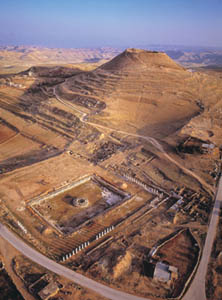
King Herod the Great began construction at Herodium in 28–27 B.C.E. Photo: Duby Tal.
It seems not then unlikely to me that Jesus’ family, with a lineage traced to the great king David (Matthew 1; Luke 3.23–38; Romans 1.3; 15.12), opted to flee from Bethlehem, long-standing residence of the kingly line and their original home. In many traditional societies, such locations of clans are maintained, even with social disruptions. Archaeology has shown how Herod built a palace complex at Herodium, including his future mausoleum, nicely overlooking the town of Bethlehem. It was as if Herod was breathing down Bethlehem’s neck.
The first-century Jewish historian Josephus portrays Herod as paranoid about any possible threat to his rule. He killed his own sons and had few qualms about killing anyone else’s. As Augustus quipped, “I would rather be Herod’s pig than his son” (Macrobius, Saturnalia 2:4; since pigs are not butchered by Jews).
We know also that Jews fled from troubles in Judaea of many kinds in the third–first centuries B.C.E., and that Egypt was one of the places they went to as refugees. Josephus comments on the problematic revolutionaries (and their children) that fled there after the First Jewish Revolt (66–70 C.E.; Jewish War 7: 407–419), but they were following a well-worn path.
Many epitaphs and inscriptions, as well as historical sources, testify to a thriving Jewish expatriate community in Egypt made up of earlier refugees that could be joined by others. However, just like today, new refugees were not welcome. A letter of the emperor Claudius, written in 41 C.E., states that Jews in Alexandria lived in “a city not their own” in which they were “not to bring in or invite Jews who sail down to Alexandria from Syria[-Palaestina]” (P. London 1912; CPJ I:151).
Visit the historical Jesus study page in Bible History Daily to read more free articles on Jesus.
A remembrance of Jesus’ family in Egypt is preserved in Matariya, in the suburbs of Cairo at Heliopolis, a spot understood to be a stopping place on the holy family’s flight, and it is probably the most important site in the world for anyone wishing to contemplate Joseph, Mary and Jesus as refugees.
For new refugees, as anywhere, life would have been very hard. The first-century Jewish philosopher Philo of Alexandria tells us of the consequences of poverty, which could result in enslavement (Special Laws 2.82). Presumably, Jewish charity and voluntary giving through the synagogue would have helped a struggling refugee family, but they would also have been reliant on the kindness of strangers.
The legacy of being a refugee and a newcomer to a place far from home is something that I think informed Jesus’ teaching. When he set off on his mission, he took up the life of a displaced person with “nowhere to lay his head” (Matthew 8.20; Luke 9.58). He asked those who acted for him to go out without a bag or a change of clothing, essentially to walk along the road like destitute refugees who had suddenly fled, relying on the generosity and hospitality of ordinary people whose villages they entered (Mark 6.8–11; Matthew 10.9–11; Luke 9.3). It was the villagers’ welcome or not to such poor wanderers that showed what side they were on: “And if any place will not receive you and refuse to hear you, shake off the dust on your feet when you leave, for a testimony to them” (Mark 6.11).
“Jesus Was a Refugee” by Joan E. Taylor was first republished in Bible History Daily on May 12, 2016.
 Joan E. Taylor is Professor of Christian Origins and Second Temple Judaism at King’s College London. Her research interests include the New Testament and other early Christian texts; the historical figures of Jesus of Nazareth, John the Baptist, Mary Magdalene and other New Testament persons; Second Temple Judaism; and women and gender within early Judaism and Christianity. Dr. Taylor has received various awards and fellowships, including the Irene Levi-Sala Award in Israel’s archaeology for her book Christians and the Holy Places (Oxford: Clarendon, 1993, rev. 2003).
Related reading in Bible History Daily:
Become a BAS All-Access Member Now!
Read Biblical Archaeology Review online, explore 50 years of BAR, watch videos, attend talks, and more

Related Posts




Must-Read Free eBooks
Want more Bible history?
Sign up to receive our email newsletter and never miss an update.
Unlock Unlimited Access to the Bible's Past

Unlock Unlimited Access to the Bible's Past
Become an All-Access Member to explore the Bible's rich history. Get Biblical Archaeology Review in print, full online access, and FREE online talks. Plus, enjoy special Travel/Study discounts. Don't miss out—begin your journey today!

No comparison to present refugees all over the world.
My grand parents came from West Prussia. All people started in Africa and are all over the world.
With the gifts of the Magi – particularly the gold – I have wondered if that was the source of funds for the long stay in Egypt.
With the gifts of the Magi – particularly the gold – I have wondered if that was the source of funds for the long stay in Egypt.
What? refugee? He was the son of G-D . The earth is His and the fullness of it therof
As The other comment states,the gifts of the Magi !
What? refugee? He was the son of G-D . The earth is His and the fullness of it therof
As The other comment states,the gifts of the Magi !
Not only was Jesus a refugee, so were many in the young church especially following the retaking of Jerusalem and the destruction of the temple. The Gospel according to John speaks to this homelessness as John’s hearers/readers were assured that their home was in Jesus and that Jesus had prepared a place for them. 1 Peter begins by addressing the exiles in many places. Again in 2:11 he speaks of them as sojourners and exiles.
Not only was Jesus a refugee, so were many in the young church especially following the retaking of Jerusalem and the destruction of the temple. The Gospel according to John speaks to this homelessness as John’s hearers/readers were assured that their home was in Jesus and that Jesus had prepared a place for them. 1 Peter begins by addressing the exiles in many places. Again in 2:11 he speaks of them as sojourners and exiles.
2. I’m wondering how the disciple Matthew could not know Herod died some six plus years before the birth of Christ?
2. I’m wondering how the disciple Matthew could not know Herod died some six plus years before the birth of Christ?
Were Mary and Joseph eligible for low-income housing subsidies, subsidized medical care, food stamps, WIC payments, tax refund payouts to the poor, mandated free schooling, voting rights during their stay in Egypt?
Did Mary and Joseph join rape gangs and gangs of rioters?
Were they members of terror cells?
Can we have a BAR article on Jesus’ time in Egypt without making erroneous claims about contemporary political conditions (“unstoppable force,” “in order to preserve jobs” etc., “cold-heartedness”) in the modern west?