


Where Is Golgotha, Where Jesus Was Crucified?
Does the Church of the Redeemer hold the answer?
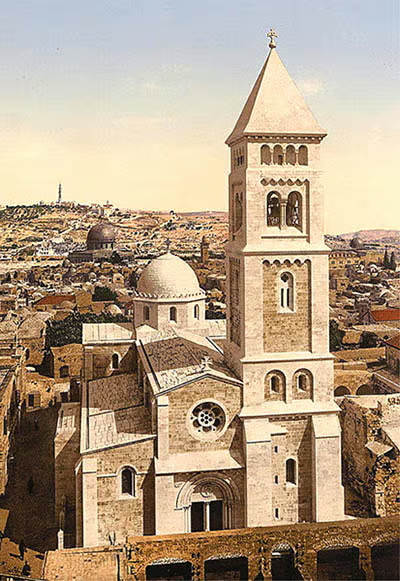
Does the Church of the Redeemer (pictured here) provide evidence that the Church of the Holy Sepulchre is the authentic site of Golgotha, where Jesus was crucified? Where is Golgotha today in Jerusalem?
According to the New Testament, Golgotha was the name of the site where Jesus was crucified. Where is Golgotha located in Jerusalem? In their Archaeological Views column “Golgotha: Is the Holy Sepulchre Church Authentic?” in the May/June 2016 issue of Biblical Archaeology Review, Marcel Serr and Dieter Vieweger discuss past and current investigations into the site where Jesus was crucified.
Where is Golgotha today? The exact location where Jesus was crucified is disputed. In the fourth century C.E., the Church of the Holy Sepulchre was built at the site of Golgotha as identified by Roman emperor Constantine’s mother, Helena. Scholars began to question this identification in the 19th century, however, since the Church of the Holy Sepulchre is inside the city walls of the present-day Old City of Jerusalem. Golgotha would have to have been located outside the city in accordance with Roman and Jewish customs of the time. The Gospels, too, seem to suggest that Jesus was crucified outside of the city (Mark 15:20; Matthew 27:31ff; John 19:17ff). So where is Golgotha located?
Easter: Exploring the Resurrection of Jesus
In this free eBook, expert Bible scholars offer in-depth reflections on the resurrection.
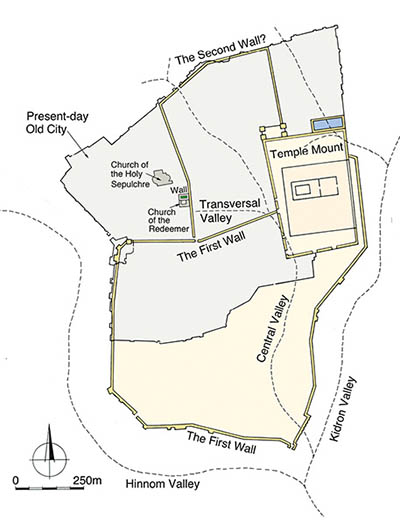
Where is Golgotha? Was the Church of the Holy Sepulchre, the traditional site where Jesus was crucified, located within or outside of the city walls when it was built in the fourth century C.E.? The drawing here depicts the present-day Old City of Jerusalem (shaded in gray) as well as the proposed location of the so-called Second Wall that would have stood during Jesus’ time. Drawing: Leen Ritmeyer.
It’s important to note that the current Old City walls are not the ones from Jesus’ time. As Serr and Vieweger note in their Archaeological Views column, “Efforts to find a so-called Second Wall south of the Holy Sepulchre Church that had served as the northern wall of Jerusalem in Jesus’ time (and would have moved the site of the church outside the city in Jesus’ time) proved elusive—although Josephus, the knowledgeable first-century Jewish historian, does refer to such a wall (The Jewish War 5.146).”
Eminent scholars Conrad Schick and Louis-Hugues Vincent thought they had found the Second Wall in 1893 when a wall was uncovered during the construction of the Church of the Redeemer just south of the Church of the Holy Sepulchre. For almost a century this seemed to solve the problem of authenticity—the Church of the Holy Sepulchre was located at Golgotha, where Jesus was crucified!
But in the 1970s, German archaeologist Ute Wagner-Lux of the German Protestant Institute of Archaeology in Jerusalem excavated under the Church of the Redeemer and determined that this wall could not have been the Second Wall. Why? “This wall was only five feet thick—far too narrow to be a city wall,” say Serr and Vieweger. So the search began anew.
Become a BAS All-Access Member Now!
Read Biblical Archaeology Review online, explore 50 years of BAR, watch videos, attend talks, and more

All was not lost, though. The excavations at the Church of the Redeemer do reveal clues that the Church of the Holy Sepulchre is located outside the elusive Second Wall.
To learn what evidence leads Serr and Vieweger to believe the Church of the Holy Sepulchre could be the authentic location of Golgotha, read their full Archaeological Views column “Golgotha: Is the Holy Sepulchre Church Authentic?” in the May/June 2016 issue of Biblical Archaeology Review.
BAS Library Members: Read the full Archaeological Views column “Golgotha: Is the Holy Sepulchre Church Authentic?” by Marcel Serr and Dieter Vieweger in the May/June 2016 issue of Biblical Archaeology Review.
Not a BAS Library or All-Access Member yet? Join today.
This Bible History Daily feature was originally published on May 23, 2016.
Related reading in Bible History Daily
Tour Showcases Remains of Herod’s Jerusalem Palace—Possible Site of the Trial of Jesus
The “Strange” Ending of the Gospel of Mark and Why It Makes All the Difference
All-Access members, read more in the BAS Library
Archaeological Views: Golgotha: Is the Holy Sepulchre Church Authentic?
Not a BAS Library or All-Access Member yet? Join today.
Our website, blog and email newsletter are a crucial part of Biblical Archaeology Society's nonprofit educational mission
This costs substantial money and resources, but we don't charge a cent to you to cover any of those expenses.
If you'd like to help make it possible for us to continue Bible History Daily, BiblicalArchaeology.org, and our email newsletter please donate. Even $5 helps:

Related Posts





Must-Read Free eBooks

Want more Bible history?
Sign up to receive our email newsletter and never miss an update.
Unlock Unlimited Access to the Bible's Past

Unlock Unlimited Access to the Bible's Past
Become an All-Access Member to explore the Bible's rich history. Get Biblical Archaeology Review in print, full online access, and FREE online talks. Plus, enjoy special Travel/Study discounts. Don't miss out—begin your journey today!

Another very interesting thread, although, I am not convinced that any tradition has this right because it seems very possible Gethsemene in Matthew and Mark is NOT the same place as the “garden” mentioned in John 18:1. The confusion is very understandable, since both places are just past Jerusalem’s eastern boundary and across the Kidron Brook. However, Messiah’s words in John 17 are clearly given indoors, whereas Matthew and Mark have the disciples sleeping outside just before the arrest, meaning the speech in John 14-17 comes first, then they go out singing the hallel psalms (115-118, usually done at Pesach), which in turn synchs up with Matthew 26:30-36 and the parrallel passages in Mark and Luke.
As a result, once they went out from the seder meal (and there is no doubt in my mind the Last Supper was just that) they probably stopped at Gethsemene first, then moved a little further to the garden in John and then Messiah got arrested. The confusion of several hundred yards between the two places may cause other issues when trying to locate Golgotha.
So for the Tomb of the Holy Sepulchre, the lower parts of the structure (where the public is not allowed) are loculi Jewish tombs, and their presence in that spot proves it was outside the city walls, since Torah prohibited them being inside. So yes Messiah’s tomb is within the church, but no, it’s not where the public goes inside the church. The real place of Golgotha no one is allowed to see.
I therefore think there is no “Garden OF Gethsemene” per se but merely an olive press in one place and a garden nearby but in another place.
Andrew Gabriel Roth
Translator of the Aramaic English New Testament
Frankly, I am surprised that professional archaeologists are still asking this question. This site was discovered more than twenty years ago. Amateur archaeologist Ron Wyatt also found evidence of crucifix posts holes in the rock in this area.
Actually Jesus’s was not crucified.the bible itself states that he was put upon an upright stake.
The Greek word generally translated “cross” is stau·rosʹ. It basically means “an upright pale or stake.” The Companion Bible points out: “[Stau·rosʹ] never means two pieces of timber placed across one another at any angle . . . There is nothing in the Greek of the [New Testament] even to imply two pieces of timber.” just to set this straight.thankyou for reading.
Maybe but there is plenty of evidence that many people were crucified on a T-looking thing. Also, doesnt it say that Jesus carried the t-bar portion which crossed it?
He was crucified. the gospel of Luke states they laid the cross on Simon so he could help him carry it. and Luke 23 verse 33 the bible states they crucified Him, so somebody is missing this. they put nails in both his hands and feet.
I been to the Church of the Holy Sepulchre, it’s the cheapest place I’ve ever been in. Why was the Garden Tomb not mentioned. It matches the description in the Bible perfectly.
Juniper says
I think that America will never be great agian untill we put God first
Why isn’t the Garden Tomb ever discussed as the burial place of Jesus? Anyone who has seen this site and the caves on the outside facing the bus station can’t help but think tis could be the location. The question I have is has this area changed at all since 33 AD? If not this could well be the correct location. It is on the road to Damascus and in full view of everyone in the area at that time which is what the Romans would of done.
The garden tomb has been proven to be much later than Jesus time. That’s why it’s not been taken seriously.
But the church of the holy sepulchre sure doesn’t seem like the right spot, but maybe it is.
The Garden Tomb is not considered a legitimate site, since it has no historical evidence for it. (Someone looked over in the 19th century and said, “That looks like a skull!” Not accounting for 1800 years of erosion on the hill side of course.) The Church of the Holy Sepulcher does. In fact, it’s not that Helena claimed the site, its more accurate to say that the 4th century Bishop of Jerusalem told Constantine of it and asked to dig there (under a Roman temple put up in the 2nd century). He said it was put on top of the empty tomb/ Golgotha. They dug down and found empty tombs, one of which matched the description in John. (Helena then claimed to find the cross there.) Protestants, like myself, may not find the decor appealing, but the location is most likely accurate.
I just had an amazing read, and I just can’t understand if it’s actually even possible, but I think I just got an inside look at the cross of Golgotha, or actually parts of it burried in a church in Finland, city of Rauma.
Anyone who’s been to Jerusalem, while the Garden Tomb does fit some of the brief description in John’s Gospel, knows that the Church of the Holy Sepulchre is the oldest place attested to by tradition. It is doubtful that when Helena, Constantine’s mother, would have gotten something as significant as the place for the death, burial and resurrection of Jesus–wrong. However, remember, as most of us believe–He Is Risen and the tomb is empty; no matter where you believe it to be.