


Water from a Walking Rock
What does Paul mean in 1 Corinthians 10:4?
“… For they drank from the spiritual rock that followed them, and the rock was Christ.”
—1 Corinthians 10:4

A WALKING ROCK IN THE DESERT. A walking rock, sailing stone, moving rock or sliding rock are all names for a rock that moves along a smooth valley floor without the assistance of humans or animals. What does Paul mean in the Bible when he talks about the “spiritual rock that followed” the Israelites during their wanderings in the wilderness? Is he talking about a walking rock? No—the natural phenomenon of a walking rock is very different than the miraculous water-giving rock mentioned in 1 Corinthians 10:4. Photo: Lgcharlot’s is licensed under CC-by-SA-4.0
What does Paul mean in the Bible when he says that the Israelites drank “from the spiritual rock that followed them” during their wanderings in the wilderness?
Paul makes this claim—in 1 Corinthians 10:4—while recounting how the Israelites were sustained in the wilderness after their dramatic Exodus from Egypt before they entered the Promised Land. They “all ate the same spiritual food” and “drank the same spiritual drink” (1 Corinthians 10:3–4).
Those familiar with the Hebrew Bible (Old Testament) might stop and wonder: What does Paul mean? In the Bible, it says that the Israelites miraculously received water from a rock two times (Exodus 17:1–7 and Numbers 20:1–14). Both times Moses hit the rock, which then produced water, but the text never claims that the Israelites were followed by a water-giving rock. Therefore, what does Paul mean in 1 Corinthians 10:4?
John Byron examines this passage in his Biblical Views column “Paul, Jesus and the Rolling Stone” in the September/October 2015 issue of BAR.
Byron notes that, interestingly, Paul is not the only person to suggest that the Israelites were followed by a water source during their wilderness wanderings. A first-century C.E. source called Pseudo-Philo’s Biblical Antiquities makes a similar claim: “But as for his own people, he led them forth into the wilderness: Forty years did he rain bread from heaven for them, and he brought them quails from the sea, and a well of water following them” (10.7).
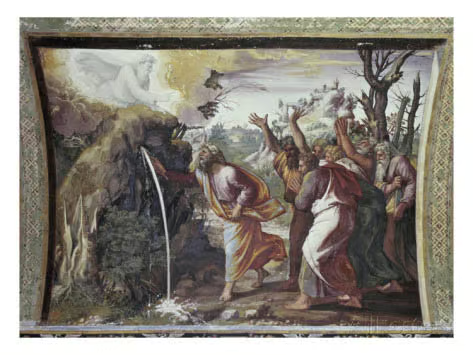
MOSES HIT THE ROCK, and water gushed forth—as depicted in this fresco by Raphael Sanzio. Did a water-giving rock follow the Israelites through the wilderness? If not, what does Paul mean in 1 Corinthians 10:4?
Pseudo-Philo claims that a well of water followed the Israelites through the wilderness, whereas in 1 Corinthians 10:4, Paul says that it was a rock that followed them. How did these two ancient interpreters come to their conclusions?
“What they seem to have concluded,” Byron explains, “is that since Moses named both the rock at Rephidim (Exodus 17:7) and the one at Kadesh (Numbers 20:13) ‘Meribah,’ the logical conclusion was that both were one and the same rock and that it, therefore, must have accompanied Israel on their journey.”
1 Corinthians 10:4 reflects a common ancient interpretation—that the Israelites were followed by a water source during their wilderness wanderings, which is demonstrated by Paul’s casual reference and supported by Pseudo-Philo.
FREE ebook: Paul: Jewish Law and Early Christianity. Paul’s dual roles as a Christian missionary and a Pharisee.
In the passage, Paul makes a second unusual claim: The rock that followed the Israelites through the wilderness was Christ.
How should we respond to these two claims? Was Paul speaking literally or figuratively?
“At the end of the day it’s unclear whether Paul really thought the rock followed Israel in the desert,” Byron says. “Most ancient and modern commentators assume that Paul is reading Israel’s story typologically rather than suggesting that Jesus was present with Israel in the wilderness in the form of a movable water source.”
To see John Byron’s full explanation of 1 Corinthians 10:4, read his column “Paul, Jesus and the Rolling Stone” in the September/October 2015 issue of BAR.
BAS Library Members: Read the full Biblical Views column “Paul, Jesus and the Rolling Stone” by John Byron in the September/October 2015 issue of Biblical Archaeology Review.
Not a BAS Library or All-Access Member yet? Join today.
This Bible History Daily feature was originally published on September 7, 2015.
Related reading in Bible History Daily
Out of Egypt: Israel’s Exodus Between Text and Memory, History and Imagination
Related Posts


Must-Read Free eBooks
Want more Bible history?
Sign up to receive our email newsletter and never miss an update.
Unlock Unlimited Access to the Bible's Past

Unlock Unlimited Access to the Bible's Past
Become an All-Access Member to explore the Bible's rich history. Get Biblical Archaeology Review in print, full online access, and FREE online talks. Plus, enjoy special Travel/Study discounts. Don't miss out—begin your journey today!

Moses stole the Ark of the covenant which had a staff used with it. He struck the ground and produced water. The Ark of the covenant had God’s energy stored in it from the Pyramid. This quote is relatively simple. I don’t believe that the Egyptian society would have slaves unless they were captured during attacks.
I erred when stating that Hesy’s stela was found iin Djoser’s pyramid. However, the symbol for carpenter, the axe appears over Hesy which affiliates him with the masons who built the pyramids.
Hesy’s title of medicine man is “hk,” which is also the the term for magic, “huk,” from which the Hebrew “hokhmah,” or wisdom is derived. Thus the presence of “hokhmayim” or wise men in Pharaoh’s court in Exodus 7:11.
I should clarify my previous comment by pointing out the Egyptian word for magic was “hekau,” which means “words of power,” and was invoked when harnessing the power of a god (s). The Egyptian word for medicine man was ‘huk,” that is similar to the Hebrew word “hoq,’ meaning, ” to carve,” and it is from this which yhe Hebrew word for wisdom is derived.
As for the word “hokhmayim,” or “wise men,” it seems to me that it is composed of 2 words with the 1st being the Egyptian, “huk’ (medicine man) and the Semitic ” mayim” (water), just as the word for “Memphis'” is composed of two words, the word for water, “mem” and ,”Phiops,” the name used for the 3rd dynasty king Pepi.
Among the accounts of magical acts set in the time of the 4th dynasty is a sage who can re-attach severed heads, something that had yet only been achieved in fictional works like “Frankenstein.”
The Pharaoh Pepi or Phipps was from the 6th dynasty, not the 3rd.
The theory of a medicine man’s “waters” is not so farfetchd after all, considering that the figure of the 12th century author Moses Maimonides is similar to the status of the “great medicine man” Hesy-Ra. While working long days as KIng Saladin’s personal physician in Egypt he wrote “The Guide for the Perplexed” in which he states in the introduction:
“Having spoken of similes, I proceed to make the following remark: – The key to the understanding and to the full comprehension of all that the Prophets have said is found in the knowledge of the figures, their general ideas, and the meaning of each word they contain. You know the verse: –
‘I have also spoken in similes by Prophets’ (Hosea xii 10); and also that verse, ‘Put forth a riddle and speak a parable’ (Ezekiel xvii. 2). And because the Prophets continually employ figures, Ezekiel said, ‘Does He not speak in parables?’ (xxi. 5). Again, Solomon begins his book of Proverbs with the words, ‘To understand a proverb and figurative speech, the words of the wise and their dark sayings’ (Prov. I 6); and we read in Midrash, ‘Shir-ha-shirim Rabba, I 1); ‘To what were the words of the Law to be compared before the time of Solomon? To a well the waters of which are at a great depth, and though cool and fresh, yet no man could drink of them. A clever man joined cord with cord, rope with rope, and drew up and drank. So Solomon went from figure to figure, and from subject to subject, till he obtained the true sense of the Law’ So far go the words of our sages” (“Moses Maimonides; The Guide for the Perplexed” by M. Friedlander, PH.D., Dover Books, p.5-6).
As for commentator Ronald #11’s reference to Moses stealing the Ark of the Covenant is not so farfetched as it sounds when you consider the site of Tel el-Arad which had a sanctuary in King David’s time and like the Jerusalem sculpted guardian cherub figures adorning the Ark in the Holy of Holies are the 2 standing stones that are thought to be representative of Yahweh and his consort, the goddess Asherah.
At an earlier time, when the unification of upper and lower Egypt under Narmer @ 3100 B.C.E. began along with their state-run monopoly on the copper and turqoise mines in the Sinai desert, the site of Arad was apparently under Egyptian control as we have the “serek” (the king’s name written within the shape of a falcon, the god Horus) of the first pharaoh, Narmer, whose name is an ideogram of a fish snd a chisel.
Then you have this story about Moses in the Koran where he and an traveling aid journey in search of the conjunction of the two seas and they are ultimately led to a mysterious sage by a fish “which took its course through the sea as in a tunnel” (Koran 18:61).
The Bible shouldn’t be taken literally in this case. There wasn’t an actual moving water source following the Israelites. The Bible specifically tells us when and where they received water during the Exodus and it actually tells us what and who the spiritual rock was. The Israelites were guided by the Lord on their journey. Exodus 13:20-22 “So they took their journey from Succoth and camped in Etham at the edge of the wilderness. And the Lord went before them by day in a pillar of cloud to lead the way, and by night in a pillar of fire to give them light, so as to go by day and night. He did not take away the pillar of cloud by day or the pillar of fire by night from before the people.” The spiritual rock was and is Christ in the form of the Angel of the Lord. Exodus 14:19-20 “And the Angel of God, who went before the camp of Israel, moved and went behind them; and the pillar of cloud went from before them and stood behind them. So it came between the camp of the Egyptians and the camp of Israel. Thus it was a cloud and darkness to the one, and it gave light by night to the other, so that the one did not come near the other all that night. Thus the spiritual Rock is the Rock of Ages which was present during the Exodus and will be again in the final days.
Good observance, Brent, abour the reference to Exodus 14:19-20, and so the pursuing Egyptian forces are left in the dark, thus symbolizing the vanguard of the god of darkness, Set. The Israelites being liberated as a nation are the forces of the god of light, Horus, known from the Pharaoh’s first of a five-fold title as the Livivg Horus. Since prehistoric times the city of Hierakonopolis which the first pharaoh Narmer used as a springboard to expand his power into Lower Egypt and eastward into Negev and Sinai desert, along with the god Horus as his battle standard (thus giving him divine approval ‘like Nimrod a mighty hunter before Jehovah,” Genesis 10:9) and who benefitted from the gnome of the city of Horus’s position in Upper Egypt along the desert routes to mineral-rich areas. The reference to “the way of the land of the Philistines” in Exodus 14:17 was known as “the way of Horus” probably named so by Pharaoh Narmer and “the followers of Horus” who established s presence in what became known to us as ‘the way of the wilderness of the Sea of Reeds” in the western wilderness of Sinai,(Exodus 13:18).
I should have used the word “Nome” which is the designation of an established cult center such as the seat of the god Horus being in Hieraconopolis and is therefore not a “gnome,” the inconspicuous lawn ornament staring out from under a bush.
Yes, the quiet little bearded gnome with the pointy hat stands in starlk contrast with the mighty hunter types portrayed on a prehistoric palette from Hieraconopolis who are shirtless and wearing kilts, engaged in hunting various animals including lions. They look like the actor Steven Seagal in his tough-guy roles:
“The personages wear the ritual (pony) tail, a characteristic of the Pharaoh.” (“Sacred Science” p.112)
Along with the iconic image of the symbols of the intertwined branches of the papyrus and the water lily, representing lower and upper Egypt respectively, we have an account brought to light from the restored Old Kingdom text known as “The Theology of Memphis’ and restored by Pharaoh Shabaka in the late 8th century B.C.E. (and whose brother that he was succeeded by, Shabacto, listed as the fifth son of Cush in Genesis 10:7) and in this earlier account the symbols of upper and lower Egypt are the reed and the papyrus, perhaps suggesting that since these plants were used as materials for scribes, that there were formal diplomatic relations between the newer pyramid-builders of Lower Egypt and the older Upper Egypt which before unification included northern Nubia.
The word ” nesw.t” in Egyptian meant “king of upper Egypt” and it is akin to the title of prince, “nesu,” in Hebrew (Genesis 23:6), and the Sumerian “ensi,” which was a ruler whose authority derived from the city’s local temple deity.
“The title ‘nesu-bit’ has often been translated as ‘King of Upper and Lower Egypt’, but it actually has a much more complex and significant meaning. ‘Nesu’ seems to be intended to refer to the unchanging divine king (almost the kingship itself), while the word ‘bit’ describes the current ephemeral holder of the kingship; the one individual king in power at a specific time. Each king was, therefore, a combination of the divine and the mortal, the ‘nesu’ and the ‘bit’, in the same way that the living king was linked with Horus, and the dead kings, the royal ancestors, were associated with Horus’ father Osiris. It was primarily because of the Egyptian’s sense of each of their kings as incarnations of Horus and Osiris that the tradition of the worship of divine royal ancestors developed.” (“The Oxford History of Ancient Egypt” by Ian Shaw, p.9)