


Water from a Walking Rock
What does Paul mean in 1 Corinthians 10:4?
“… For they drank from the spiritual rock that followed them, and the rock was Christ.”
—1 Corinthians 10:4

A WALKING ROCK IN THE DESERT. A walking rock, sailing stone, moving rock or sliding rock are all names for a rock that moves along a smooth valley floor without the assistance of humans or animals. What does Paul mean in the Bible when he talks about the “spiritual rock that followed” the Israelites during their wanderings in the wilderness? Is he talking about a walking rock? No—the natural phenomenon of a walking rock is very different than the miraculous water-giving rock mentioned in 1 Corinthians 10:4. Photo: Lgcharlot’s is licensed under CC-by-SA-4.0
What does Paul mean in the Bible when he says that the Israelites drank “from the spiritual rock that followed them” during their wanderings in the wilderness?
Paul makes this claim—in 1 Corinthians 10:4—while recounting how the Israelites were sustained in the wilderness after their dramatic Exodus from Egypt before they entered the Promised Land. They “all ate the same spiritual food” and “drank the same spiritual drink” (1 Corinthians 10:3–4).
Those familiar with the Hebrew Bible (Old Testament) might stop and wonder: What does Paul mean? In the Bible, it says that the Israelites miraculously received water from a rock two times (Exodus 17:1–7 and Numbers 20:1–14). Both times Moses hit the rock, which then produced water, but the text never claims that the Israelites were followed by a water-giving rock. Therefore, what does Paul mean in 1 Corinthians 10:4?
John Byron examines this passage in his Biblical Views column “Paul, Jesus and the Rolling Stone” in the September/October 2015 issue of BAR.
Byron notes that, interestingly, Paul is not the only person to suggest that the Israelites were followed by a water source during their wilderness wanderings. A first-century C.E. source called Pseudo-Philo’s Biblical Antiquities makes a similar claim: “But as for his own people, he led them forth into the wilderness: Forty years did he rain bread from heaven for them, and he brought them quails from the sea, and a well of water following them” (10.7).
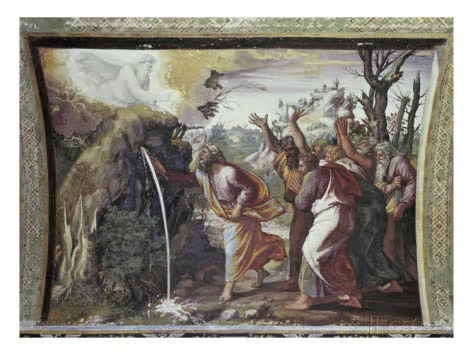
MOSES HIT THE ROCK, and water gushed forth—as depicted in this fresco by Raphael Sanzio. Did a water-giving rock follow the Israelites through the wilderness? If not, what does Paul mean in 1 Corinthians 10:4?
Pseudo-Philo claims that a well of water followed the Israelites through the wilderness, whereas in 1 Corinthians 10:4, Paul says that it was a rock that followed them. How did these two ancient interpreters come to their conclusions?
“What they seem to have concluded,” Byron explains, “is that since Moses named both the rock at Rephidim (Exodus 17:7) and the one at Kadesh (Numbers 20:13) ‘Meribah,’ the logical conclusion was that both were one and the same rock and that it, therefore, must have accompanied Israel on their journey.”
1 Corinthians 10:4 reflects a common ancient interpretation—that the Israelites were followed by a water source during their wilderness wanderings, which is demonstrated by Paul’s casual reference and supported by Pseudo-Philo.
FREE ebook: Paul: Jewish Law and Early Christianity. Paul’s dual roles as a Christian missionary and a Pharisee.
In the passage, Paul makes a second unusual claim: The rock that followed the Israelites through the wilderness was Christ.
How should we respond to these two claims? Was Paul speaking literally or figuratively?
“At the end of the day it’s unclear whether Paul really thought the rock followed Israel in the desert,” Byron says. “Most ancient and modern commentators assume that Paul is reading Israel’s story typologically rather than suggesting that Jesus was present with Israel in the wilderness in the form of a movable water source.”
To see John Byron’s full explanation of 1 Corinthians 10:4, read his column “Paul, Jesus and the Rolling Stone” in the September/October 2015 issue of BAR.
BAS Library Members: Read the full Biblical Views column “Paul, Jesus and the Rolling Stone” by John Byron in the September/October 2015 issue of Biblical Archaeology Review.
Not a BAS Library or All-Access Member yet? Join today.
This Bible History Daily feature was originally published on September 7, 2015.
Related reading in Bible History Daily
Out of Egypt: Israel’s Exodus Between Text and Memory, History and Imagination
Related Posts


Must-Read Free eBooks
Want more Bible history?
Sign up to receive our email newsletter and never miss an update.
Unlock Unlimited Access to the Bible's Past

Unlock Unlimited Access to the Bible's Past
Become an All-Access Member to explore the Bible's rich history. Get Biblical Archaeology Review in print, full online access, and FREE online talks. Plus, enjoy special Travel/Study discounts. Don't miss out—begin your journey today!

For centuries prior to the unification of Egypt the merchantile city of Maadi in Lower Egypt had the monopoly on copper while Upper Egypt was mostly without copper, though the elites left in their tombs tokens of affection the likes of which could be compared to owning the pearl-handled pistol of General Patton. Then under the unifier Narmer and his sucessors at Hieraconopolis the priveledged class from the south usurped the position of this commercial hub with ties to the Negev and Sinai desert that facilitated trade in copper and mineral and the route that went east to Arad and on to Susa and beyond.
Beersheba (home of the Patriarchs) was also a commercial hub with three satellite cities nearby producing copper, jewel and ivory goodd for the marketplace and they preserved food products in cellars under the houses and the same storage rooms were found at Maadi (whose name is similar to the concept of the “Ma’ad” in Islamic eschatology that means “return,” not to be confused with the ‘Maadi,” the reincarnation of the 12th Imam whose face will be covered with moles, or “Mad T.V.; Steven Seagal Voting”).
An alternative account of the water from the rock comes from Psalm 78:20 where it is God who performs the miracle, “Behold, (He) struck (the) rock.” Here the Hebrew is “hikkah tsur,” and again as I noted previously, this word ‘huk” has significance,, though I was incorrect about its meaning being “great medicine man,” the term “huk” is an unknown title bestowed on Hesy-Ra that designates a priestly office:
“In the Edwin Smith surgical papyrus, every medicine man is a priest of Sekhmet, the lioness-goddess wife of Ptah, just as Hesy, here the great medicine man, is ” HK” (unknown title) of the lioness-goddess Mehyt, wife of Onuris” (Sacred Science, p.143).
In the interpretations from the mystical book of Zohar, which vary at times, the water that issues forth derives ultimately from the source of God’s primordial attribute of “wisdom” (hokhmah) and the rock that was struck symbolized the physical universe which is as diversified as the galaxies expanding away from one another in the attribute of “understanding” (binah), thus alluded to in Proverbs 3:19; “Jehovah founded the earth by wisdom; He established the heavens by understanding,”
Wisdom/hokhmah is identified with the past and understanding/binah is the future and referred to as “the world to come,” making the tombs of the Egyptian royal elite decorated with scenes of the afterlife a likely symbol for “the world to come.”
In a tomb from the early dynastic period at Hieraconopolis, we have what is known as the painted tomb (#100), which has the first known wall mural depicting a scene with boats on the Nile (Moses is instructed to take in his hand the staff used to strike the Nile and strike the rock in Exodus 17:5-6, a subtle connection to the past) and the artists who were commissioned to decorate the tombs were formerly pottery painters:
“From this point on, pottery decoration declined rapidly as the professional craftsmen of the day turned their attention to decorating the palaces an tombs of an emerging aristocracy,. Artistic energies that had once been devoted to producing fancy containers that would capture local trade markets in the Early Gerzean period, now came to be dominated by the interests of the same local magnates who would soon unite Egypt by force of arms” (‘Egypt Before the Pharaohs” by Michael A. Hoffman, p.133).
As you can tell I’ve haven’t had any formal schooling in this field but it was ever since that nice lady at the little radical bookstore in a brownstone neighborhood of Brooklyn who let me browse and Budge’s “Egyptian Magic” revealed to me the concept of “hekau” or “words of power,” it has been an obsession of mine. This theory thst I borrowed from past thinkers has brought me to the concept from the Gnostics and Kabbalists concerning the eternal Father and Mother expressed as “Yahweh and his Asherah” in the 8th century B.C.E., who constitutef the first two letters of the tetragramaton; YHVH. I’m reminded of the “Matrix” films in which a computerized reality simulator was ultimately a creation of s man and a woman who were the original programmers of this Mega-computer like the inescapable truth of God being both male and female in Genesis 1:28.
Correction; Genesis 1:27
The connection between the word “hokhmah” or wisdom and the title of “huk” which is a type of priest doesn’t pan out so good when you consider that ‘”hokhmah” is actually “chokhmah” with the letter ‘chet’ and not ‘heh,’ though the expositors of the book of Zohar tend to overlook such differences. The phrase “strike rock” in Psalm 78.20, or “hikkah tsur” is probably our best clue of the tradition of “hekau” found in this work that was written after the conquest of Northern Israel by the Assyrians in the late 8th century B.C.E.
The word “tsur’ means ” rock, cliff wall” and the likliest candidate would be the Valley of the Kings where the pharaohs were interred. The Lord said to Moses in Exodus 17:6, “I will be standing before you there upon the rock (tsur) in Horeb.” This being in the western Sinai this is not to be confused with Mount Horeb in Midian (northern Arabia) and so the name could be derived from the god Horus, The Israelites were headed in the direction of the torquois mine at Serabit el-Khadim, where there was a sanctuary of the goddess Hathor whose name is comprised of the word for house (het) and the name of Horus (Heru) and this was very sncient, dating to a time when Horus was a sun god and the name Hathor originally referred to the portion of the sky in the east where Horus had domain.
“Upon the rock in Horeb” could refer to the mortuary temple of Pharaoh Hatshepsut behind which is a cliff wall where the western sky rests upon (the Lord standing upon the rock) an her temple was dedicated to Hathor (House of Horus, hinted at in the name Horeb where the letter ‘bet’ also means house, in keeping with Zohatic interpretations) and the goddess represents the start stirred night sky as well.
That is, the star-studded night (?).
Hatshepsut was given a royal coronation no different than the male possessors of the title Pharaoh (Great House) and she also is purified in a ritual involving two gods. In this instance, Amon and Khonsu, each pouring water over the soon-to-be god incarnate king. In her temple at Deir el-Bahri these words were recited during the second purification ritual in which the queen is led away by the god Kheseti:
“Leading the way to enter the ‘Great House’ (by) the ‘Pillar of his Mother’ (a priestly title) of the ‘Great House’ (for the) purification of ‘Great House.'”
At the completion of the coronation the god Horus says “Thou hast established thy dignity as king, and appeared upon the Horus-Throne” (“Ancient Records of Egypt, vol.2, by James Henry Breasted, pp. 99-100).
Thus does the pharaoh become the god-incarnate “Living Horus,” and thus was the meaning of the argument, “Its Jehovah in our midst or not?” (Exodus 17:7).
Jesus is the only God that man has ever dealt with. I hope this edifies.
https://www.youtube.com/watch?v=sGmDmPsvJ4U
1 Cor 10: 4 says plainly that the rock was Christ and that it was spiritual. Jesus said that we live by every word that proceeds from the mouth Of the living God and his words are spirit and life. Could it be that Christ was with the Israelites speaking to them the words of life, the words of God and which include the Ten Commandments as well as the levitical laws?. Could it also be that he spoke many other things to them that are not recorded. Moses and his aide Joshua son of Nun Exodus 33: 11
Maybe Paul was just used the illustration of the real Rock which is Jesus as in 1Cor.10 to relate to that rock Moses strike. As the body of Jesus gives off water, the billar which followed them was also a symbol of Jesus. Jesus is everything. He is the real rock that gives off water in the wilderness, He is also the billar or whatever that followed them, He is the corner stone, He is also the rock in the story of the two house builders: one builds on sand, and the other build on Rock.
billar should be spelled “pillar”