


What Color Was Tekhelet?
Blue tzitzit and murex dye
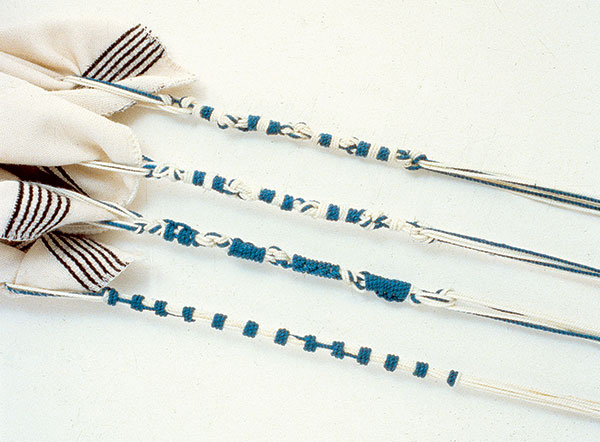
Do the blue tzitzit strings of this traditional Jewish prayer shawl reflect the shade of blue in the Bible, called tekhelet in Hebrew? Evidence suggests the tekhelet that colored ancient blue tzitzit was sky-blue and derived from murex dye.
In the Bible, a shade of blue called tekhelet was God’s chosen color for the ancient Israelites. Tekhelet drapes adorned Solomon’s Temple, and tekhelet robes were worn by Israel’s high priests. According to Baruch and Judy Taubes Sterman in “The Great Tekhelet Debate—Blue or Purple?” in the September/October 2013 issue of BAR, even ordinary Israelites “were commanded to tie one string of tekhelet to the corner fringes (Hebrew, tzitzit) of their garments as a constant reminder of their special relationship with God” (Numbers 15:38–39). The tradition of blue tzitzit still exists today.
But what was the actual color of ancient tekhelet and blue tzitzit? Was it a shade of blue or was it closer to purple? Blue tzitzit and tekhelet-colored fabrics were widely worn and traded throughout the ancient Mediterranean, but by the Roman period, only the emperor could wear tekhelet. By the seventh century C.E., with the Islamic conquest of the Levant, the tekhelet’s source and method of manufacture were lost.
FREE eBook: Life in the Ancient World.
Craft centers in Jerusalem, family structure across Israel and ancient practices—from dining to makeup—through the Mediterranean world.
A century ago, Isaac Herzog, who would later become Israel’s first chief rabbi, researched tekhelet for his dissertation. He concluded that blue in the Bible was a bright sky-blue derived from the secretions of a sea snail, Murex trunculus.* This species was known to produce a murex dye the color of dark purple. Decades after Herzog’s death, chemist Otto Elsner proved that murex dye could in fact produce a sky-blue color by exposing the snail secretions to ultraviolet rays during the dyeing process. Sky-blue tzitzit, then, could be made with murex dye.
Despite Elsner’s discovery, the debate around the color of tekhelet continued. Dissenters argued that the ancient dyers, who created dyes in covered vats, likely didn’t know how to adjust the dye colors using the sun’s ultraviolet rays. Eleventh-century Biblical exegete Rashi described tekhelet as a deep blue or dark violet. A violet swatch of wool discovered during excavations at the first-century Herodian fortress of Masada was proven to have been colored by murex dye.
In a letter to BAR, Professor Zvi C. Koren, director of the Edelstein Center for the Analysis of Ancient Artifacts at the Shenker College of Engineering and Design in Ramat Gan, Israel, criticizes the Stermans’ analysis, to which the Stermans have replied. Visit the BAS Scholar’s Study: The Great Tekhelet Debate page today.
However, important evidence persuasively suggest that Biblical tekhelet was in fact sky-blue. Assyriologist Wayne Horowitz explains that the Sumerian word uqnu, the word for the gem lapis lazuli, was used for the color blue and its shades. The term was applied to the sky and to blue wool (uqnatu). When the foreign word takiltu, Hebrew tekhelet, was adopted into Akkadian, the same cuneiform signs as uqnatu were used. To the ancient Mesopotamians, therefore, the color of lapis lazuli and the sky were equivalent to the color of tekhelet.
So what was the color of Biblical tekhelet? The Jerusalem-based Ptil Tekhelet Foundation believes it was sky-blue derived from the murex dye. For over 25 years, this foundation has produced hundreds of thousands of blue tzitzit strings colored with murex dye. The blue tzitzit on Jewish prayer shawls remind worshipers of the sea, the sky and God’s holy throne.
BAS Library Members: Read the full article on ancient tekhelet by Baruch and Judy Taubes Sterman in Archaeological Views, “The Great Tekhelet Debate—Blue or Purple?” as it appears in the September/October 2013 issue of Biblical Archaeology Review.
Not a BAS Library or All-Access Member yet? Join today.
Notes
* See Ari Greenspan, “The Search for Biblical Blue,” Bible Review, February 2003.
Related reading in Bible History Daily
All-Access members, read more in the BAS Library
Archaeological Views: The Great Tekhelet Debate—Blue or Purple?
Arch-Tech: Purple Threads from the Days of David and Solomon
Not a BAS Library or All-Access Member yet? Join today.
This Bible History Daily feature was originally published in 2013.
Related Posts






Must-Read Free eBooks


Want more Bible history?
Sign up to receive our email newsletter and never miss an update.
Unlock Unlimited Access to the Bible's Past

Unlock Unlimited Access to the Bible's Past
Become an All-Access Member to explore the Bible's rich history. Get Biblical Archaeology Review in print, full online access, and FREE online talks. Plus, enjoy special Travel/Study discounts. Don't miss out—begin your journey today!

I have trouble believing that an unclean animal was (and apparently still is) used to obtain a dye for manufacturing one of Yahweh’s Commandments (tsitsith).
Leviticus Chapter 11 clearly outlines what creatures are clean and which are unclean. Snails are among the unclean. One could have a pet snail while it is still alive, but the unclean creatures’ carcasses are not to be touched, they are abhorrent and detestable. As I understand it, the snails are crushed (killed), producing carcasses in the process of squeezing out a drop of blue dye to be collected. Isn’t this dye (part of the guts?) essentially part of the carcass?
Lev. 11:10 “But whatever is in the seas and in the rivers, that do not have fins and scales among all the teeming life of the water, and among all the living creatures that are in the water, they are detestable things to you,
11 and they shall be abhorrent to you; you may not eat of their flesh, and their carcasses you shall detest.
12 ‘Whatever in the water does not have fins and scales is abhorrent to you.
35 ‘Everything, moreover, on which part of their carcass may fall becomes unclean; an oven or a stove shall be smashed; they are unclean and shall continue as unclean to you.”
Using and wearing part of a snails carcass is almost as bad as making a Bible cover out of pig skin, and saying that it doesn’t matter (Bible covers that are Berkshire Leather are described by Ingram Publishing as “High-quality pigskin…”, the same as well for their “Genuine Leather” Bible covers, they are made from the swine’s skin).
I am reminded of the abominable act of Antiochus IV Epiphanes slaughtering a pig on the Altar in the Temple at Jerusalem, thereby defiling the whole place! Detestable!
Please convince me that I am wrong about the dye. Meanwhile, I will continue to wear tsitsiths that are made with regular blue dyed strings purchased from the local stores.
In this regard, consider another of Jehovah’s laws to ancient Israel. Many today might find a law about putting fringes and blue threads on their garments hard to understand. (Read Numbers 15:37-39.) Do you see the relevance, though? Obeying such a law helped God’s people to keep themselves distinct and separate from the pagan nations around them. That was vital if they were to gain and maintain Jehovah’s approval. (Lev. 18:24, 25) However, that law also reveals a dangerous internal influence that might lead us away from our destination of everlasting life. How so?
Note what Jehovah gave his people as a reason behind this law: “You must not go about following your hearts and your eyes, which you are following in immoral intercourse.” Jehovah has profound insight into human nature. He well knows how easily our heart, or inner self, is seduced by what we take in through our eyes. The Bible thus warns us: “The heart is more treacherous than anything else and is desperate. Who can know it?” (Jer. 17:9) Do you see, then, just how fitting was Jehovah’s warning to the Israelites? He well knew that they would be inclined to look at the pagan peoples around them and be seduced by what they saw. They might be tempted to look like those unbelievers and then to think, feel, and act like them.—Prov. 13:20.
http://wol.jw.org/en/wol/d/r1/lp-e/2011523#h=12:383-13:745
http://wol.jw.org/en/wol/d/r1/lp-e/2003523#h=19:0-19:605
http://wol.jw.org/en/wol/d/r1/lp-e/1200001224#h=23:0-23:379
To Tom (post #14),
Your point about employing kosher substances for ritual uses is a very important one. I invite you to read my in-depth analysis of this issue, which shows unambiguously that kosher substances are required only for things with God’s name in them (Torah, Tefillin, Mezuza) – see:
http://www.divreinavon.com/pdf/Mutar_Beficha.pdf
For further discussions on the halakhic aspects of the reinstitution of tekhelet through the Murex trunculus see my book:
https://www.createspace.com/4597533
Can tzitzits be attached to belt loops instead?
ThWDH BShM YHWH(thanks~in-name~YaHuWaH), your insight Tom is the only sound explanation of the TsiTsiYuTh regarding the snail dye dilemma that is sound in ThWRH.
I honestly believe it sky blue, represents grace the Lord’s clour . The Gospel of grace and truth. Amen. This colour is coming back to the Jewish state of Israel. Grace is the sky blue colour
Jo [comment 14] asked last year whether Tzitzit [Hebrew for “tassels” – not “fringes”!] can “be attached to belt loops instead?”.
The Biblical commandment itself is quite helpful in addressing this issue. Numbers 15:37-38 states: “make Tzitzit on the corners of their garments … they shall attach to the Tzitzit at each corner a thread of Tekhelet”. Deut. 22:12 adds: “You shall make yourself tassels [Hebrew gedilim] on the four corners of your garment with which you cover yourself”.
So a belt is excluded as it is not a four-cornered garment.
Thank you for the insightful information about Tzitzit. I never thought about the color blue in this way. I was a little surprised that the color comes from an unclean animal. Personally I don’t think anything that God has created is bad, only misunderstood.
Is a “belt loop” a “belt”? Of course not. The belt loop is an integral part of a garment, while a belt is sometimes considered an “accessory.”
Are belt loops at the corners of a garment? Not many people are built so that they have square sides to have a square garment (trousers, pants) with belt loops at the corners. In the Western world, few people wear square garments, so belt loops might be considered at the “corners” of garments. Just as the world is not square, it is considered in the Bible to have four corners (Is. 11:12; Rev. 7:1).
Harlow and Harrar’s Textbook of Dendrology (ninth ed.). New York: McGraw-Hill.