


What Color Was Tekhelet?
Blue tzitzit and murex dye
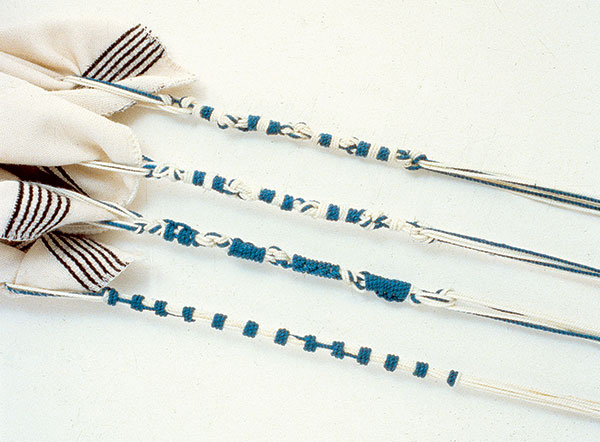
Do the blue tzitzit strings of this traditional Jewish prayer shawl reflect the shade of blue in the Bible, called tekhelet in Hebrew? Evidence suggests the tekhelet that colored ancient blue tzitzit was sky-blue and derived from murex dye.
In the Bible, a shade of blue called tekhelet was God’s chosen color for the ancient Israelites. Tekhelet drapes adorned Solomon’s Temple, and tekhelet robes were worn by Israel’s high priests. According to Baruch and Judy Taubes Sterman in “The Great Tekhelet Debate—Blue or Purple?” in the September/October 2013 issue of BAR, even ordinary Israelites “were commanded to tie one string of tekhelet to the corner fringes (Hebrew, tzitzit) of their garments as a constant reminder of their special relationship with God” (Numbers 15:38–39). The tradition of blue tzitzit still exists today.
But what was the actual color of ancient tekhelet and blue tzitzit? Was it a shade of blue or was it closer to purple? Blue tzitzit and tekhelet-colored fabrics were widely worn and traded throughout the ancient Mediterranean, but by the Roman period, only the emperor could wear tekhelet. By the seventh century C.E., with the Islamic conquest of the Levant, the tekhelet’s source and method of manufacture were lost.
FREE eBook: Life in the Ancient World.
Craft centers in Jerusalem, family structure across Israel and ancient practices—from dining to makeup—through the Mediterranean world.
A century ago, Isaac Herzog, who would later become Israel’s first chief rabbi, researched tekhelet for his dissertation. He concluded that blue in the Bible was a bright sky-blue derived from the secretions of a sea snail, Murex trunculus.* This species was known to produce a murex dye the color of dark purple. Decades after Herzog’s death, chemist Otto Elsner proved that murex dye could in fact produce a sky-blue color by exposing the snail secretions to ultraviolet rays during the dyeing process. Sky-blue tzitzit, then, could be made with murex dye.
Despite Elsner’s discovery, the debate around the color of tekhelet continued. Dissenters argued that the ancient dyers, who created dyes in covered vats, likely didn’t know how to adjust the dye colors using the sun’s ultraviolet rays. Eleventh-century Biblical exegete Rashi described tekhelet as a deep blue or dark violet. A violet swatch of wool discovered during excavations at the first-century Herodian fortress of Masada was proven to have been colored by murex dye.
In a letter to BAR, Professor Zvi C. Koren, director of the Edelstein Center for the Analysis of Ancient Artifacts at the Shenker College of Engineering and Design in Ramat Gan, Israel, criticizes the Stermans’ analysis, to which the Stermans have replied. Visit the BAS Scholar’s Study: The Great Tekhelet Debate page today.
However, important evidence persuasively suggest that Biblical tekhelet was in fact sky-blue. Assyriologist Wayne Horowitz explains that the Sumerian word uqnu, the word for the gem lapis lazuli, was used for the color blue and its shades. The term was applied to the sky and to blue wool (uqnatu). When the foreign word takiltu, Hebrew tekhelet, was adopted into Akkadian, the same cuneiform signs as uqnatu were used. To the ancient Mesopotamians, therefore, the color of lapis lazuli and the sky were equivalent to the color of tekhelet.
So what was the color of Biblical tekhelet? The Jerusalem-based Ptil Tekhelet Foundation believes it was sky-blue derived from the murex dye. For over 25 years, this foundation has produced hundreds of thousands of blue tzitzit strings colored with murex dye. The blue tzitzit on Jewish prayer shawls remind worshipers of the sea, the sky and God’s holy throne.
BAS Library Members: Read the full article on ancient tekhelet by Baruch and Judy Taubes Sterman in Archaeological Views, “The Great Tekhelet Debate—Blue or Purple?” as it appears in the September/October 2013 issue of Biblical Archaeology Review.
Not a BAS Library or All-Access Member yet? Join today.
Notes
* See Ari Greenspan, “The Search for Biblical Blue,” Bible Review, February 2003.
Related reading in Bible History Daily
All-Access members, read more in the BAS Library
Archaeological Views: The Great Tekhelet Debate—Blue or Purple?
Arch-Tech: Purple Threads from the Days of David and Solomon
Not a BAS Library or All-Access Member yet? Join today.
This Bible History Daily feature was originally published in 2013.
Related Posts






Must-Read Free eBooks


Want more Bible history?
Sign up to receive our email newsletter and never miss an update.
Unlock Unlimited Access to the Bible's Past

Unlock Unlimited Access to the Bible's Past
Become an All-Access Member to explore the Bible's rich history. Get Biblical Archaeology Review in print, full online access, and FREE online talks. Plus, enjoy special Travel/Study discounts. Don't miss out—begin your journey today!

The first mention of the “Chilazon” (?murex?) is in the first century CE tosefta. So the source is very post biblical. The other point that someone mentioned about the ancients not knowing how to modulate the color by using the sun is not a valid point. At some point someone would have left a bit of dye in the sun and noticed that the color changed. A bigger problem in my opinion is the fact that in the modern renaissance of tekhelet a reducing agent is used in the process. I doubt that this was available in ancient times.
I don’t think God is going to judge people by what color tassels they wore.
His laws are to be written on our hearts. To love the Lord our God with all our minds, hearts and souls.
It is good to use reminders to bring our thoughts constantly back to God. It isn’t meant to be a symbol of superiority over another (holier than thou attitude).
It doesn’t help you or the world if you can recite all the laws but not live them in your heart.
Just something to think about!
Many opinions here. According to my expriences it is good to know details of the Bible and tekhelet (without making it too big issue) because everything declare the glory of God! If that is done in love, then what’s the matter? Knowledge doesn’t hurt nor get anyone puffed-up if the knowledge is kept in it’s legitimate role as the servant of Love. I am a visual person and Biblical symbolism has always been very important part in worship. It was that too in the ancient Israel. Just see all the details in the Tabernacle and everything. They have meaning, teach about God and they matter a lot. Tekhelet too.
While the article was inspirational and I respect it even if I don’t agree with it, and I repsepct everyone’s views here on the blue in tzitzit, I remind that the source of the true ultramarine blue in art was (and still is) lapis lazuli. The synthetic Frenc Ultramarine is not the same thing the greatests European artist used. What and earth art has to do with tekhelet? I believe even the history of greatest art has a clue. I will come to that later…
But the original language and context in the Scripture is all in all. Right?
In Exodus 24 it is said that the pavement under God’s feet is sapphire (“sappir” in Hebrew). Yes, the Hebrew word “sappir” sounds like the modern “sapphire” but I’ve learned that according to the historians what we know as the blue sapphire (gem) today was not known until the Roman era 300 BCE and the ultramarine deep blue lapis lazuli stone (which includes gold-colored pyrite), the “sappir” in the Hebrew Bible, was the “old sapphire”. Which was not a gem (as the modern sapphire) but semi-precious stone and was the source of the first (true) ultramarine blue hue in the whole world.
I believe the ancient Biblical sappir was not the sapphire of today but lapis lazuli. According to history we have no other option than to believe this if the historians are correct. Additionally in Ezekiel 1:26 it is said that God’s throne is made of the same “sappir” as the sappir-pavement under God’s feet in Exodus 24. Again, in the Biblical context “sappir” is lapis lazuli. Not the modern blue sapphire-gem which was not known until the Roman era. History proves that.
This same “old sapphire” lapis lazuli was also the second stone in the second row in the high priest’s breastplate (see “sappir” in Exodus 28).
Lapis lazuli was also used in ancient Egypt very much in the royal and religious context. Why? I believe it was so because the Egyptians knew very well this deep blue stone had connection to the supernatural (YHVH-God). Well, the Egyptians had their perverted perspective of the “Divine”, but even the perversions could have some clues of the Truth I believe. At least I have learned this principle very well in astronomy which is originally Biblical = God / Messiah-centered, not occult / pagan = the devil / self-worship centered.
Thirdly, the ancients thought that the deep ultramarine blue lapis lazuli reminds of the starry sky (because of the gold-colored pyrite in it as has been said). What a picture here in the Biblical sappir / lapis lazuli of the heavens / starry sky which declare the glory of YHVH-God (Psalm 19)! “The Heavens is my throne…” (Isaiah 66). We have Two Witnesses in the Scripture regarding God’s throne and the pavement under His feet being lapis lazuli, the ancient sappir-sapphire: Exodus 24 and Ez 1. If God’s throne is lapiz lazuli and the ancient Mesopotamians likened lapis lazuli with the (starry) sky, then IMHO the blue tekhelet-thread in tzitzit has to be lapis lazuli (the “primitive” ultramarine) too.
Again, the true ultramarine in art was made of lapis lazuli stone. The original ultramarine is rare and expensive even today.
Everything is connected in the Bible in a way or another: God’s throne and the (starry) sky even to the “four corners” of our garments with the ultramarine lapis blue (I believe). If God’s throne is made of the ultramarine lapis lazuli which has gold pyrite in it (together with blue, gold is a symbol of God’s glory too), the ancient Hebrew Sappir, then I don’t see any good reason to follow the rabbis or let any men have dominion on my Faith with the “sky blue” hue (what ever that is?), but use the true ultramarine-blue threads in my tzitzits which reminds me of Him and His Commandments, God’s throne and the pavement under His feet, and even the starry sky, the heavens!
“Thus saith YHVH (the LORD), The heaven is my throne, and the earth is my footstool: where is the house that ye build unto me? and where is the place of my rest?” (Isaiah 66:1)
What a King we serve in His Sappir! Blessings from Finland.
HalleluYah HalleluYah HalleluYah my brotherThank you when you asked you receive so we do not follow the traditions of the Pharisees of or the synagogues of today according to revelations. Where can I get some tzitzits Like the ones you’re speaking of as to order them and see what they have available or they can make the ones I want to fit the clothing I wear? Or get the material and have someone make them for me I have a friend that has a sewing business that does a lot of things. Here’s something for you I think you’ll like this teaching my friend.
https://www.bitchute.com/video/SiLs2C6HIZV1/
Pekka thanks for ur insight
The ramban the rikanta say clearly that the color is the last om the color spectrum this violet dark blue
They compare it to what the kings wore and we know that wasn’t light blue
PEKKA u said u go with the original color
Im trying to get the untouched original color produced by the murex and i can’t get it only the ruined PUSALA omes from ptil tichelet
The best illustration I saw of this dye process was on an episode of the Naked Archaeologist TV show. The cloth was put in the dye, and, I think, left in the sunlight. In the dye, it was nothing resembling blue. But as it was drawn out of the liquid, in the light, its color changed dramatically through green to blue; it stayed blue when it dried. To a modern, this would seem amazing. To an ancient person, this must have seemed to be divine. The secret of the technique was lost with the original craftsmen. This process was recently rediscovered by someone in Israel searching for this color. Was this the ancient process? We’ll probably never know. But, had it been, I could understand the importance of the resulting blue color, and its connection with holiness.
Many of you are confused as to why YaHuWaH would use unclean creatures such as the “Tekelet Cerulean Mussel” (a shellfish) to make the Blue & Purple dye for the Temple Curtains as well as the Tziytzit (fringes) in Numbers 15:38.
The confusion stems from the definition of the word “carcass” (spelled carcase in the King James Version) in Leviticus, the 11th chapter.
There are four different Hebrew words for “carcase” in the Tanakh (Old Testament), but in Leviticus 11, the word “carcase” is #H5038 “nebelah,” which means “that which dies of itself.”
We are commanded not to touch the carcase (an animal that dies of itself) of a clean or an unclean animal, because that animal could be diseased.
However, the unclean animal that is killed for the purpose of making shoe leather, camel’s hair clothing, or dye for fabric, is not unclean for these purposes—they are only unclean for eating.
We are prohibited from touching all animals (clean or unclean) if they die on their own or by another wild animal.
However, all unclean animals are unclean for eating under all circumstances.
In Exodus 13:13, YaHuWaH commands us to break the neck of a first-born donkey if he is not redeemed. In order to do this, one would have to touch the dead donkey’s body after he is killed. This is acceptable, because the donkey did not die of itself.
Also, check out the graphics below for PROPHETIC INSIGHT as to why YaHuWaH has used this unclean creature for the blue & purple dye.
Also see the blog entitled: Messiah Seen in the Tabernacle Colors: The Tekhelet & the Towla
http://doubleportioninheritance.blogspot.com/2017/03/messiah-seen-in-colors-of-tabernacle.html
Please don’t mutilate HaShem’s NAME with some sloppy rendition with no linguistic support.
In Season 1 of “The Naked Archeologist”, Simcha Jacobovici did an episode on this showing attempts to reproduce the color and also identify the “Hillazon” which according to the Bible was the dye’s source. The episode was number 11 and is titled “True Blue”.
Oh my goodness! Awesome article dude! Thanks, However I am experiencing troubles with your RSS. I don’t understand why I can’t subscribe to it. Is there anyone else having the same RSS issues? Anyone that knows the answer will you kindly respond? Thanks!!