


Biblical Pharisees and Jewish Halakhah
Good guys with bad press, says scholar Roland Deines

Were the Biblical Pharisees really as bad as the New Testament makes them seem? Professor Roland Deines thinks not. Photo courtesy Roland Deines.
And yet, Deines says, the Biblical Pharisees were popular in the first century; they were the people’s party. Why would the people follow a bunch of hypocrites?
As Roland Deines explains in a BAR column, the New Testament and Josephus include polemical texts against the Pharisees rather than objective descriptions. In fact, it was the Pharisees’ take on Jewish halakhah that made them so popular.
The strict (and extensive) purity laws of Jewish halakhah made it both costly and time-consuming to follow—putting the Biblical instructions out of reach for most common people. For example, if impurity touched the outside of a pottery vessel, it needed to be broken and the contents thrown away. Instead, the Pharisees interpreted these laws in a way that made purity accessible to more people. According to the Pharisaic interpretation, the inside of the aforementioned vessel remained pure and the contents could still be used.
Although this sort of legalistic interpretation may seem like nit-picking to some, the Pharisees made purity attainable for all of Israel, not just the elite.
For more of Roland Deines’s explanation about the popularity of the Biblical Pharisees and their take on Jewish halakhah, see Roland Deines, Biblical Views: “The Pharisees—Good Guys with Bad Press” in the July/August 2013 issue of Biblical Archaeology Review. This Bible History Daily post was originally published in August 2013.
Not a BAS Library member yet? Join the BAS Library today.

FREE eBook: Life in the Ancient World.
Craft centers in Jerusalem, family structure across Israel and ancient practices—from dining to makeup—through the Mediterranean world.
Related reading in Bible History Daily:
Ancient Jewish Theology and Law
Jonathan Klawans on the divergence of the Pharisees, Sadducees and Essenes
Schisms in Jewish History
Lawrence H. Schiffman’s four-part series on unity and disunity throughout Jewish history.
This Bible History Daily feature was originally published in 2013.
Related Posts

Mar 8
Deborah in the Bible


Mar 5
Tabitha in the Bible




Must-Read Free eBooks

Want more Bible history?
Sign up to receive our email newsletter and never miss an update.
Unlock Unlimited Access to the Bible's Past

Unlock Unlimited Access to the Bible's Past
Become an All-Access Member to explore the Bible's rich history. Get Biblical Archaeology Review in print, full online access, and FREE online talks. Plus, enjoy special Travel/Study discounts. Don't miss out—begin your journey today!

In the book of Ben Sirach the primordial Wisdom of the Most High is personified searching for a place to reside, as I quote from “Veda and Torah” by Barbara Holdrege, p.136:
“Wisdom thus ‘took root in an honored people’ and established her seat among the people of Israel in the holy tabernacle in Jerusalem (24:10). Universal wisdom, which God had originally ‘poured out upon all his works,'(1:8) assumed a particularized form and became embodied on earth in the Book of the Torah (24:8).”
This concept was continued in the Kabbalah as I quote from “Innerspace” by Aryah Kaplan, p.58:
“”Chokmah (Wisdom) is seen as the basic blueprint that God created to bring the entire spiritual-physlcal universe into existance. It is also the active intellect that God uses to run the universe. Although God was not compelled to create the world through the vehicle of the intellect, He bound Himself to its rules when He created Chokmah. He then created man with the same intellect and the same built-in axioms. They would allow him to grasp the underlying principles of creation by contemplating God’s handiwork.”
The Gospel of John 9:1 mentions Jesus and his disciples walking along and seeing a blind man from birth and engaging in a halachic discussion as to the origin of the “sin” that caused the man’s condition (the Hebrew for ‘walk’ is halak which also means ‘law’). Jesus answers, “Neither he nor his parents sinned; it is so that the works of God might be made visible through him” (9:4). It reminds me of the album cover of Stevie Wonder’s “Innervison.”
The kabbalistic scholar Gershom Scholem in his autobiography “From Berlin to Jerusalem” (p.58). mentions Jewish student organizations in Germany around 1914, among which was a Jewish hiking association that imitated the traditional hiking culture so prevailant there. However, Scholem, being an intellectual, focused on his Judaic studies and also rejected the nationalistic war fervor that prevailed in World War I. He would later escape the Nazis and take a post at the Hebrew University in Jerusalem.
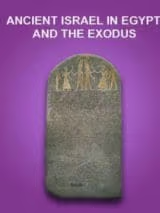
The boast on Pharaoh Meryneptah’s stele proclaimed, “Isreal’s seed is not!”
When in fact the hill country where the Isrealites settled was being reworked so as to allow for planting seed with terrace-work and irrigation trenches.
Forgive me for sounding so nonacademic and simple in my reply here. Although I have read much of Josephus I cannot comment on that so much, but as it relates to Jesus, his focus was on the heart and following the rule of loving God and others. He was not opposed to, but rather in favor of biblical rules for Godly living, but he kept big things bigger and small things smaller. It is no surprise that the pharisees had a following. It is natural for us as human beings to become legalistic and feel comfortable in that. We like to complicate things that are simple, just look at bills that are passed in government. It is hard to keep things simple and pure. Also Jesus saw the error and damage being done by some of the pharisees and so he spoke out against it.
Not sure I understand the point of The Bible not being “objective.” Sounds like the approach here by Roland is that the New Testament writers were biased as opposed to inspired by God. Jesus was able to see their hearts and the hearts of many others as well. Obviously, they had popularity because the man born blind and healed by Jesus still honored the Pharisees even after Jesus healed his eyes. I’m sure there was some intimidation and fear mixed in as well that caused people to fear the Pharisees. To deny who the Pharisees were as Jesus described seems to say that Jesus was not correct. In that case I side with God of the Universe the Lord Jesus.
That a political leadership party or junta is popular is not an indicator that they were not crooked, sanctimonious, self-righteous, evil, wicked, etc.
I can think of a current example or two.
I agree partially with Mike (4) above, but just as millions of sincere Evangelical Christians do NOT share the jingoistic Herod-worshiping (or is it Caesar-worshiping?) prejudices of their leaders (in fact one very LARGE group of Americans, African-Americans, are to a large degree theologically and ethically conservative, and yet very liberal in politics — as a matter of self defense), not all the Pharisees were evil. As the article pointed out, Pharisees GENERALLY expanded the concept of priestly observance to any devout Jew regardless of social or economic status (priesthood of all believers, there’s a catchy phrase!). Jews who could not afford the daily Temple sacrifices, or who were ritually excluded from the Temple due to handicaps, could still satisfy God by living devout and ethically pure lives, or at least as pure as they could manage. The consistent EFFORT was preached by the best Pharisees, and they also emphasized that the most important part of that effort was to be holy in one’s treatment of others.
The later-written Gospels were written to a somewhat anti-Jewish audience, and after the fall of the Temple, so the Pharisees were the principal “villains.” The Sadducees, wealthy Levites and priests, had lost their influence when the Temple was destroyed. Modern Orthodox and Conservative Judaism was “weaned” from the physical Temple ritual by the better Pharisees.
One former Pharisee who portrayed their teaching as “God wants perfect results, not the best you can do in effort” was Paul, who apparently felt that extreme position to be the way God was judging HIM personally, and so gave us this misunderstanding of Pharasaic thought, as a contrast to grace through Christ. As a partial result of this dichotomy between faith and works, other Pharisees were portrayed as ignoring human needs to “fulfill” the letter of a commandment. And there certainly HAD been some of that teaching, dating back to the Hasmonean dynasty (descendants of the Maccabees who called themselves “kings”), as the Roman general Pompey was able to conquer Jerusalem without a fight by attacking during the Sabbath, when Jews would not fight back. But the correction to that attitude was also found in the Judea in which Jesus lived, and Jesus was not the ONLY proponent of this reform (or if He was, He was certainly copied by Pharisees over the next few centuries).
So, some Pharisees surely were crooked or corrupt, but they had far less opportunity for corruption than the Saducees, at least until the Temple was destroyed. They were popular precisely BECAUSE they took the side of the “little guy” against Saducee confiscation of what little the average peasant had (the widow’s mite, so to speak). Santimoniousness and self righteousness are temptations that may be found in any spiritual path, even Christianity (can anyone think of examples?) but are not necessarily the rule.
the Pharisees made purity attainable for all of Israel, not just the elite.
– The Pharisees made purity attainable to the people, and not God?
Jeremiah 31:31-34
“The days are coming,” declares the Lord, “when I will make a new covenant with the people of Israel and with the people of Judah. It will not be like the covenant I made with their ancestors when I took them by the hand to lead them out of Egypt, because they broke my covenant, though I was a husband to them,” declares the Lord. “This is the covenant I will make with the people of Israel after that time,” declares the Lord. “I will put my law in their minds and write it on their hearts. I will be their God, and they will be my people. No longer will they teach their neighbor, or say to one another, ‘Know the Lord,’ because they will all know me, from the least of them to the greatest,” declares the Lord. “For I will forgive their wickedness and will remember their sins no more.”
What? “Bad guys” can’t be popular? Tell that to Pedro Escobar, who was lionized in Columbia for his “good deeds” while simultaneously being the world’s largest drug dealer at that time, which included all the violence that went along with achieving that status. The people LOVED him. Popularity is no sign of righteousness–it’s stupid to even consider. Yeishuu`a (Jesus) condemned the Pharisees to eternal death (saying they were “twice dead”) because they earned their “popularity” by deliberately twisting and doing away with the dictates of Tohraah. Their taqqanoth, as exemplified in “qorban” by Yeishuu`a, taught that explicit instruction from Scripture could be ignored if the people would just follow the “smooth” ways of the Pharisees’ teachings. Their oral interpretations deliberately superseded YHWH’s word in order to ingratiate themselves with the people and pull them away from the influence of the Sadducees (not that they were any better). The Pharisees “bought” their influence over the people by means of reducing the “burdens of YHWH” while simultaneously adding burdens of their own devising. For many of the people, it was an acceptable trade. In the sight of YHWH, this trade earned “second death”.
So politics has not changed in 2,000 years.
Any Zeal must be at first rational (Romans 10:2). Acts 6:7 speaks about pharises or others converting to follow Jesus Christ?
If the pharisees “were not so bad”, as this article purports, why will then the pharisees turn against Jesus so much that they were looking for an occasion to catch him saying something “against” the law, and ultimately, for an opportunity to kill him? From Scripture, one can determine that not all pharisees were alike. For instance, there we have Nicodemus, a pharisee and a members of the Sanhedrin, and Joseph of Arimathea, another pharisee and also a member of the Sanhedrin. These two men understood that Jesus had come from God. They revered him and believed in him, under threat of their own lives. In any case, Jesus, being the Messiah, the Son of God, revealed (and still reveals) the contents of the hearts of the pharisees. Under such scrutiny, what we really feel and believe, will be made plain. In summary, the great majority of the pharisees were against Jesus and his teachings.