


Exploring Genesis: The Bible’s Ancient Traditions in Context
Answer Biblical archaeology’s earliest questions.
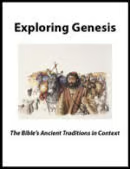
Exploring Genesis: The Bible’s Ancient Traditions in Context
In this FREE eBook, discover the cultural contexts for many of Israel’s earliest traditions. Explore Mesopotamian creation myths, Joseph’s relationship with Egyptian temple practices and three different takes on the location of Ur of the Chaldees, the birthplace of Abraham.
The esoteric stories and lost landscapes in the Book of Genesis present a great challenge for historians. Biblical scholars and archaeologists have nonetheless been able to provide cultural contexts for many of Israel’s earliest traditions. Learn about early Biblical figures, cities and environments in this FREE eBook.
The Creation story from Genesis explains how the world was formed and how humankind was created. Was this story heavily influenced by an ancient Babylonian Creation myth called Enuma Eliš? In “The Genesis of Genesis,” Victor Hurowitz explores this question. A text which describes the divine activities of the gods and the creation of man, Enuma Eliš includes many of the motifs found in the Biblical Creation story. To what extent is there a relationship between these two texts? In this comparative study, Hurowitz examines the similarities and differences between the Babylonian myth and the Biblical story and sets them in the historical context of the ancient Near East.
The story of Joseph in Genesis is well known. Sold into slavery by his brothers, Joseph ended up in a prison in Egypt and there became known for his ability to interpret dreams. Summoned from the dungeon to interpret Pharaoh’s dreams, Joseph shaved before approaching the ruler of Egypt. Most people in ancient Mesopotamia did not shave. Why, and what, did Joseph shave? In “Why Did Joseph Shave?” Lisbeth S. Fried examines Egyptian ideas of cleanliness and purity. These ideas may explain why Joseph had to appear hairless—and circumcised—before entering Pharaoh’s palace.
In the story of Abraham, we learn how one man was called by God to become the founding father of the Israelites in the land of Canaan. In Genesis, Abraham was said to have been born in Ur of the Chaldees. However, there were many places named Ur in antiquity. Where was Abraham’s Ur? Sir Leonard Woolley claimed to have found it at Tell el-Muqayyar, now called Ur, in southern Iraq. There, the British archaeologist unearthed evidence of royal burials, a ziggurat, several temples and hundreds of golden baubles, weapons and vessels. Did Woolley actually locate the patriarch’s native land, or was the famed excavator too eager to match the Biblical account with his archaeological site? In “Abraham’s Ur: Did Woolley Excavate the Wrong Place?” Molly Dewsnap Meinhardt describes Woolley’s excavations at Ur and the intrigue incited by his identification of Abraham’s birthplace.
Since Sir Leonard Woolley’s excavation of Ur in Iraq in the 1920s and 30s, his identification of the site as the birthplace of Abraham became one of the most popular theories for where the patriarch’s native land is located. The identification of Abraham’s birthplace received such widespread acceptance that Pope John Paul II planned to visit Iraq as part of his tour of Biblical sites to celebrate the new millennium. However, a careful reading of Biblical and ancient texts indicates that this Ur might not be the patriarch’s hometown after all. In “Abraham’s Ur: Is the Pope Going to the Wrong Place?” Hershel Shanks explores another popular theory for where Abraham was born: in Turkey.
Hershel Shanks’s review of the case for a northern Mesopotamian site as the home of the Biblical patriarch reopened the debate in the pages of Biblical Archaeology Review. In “Where Was Abraham’s Ur? The Case for the Babylonian City,” Alan R. Millard lists the many strengths of the traditional southern Babylonian location.
The articles in this eBook are a preview of the many Biblical stories and histories covered in Biblical Archaeology Review, Bible Review and Archaeology Odyssey.


Recent Blog Posts

The Nun of the Rings

Deborah in the Bible

Want more Bible history?
Sign up to receive our email newsletter and never miss an update.
Unlock Unlimited Access to the Bible's Past

Unlock Unlimited Access to the Bible's Past
Become an All-Access Member to explore the Bible's rich history. Get Biblical Archaeology Review in print, full online access, and FREE online talks. Plus, enjoy special Travel/Study discounts. Don't miss out—begin your journey today!


Why does the name GENESIS have the name of the great mother goddess within it.
GEN ESIS (ISIS)?
Genesis is split up like so: gen·e·sis, (look an any reputable dictionary), do not try to make something out of nothing……it is always best to check on word construction/pronunciation before commenting on a word…….this stops one from making incorrect assumptions, similar to the one that you have just made.
BAR says: ” These ideas may explain why Joseph had to appear hairless—and circumcised—before entering Pharaoh’s palace.”
Of course Joseph was circumcised, the Abrahamic covenant of circumcision was over 150 years before Joseph, and Joseph being an Israelite, would have been circumcised when he was eight days old.
As far as I know Genesis it is a Greek name, Beresheet is is the proper name… meaning in the beginning. So has nothing to do with anything pagan,the Jewish Scribes and Rabbis would never allow that.
The creation stories in Genesis were not part of the Israelite religion. The Judahites picked them up from the Babylonians during the Babylonian Captivity when they were developing the new religion of Judaism. It’s also worth noting that rabbis were not part of Second Temple Judaism. They were created in the Common Era after the destruction of the Second Temple.
Paleontology lists extinct human species, exactly 22, which is the same number of names found in the Genealogy of “begots” listed in Genesis 4 and Genesis 5.
The Genesis genealogy proposes extraordinarily long durations of life yimes for those 22 “kinds” of men, some living for as long as 950 years.
I see this list as the proper mention of the evolutionary process. It is no coincidence that these identical listing match because the Torah is true and so is the factual discoveries which match that list.
This [downloadable article] is going to include (as previous page says so) a common fallacy about the “Enuma Elish”—
I learned about this—fallacy—in our Astronomy Institute Western Cosmology course a year ago, and I ‘advised’ the professor:
The ENUMA ELISH (“When On High” aka ‘from-the-top’ aka the Enumeration [list of libel] (by) Elisha [brother of Methuselah]),
describes the act of Rebellion In The East [Egyptian phrase] which wrecked the family of the first-lineage ‘gods’ {Apsu et al,,,},
wherein Ilu’s first-son Ea [Yah] Enki murdered local-most-senior Apsu for purportedly laughing and plotting to destroy them all,
and recounts much-younger third-generation-son Marduk [Mered-uk M’Irad-uk] murder-mutilated Apsu’s mother-consort-wife…
And modern-professorial-types carry-on with this story as if it were a “Creation Event” but preceding that genetic insemination.
A little dinner wine, a little foolishness, and your professional education is a wreck for the rest of your academic lifetime….