


Easter: Exploring the Resurrection of Jesus
What can Bible scholars teach us about Easter? Discover the resurrection narrative in the Gospels, Jewish tradition and art in order to understand the Easter story in its ancient and modern contexts.
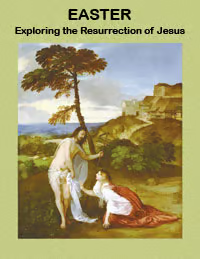
In the free eBook Easter: Exploring the Resurrection of Jesus, expert Bible scholars offer in-depth reflections on the resurrection.
Not even the intense drama and tragedy of Jesus’ trial, passion, death and burial can prepare one for the utter shock at what comes next in the well-known story: Jesus’ resurrection. The Gospels recount varying stories of the disciples’ astonishment and confusion as they encounter the resurrected Jesus.
Chapter 1
Locating the Encounter with the resurrected Jesus
On the road to Emmaus
The Gospel of Luke tells of one such meeting on the road to Emmaus. There is considerable controversy among archaeologists as to which among nine sites may be identified as Biblical Emmaus. In the first chapter of this free eBbook, “Emmaus Where Christ Appeared,” Biblical Archaeology Review editor Hershel Shanks puts forth Emmaus Nicopolis as the leading contender.

Chapter 2
Understanding the Meaning of Resurrection in the ancient world
What did resurrection mean to the earliest Christians?
What did the concept of resurrection mean to the earliest Christians? In what ways did it evolve from—and depart from—contemporaneous ideas about death and the afterlife? Author N.T. Wright traces the origins of the idea of bodily resurrection to first-century Judaism in “The Resurrection of Resurrection,” the second chapter of this free eBook.

Chapter 3
Understanding the Meaning of Resurrection
What does resurrection mean to us today?
And what about the wide range of modern interpretations of the resurrection of Jesus Christ? In the third chapter of this free eBook, “Thinking about Easter,” Marcus J. Borg questions just how literally and physically we should take the gospel accounts of the resurrected Jesus to be.

Chapter 4
Understanding the Resurrection of Jesus in the Bible
The resurrection in the Gospel of Mark
The interpretation of the Gospel of Mark in particular challenges Bible scholars because at least nine versions of its conclusion have been identified in 1,700 surviving ancient Greek manuscripts and early translations. In the fourth chapter of this free eBook, “To Be Continued…,” author Michael W. Holmes stresses the importance of piecing together the end Mark’s resurrection story.

Chapter 5
Understanding The Resurrection of Jesus in Art and Poetry
The resurrection is a well-loved artistic subject
All questions of historicity and scholarship aside, the encounters of the resurrected Jesus with his disciples have been well-loved artistic subjects for centuries. A carved ivory plaque from northern Spain in the 12th century depicts two scenes: the meeting of Jesus and his disciples on the road to Emmaus and Jesus’ appearance to Mary Magdalene outside the empty tomb. In the fifth chapter of this free ebook, “The Resurrection,” this intricate carving accompanies a poem by the medieval French bishop Marbod of Rennes contemplating Jesus’ choice of Mary Magdalene as the first witness of the resurrection.

Chapter 6
Understanding Jesus' Tomb and the Resurrection of Jesus through Art
Peter and John hurry to the empty tomb
The 1898 painting The Disciples Peter and John Running to the Sepulchre on the Morning of the Resurrection by Swiss artist Eugene Burnand captures the next event in the resurrection story. The disciples Peter and John hurry to investigate the story Mary Magdalene has just told them of the empty tomb with the stone rolled away. “To the Tomb,” the sixth chapter of this free eBook, explains the disciples’ mixed emotions and the significance of the missing tomb in this evocative painting.


Recent Blog Posts


The Nun of the Rings

Deborah in the Bible

Want more Bible history?
Sign up to receive our email newsletter and never miss an update.
Unlock Unlimited Access to the Bible's Past

Unlock Unlimited Access to the Bible's Past
Become an All-Access Member to explore the Bible's rich history. Get Biblical Archaeology Review in print, full online access, and FREE online talks. Plus, enjoy special Travel/Study discounts. Don't miss out—begin your journey today!


‘Easter’ is the anglicized name of the pagan deity Astarte (a.k.a. Venus). It was erroneously translated in the original KJV version of the Bible in Acts 12:4 (the correct translation ‘Passover’ has been revised in the new KJV). The error was due to the proximity of the Passover with the Easter celebration.
It is a Pagan spring festival to commemorate the birth of Venus, and celebrated with eggs and rabbits to symbolize rebirth and fertility. When the Roman empire ’embraced’ Christianity as her state religion, many such beliefs, practices and observations of pagan Rome were conveniently incorporated into this new state religion. This is the fulfillment of the parable in Matthew 13:33 of the woman who added leaven in three measure of meal. Over the centuries, this error had solidify to become part of the so-called ‘Christian tradition’, so much so that it is integral to Christendom, and very difficult to remove.
Interestingly, Jesus said that Christians should remember or commemorate his death. he said nothing about remembering his resurrection. Jesus resurrection was a foregone conclusion, in fulfilment of the first prophecy in the Bible at Genesis 3:15, because the the seed of God’s woman (Jesus), was only to be bruised in the heel, showing that Satan’s ‘victory’ was very short lived
He (Satan) managed to have the Jews put Jesus to death, but, only for less than 3 days……….as the Bible states Jesus had to undergo this death as a sacrifice for all mankind……….not that all mankind accept the provisions of that sacrifice.
In the ‘not too distant’ future the other part of Genesis 3:15 will be fulfilled, when Satan’s head is crushed by the resurrected Jesus Christ. The King of God’s Kingdom. (See Matthew 6:10; Daniel 2:44; Daniel 7:13, 14)
The quoted book says: “And what about the wide range of modern interpretations of the resurrection of Jesus Christ? In the third chapter of this free eBook, “Thinking about Easter,” Marcus J. Borg questions just how literally and physically we should take the gospel accounts of the resurrected Jesus to be.”
According to the Bible, there is no room for human interpretations……….ALL scripture is inspired by God. First, the word easter is not contained in God’s Word………”it is of pagan origin. “originally the spring festival in honor of the Teutonic goddess of light and spring known in Anglo-Saxon as Eastre.”” (The Westminster Dictionary of the Bible)
Second , Christians were only told to remember his death, and the reason of what that sacrificial death meant for Christians……….nothing else
Word “Easter” has not be used in Gospels for sure because they had been written in Greek and not in English. Instead Gospels (Matthew’s and John’s) used the word “Paskha” that was quite Jewish in origin. This word came the New Testament from the Old one.
Eric says: “……..original KJV version of the Bible in Acts 12:4 (the correct translation ‘Passover’ has been revised in the new KJV).” Yes, bad translation……….it should not have been Easter and if you would care to look at an interlinear translation you will find that the word should have been translated Passover………the word easter does not even occur in the Bible…….and first century Christians only celebrated Jesus death, every Nisan 14.
Interesting and enlightening
Good
Ots good to explore.