


Gospel of John Commentary: Who Wrote the Gospel of John and How Historical Is It?
A look at some of the questions surrounding the Bible’s most enigmatic gospel
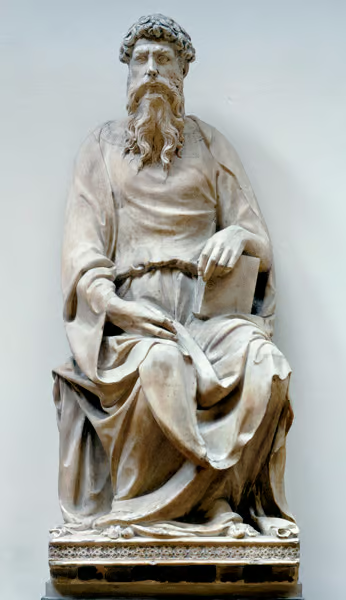
The evangelist John rests one hand on his gospel book, in this 83-inch-tall marble sculpture carved by Donatello in about 1415 for a niche in the facade of the Cathedral of Florence. Scholars writing Gospel of John commentary often grapple with the question: Who wrote the Gospel of John? Photo: Erich Lessing
The Gospels, the first four books of the New Testament, tell the story of the life of Jesus. Yet only one—the Gospel of John—claims to be an eyewitness account, the testimony of the unnamed “disciple whom Jesus loved.” (“This is the disciple who is testifying to these things and wrote these things, and we know that his testimony is true” [John 21:24]). “Who wrote the Gospel of John?” is a question that remains unanswered, though noted theologians throughout the ages maintain that it was indeed the disciple John who penned the famous Biblical book.
Gospel of John commentary is easy to find—some of the most famous theologians in history have closely examined the text and underscored its importance from as early as the beginning of the third century. It is believed that Origen, an Alexandrian Christian scholar and theologian, wrote his Gospel of John commentary while in Alexandria at some point after 218 A.D. St. Augustine—a famous fourth century church father—contributed no fewer than 124 tractates in his Gospel of John commentary, while St. Thomas’s Gospel of John commentary of the 13th century is still highly regarded today by modern scholars.
We may never know for certain who wrote the Gospel of John, any more than we can know who wrote the books of Matthew, Mark and Luke. We do know that John is a gospel apart, however. Early Matthew, Mark and Luke are so alike in their telling that they are called the Synoptic Gospels, meaning “seen together”—the parallels are clear when they are looked at side by side. Matthew and Luke follow the version of events in Mark, which is thought by scholars to be the earliest and most historically accurate Gospel. John, however, does not include the same incidents or chronology found in the other three Gospels, and the fact that it is so different has spurred a debate over whether John’s Gospel is historical or not, something that has been noted in Gospel of John commentary for hundreds—even thousands—of years.
Several hypotheses have attempted to explain why so much of Jesus’ life not portrayed in the Synoptics is present in John and vice versa. One hypothesis claims that John recorded many of the events that occurred before the arrest of John the Baptist, while the Synoptics all have Jesus’ ministry beginning only after the arrest. Another holds that John was written last, by someone who knew about the other three Gospels, but who wished to write a spiritual gospel instead of an historical one. This would mean that the person who wrote the Gospel of John would not have been a contemporary of Jesus, and therefore would not have been an eyewitness as the author claims. There is also the possibility that the author of John did not know of Mark and hence did not have the same information.
Become a BAS All-Access Member Now!
Read Biblical Archaeology Review online, explore 50 years of BAR, watch videos, attend talks, and more

One of the facts in dispute among the four Gospels is the length of Jesus’ ministry. According to the Synoptics, it lasted only about a year, while John has Jesus ministering between two and three years. The Jesus of John’s telling also knew Jerusalem well and had traveled there three or four times. The Synoptics, however, have Jesus visit Jerusalem only once. In John, Jesus had friends near Jerusalem, including Mary, Martha and Lazarus of the town of Bethany, which is just outside of the city on the east slope of the Mount of Olives.
The author of John also knew Jerusalem well, as is evident from the geographic and place name information throughout the book. He mentions, among others, the Sheep Gate Pool (Bethesda), the Siloam Pool and Jacob’s Well. The geographic specificity lends credence to the John’s account.
Another aspect of John that may be more historically accurate than the Synoptics is the account of the crucifixion and the events that led up to it. The Synoptics say that Jesus’ Last Supper was the Passover meal—held that year on a Thursday evening (Jewish holidays begin at sunset)—and they would have us believe that the Sanhedrin, the high court, gathered at the beginning of a major holiday to interrogate Jesus and hand him over to the Romans. John, in contrast, has Jesus handed over for crucifixion on “the day of Preparation of Passover week, about the sixth hour.” According to John, the Last Supper is not a Passover meal (because the holiday that year did not start until Friday evening), and Jesus is crucified and buried before Passover begins. In John’s account Jesus becomes the Passover sacrificial lamb, which was offered the afternoon before the Passover holiday. Some scholars suggest that John may be more historical regarding the crucifixion than the other three Gospels.
Given John’s familiarity with Jerusalem and its environs, it is very possible that he had visited the Pool of Siloam, which he mentions in connection with the story of the curing of the blind man (a story that appears only in John’s Gospel). It is that pool that has only recently been uncovered, as described in the accompanying article.
For more on the question of John’s historical reliability, see D. Moody Smith, “John: Historian or Theologian?” Bible Review, October 2004.
Based on “How Historical is the Gospel of John?” Biblical Archaeology Review, September/October 2005.
Related reading in Bible History Daily
All-Access members, read more in the BAS Library
Not a BAS Library or All-Access Member yet? Join today.
This Bible History Daily article was originally published in March 2012.
Related Posts



Must-Read Free eBooks
Want more Bible history?
Sign up to receive our email newsletter and never miss an update.
Unlock Unlimited Access to the Bible's Past

Unlock Unlimited Access to the Bible's Past
Become an All-Access Member to explore the Bible's rich history. Get Biblical Archaeology Review in print, full online access, and FREE online talks. Plus, enjoy special Travel/Study discounts. Don't miss out—begin your journey today!

I agree that the author of John’s Gospel wrote a more ‘spiritual’ than historical work, though the accuracy of many of his references has been demonstrated. But why do you say that he can’t have been a contemporary of Jesus? If he was a young man aged 17-20 during Jesus’ ministry, he could have written his gospel when he was c. 80 years old, as it is usually dated to the late 1st century. Some have even argued for an earlier date!
John M
Looking at the accurate geographical references, the knowledge of Jerusalem, the knowledge of the temple festivals, the knowledge of what happened during Jesus´ trial, the knowledge of the content of late night discussions with Nicodemus (a member of the Jewish leadership who Jesus called a teacher, but who at first failed to understand, who as a Jewish leader, who would have been known to the Temple guards and who was present at Jesus´ trial, as was the beloved disciple in John), I would say that considering all of these coincidences, Nicodemus should be considered a good candidate for the identity of the beloved disciple and the origin of the original material used for the Gospel of John. The text itself states the material was redacted by a follower of the beloved disciple after his death. Any comments or objections on this possible identity for the ¨beloved disciple?”
Any
John even describes a rich young man coming to Jesus who goes away sadly, stating that Jesus saw him and loved him – like the beloved disciple. -Nicodemus appears to be rich, like the young man loved by Jesus. We don´t know if he was young or old. But He was a scholar, who probably had the background to write a theological Gospel, was present at Jesus´ trial, and at his crucifixion as was the beloved disciple.
What everyone seams to neglect is that John is described as being a part of the lower classes, just as all of Jesus’s disciples were. Given that during that time and age at the best of times the literacy rate in the Roman empire was about 10%. The literacy rate of a rural Palestinian town is significantly lower, more like 3%, and these were people who could most likely only read. About 1-2% could effectively write legible Aramaic (the language Jesus and his disciples would have spoken). Far fewer could compose such a well written account such as John. Plus only the rich, or their slaves who needed to know how to write for chores, could afford the education to read or write. This effectively makes it implausible to have John being the author. But this goes without saying that John, in theory, could have gotten enough money to learn advanced Greek (what the gospels were originally written in) and later in life decided to write a book… but it seams like a lot to believe on no positive evidence and an overwhelming amount against it.
What is more probable is that an unnamed author living after Jesus died composed a gospel and it got circulating. A group found they enjoyed and accepted the teachings that it held and ascribed apostolic authority to the book in order to promote their own ends. Read Forged by top class Biblical Scholar Bart Ehrman for a more precise and deep argument plus the citations for the info.
This in no way degrades the meaning of John if you believe in it’s moral teachings, but know that there are good reasons to suggest it is not a product of John.
Regarding the authorship, notice carefully in John 21:24-25 that there are three very distinct people or groups of people mentioned:
(1) the unidentified Beloved Disciple: “this is the disciple who testifies concerning these things” (3rd person reference)
(2) the community of the Beloved Disciple… his church/followers/community (whatever you want to call them): “and *we* know his testimony is true” (1st person, plural = the community; also mentioned as “the brothers” in 21:23)
(3) the actual author who put ink to papyrus: “*I* suppose the world itself” (1st person singular).
The Beloved Disciple is the source for the Fourth Gospel, but *not* the author who put ink to papyrus. The author is a follower of the Beloved Disciple and is a separate person when you separate out the people mentioned in the last 2 verses of the book.
So why does 21:24 indicate that the Beloved Disciple “wrote” these things? Well, in the same sense that Pilate “wrote” the inscription for Jesus’ cross (19:22). Did Pilate actually get a board and paint the inscription himself? Most assuredly not. One of the Romans did it, even though Pilate was the source of the inscription.
Hope this is helpful.
The Book of John is wonderful and powerful for all new converts. At my conversion in 1978, the preacher’s sermon was on the resurrection from John’s Gospel. Since then, when I share the Gospel, and someone is very interested in knowing Jesus, I’ll have them study John’s Gospel first and foremost, then I will break open Paul’s Epistles of Romans and Hebrews. Yes, my opinion on Hebrews is that when Paul was waiting for execution in the 20’ft hole in front of the Senate in Rome, that Apollos must have visited him there. Being bound, Paul could not write, but may have instructed Apollos to write as he orally communicated. Apollos then would insert his Alexandrian Greek in and out of the passage. Hope this helps someone.
Did none of you read the well-thought -out analysis of the identity of the “beloved disciple” published in this publication or its forerunner, Bible Review, a few years back, researched and written by Ben Witherington? I found his observations, reasoning, and tentative conclusion fully convincing that the identity of the beloved was most likely Lazarus. I have since taken this theory further and found more and more evidence that satisfies both the “facts” and the “truth” of the gospel of “John.”
Some interesting remarks here. I learned some things from various comments, and that’s a good thing.
I also learned that someone who says one thing in one book and another thing elsewhere is a “top class Biblical scholar”–per comment #11. Would not say so.
I believe John was written about 30 years after the destruction of the Temple and shows the effect of Pauline Christianity. This is particularly evident in the emphasis of Christ being a part of the Godhead, and His existence as part of God at the time of the creation. John shows the evolution of Christian belief.
Any assessment of the relationship between John and the synoptics that doesn’t grapple with JAT Robinson’s Bampton Lectures published in the early 1980s as The Priority of John is really not worth wasting time with. Robinson developed much of CH Dodd’s work on the Fourth Gospel. The most raw specific early material about Jerusalem is found in John. Robinson identifies five redactions in the book, all by the same hand. Taken with his Redating the New Testament (1978) we have in John the earliest written material of any gospel (as early as 42AD) and like the remainder of the New Testament, completed before 70AD, given there is no evidence any NT writer has any knowledge of the fall of Jerusalem in that year which was a cataclysmic event for Jews and from which Jewish Christians fled ahead of time. Despite being a liberal theologian (Honest to God, 1964) Robinson’s work is very much in the classical scholarship tradition of Westcott, Lightfoot and Hort (and his uncle Armitage Robinson) which is as rigorous as anything available on historical veracity.
Years ago I took a college course that went into facts regarding the New Testament. The professor pointed out that there had been countless changes (300,000 ) to the New Testament and each change took it further from the truth. The professor also checked events that were reliably recorded at the time of the event by Roman,Greek and Hebrew writers. He came to the conclusion none of the authors was witness to the actual events. In fact he was sure that John was written much later by a person who was influenced by Roman anti semitism and was not Jewish. John has numerous derogitory statements regarding Jews that don’t fit the customs of the times. He said Roman rulers at the time would kill their mothers and certainly wouldn’t ask a crowd what to do, because it would make them look weak to their men. The professor checked the recorded birth and death of well known Roman Emperors and events such as paying taxes or taking a census and said that when they mention a specific person like Caesar Augustus, things don’t ring true regarding dates and other facts mentioned. He said the famous painting of the Last Supper was an example of misinformation. The artist is allegedy painting the Passover meal and places loves of bread on the table instead of flat unleavened bread. What is the difference and does all this matter? I don’t think so. There are over 5000 Protestant denominations in the United States and numerous other beliefs. Since no one has ever come back from the dead during the past million years that man has been on the earth, we don’t really know what happens when you die. However, we do know that religion has caused more deaths than almost any other belief.