


Israel: An Archaeological Journey
What can archaeology tell us about the world of the Hebrew Bible and New Testament? Archaeology illuminates the history of ancient Israel, the point where three of the world’s major religions converge.
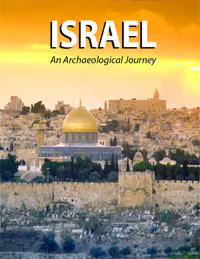
Israel: An Archaeological Journey
Sift through the storied history of ancient Israel
Israel. The very name means different things to different people. It is a geographic place: the ancient land of the Israelites as well as a modern Mediterranean nation. It is a people: practitioners of Judaism who see themselves as descended from Biblical Jacob. It is a hot-button political topic, a homeland, a vacation destination and, perhaps most significantly, it is the place where three of the world’s major religions converge, creating a palimpsest of history that is one of the richest and most complex in the world.
This free eBook examines key archaeological sites from Hebrew Bible and New Testament eras in Israel. Archaeological discoveries shed light on places of sorrow and joy, from Roman prisons to seaside entertainment districts. Explore the religion and history of ancient Israel from the Babylonian destruction through the New Testament era in this free eBook.
Chapter 1
The Fury of Babylon
In “The Fury of Babylon: Ashkelon and the Archaeology of Destruction,” Harvard professor Lawrence Stager guides readers through the excavations at Ashkelon, painting a portrait of the city whose vicious destruction by the Babylonian army was so vividly described by the prophet Jeremiah (Jeremiah 47:4–5). Stager sets the site against the backdrop of the larger political and historical context of Egypt and Babylon in the seventh century B.C., and offers a detailed picture of the city and the life of its inhabitants on the eve of its destruction, as gleaned from a meticulous examination of the archaeological record.
Chapter 2
Vegas on the Med: A Tour of Caesarea’s Entertainment District
In an unprecedented breakthrough, paleographer Ada Yardeni recently identified the handwriting of a single scribe on more than 50 Dead Sea Scrolls from the Qumran caves. Remarkably, Yardeni identified the same scribal hand in a manuscript of the Joshua Apocryphon discovered in the Masada desert fortress, 30 miles south of Qumran. In “Scribe Links Qumran and Masada,” Sidnie White Crawford explains what this identification can tell us about the scribal community at Qumran.
Chapter 3
How Jewish was Sepphoris in Jesus’ Time?
Although Judea was already a Roman province when Jesus lived, there has long been debate about the cultural influences that may have shaped his life and teachings. In their article “How Jewish was Sepphoris in Jesus’ Time?” scholars Mark Chancey and Eric Meyers examine the Galilean city of Sepphoris as it was in the early first century A.D. Since the city is just 4 miles from Nazareth and has yielded more archaeological data than the nearby village, scholars have traditionally viewed Sepphoris as a cultural barometer of life where Jesus grew up. How Jewish was Sepphoris? Chancey and Meyers argue that, despite the influence of the omniscient Romans, a strong Jewish cultural identity existed in the community during Jesus’ formative years. Through a careful examination of the archaeological record at Sepphoris, Chancey and Meyers make a case for the Jewish culture that they maintain was the backdrop of Jesus’ life.
Chapter 4
Where Masada’s Defenders Fell
The people of Judea strove to maintain their identity despite the presence of the occupying Romans. There is no stronger symbol of this struggle for Jewish identity and independence than Masada, the palace-fortress built by Herod the Great that was the site of the last, desperate stand of a group of Jewish Zealots against the Roman army during the First Jewish Revolt. The traditional interpretation of events at Masada is that this struggle ended in the dramatic suicide of the almost 1,000 Zealots in 73 A.D. Both archaeologists and historians have long studied the site and the existing primary source for more clues regarding the rebels’ last hours. In his article “Where Masada’s Defenders Fell,” sociologist Nachman Ben-Yehuda takes a close look at the traditional interpretations of the first-century accounts of Flavius Josephus. In a re-examination of the text, Ben-Yehuda offers a different theory regarding the final resting place of Masada’s defenders.
Chapter 5
A New Reconstruction of Paul’s Prison
The writings of Flavius Josephus are not just relied upon for interpreting events at Masada. Indeed, his works are frequently used as the launching point for many archaeological investigations in the history of ancient Israel. Archaeologist Ehud Netzer relies in part on Josephus to reconstruct Herod’s Antonia fortress. In “A New Reconstruction of Paul’s Prison: Herod’s Antonia Fortress,” Netzer puts forth his archaeological interpretation of the structure that guarded the Temple Mount and may have been where Paul was imprisoned by the Roman authorities.
Through archaeology, we get a better understanding of the history of ancient Israel and the ancient cultures and events that have shaped modern society and religion. This free eBook provides a close look at life and religion at the heart of the Holy Land. We are delighted to offer this journey into archaeology, Israel and the Biblical world for free.


Recent Blog Posts

The Nun of the Rings

Deborah in the Bible

Want more Bible history?
Sign up to receive our email newsletter and never miss an update.
Unlock Unlimited Access to the Bible's Past

Unlock Unlimited Access to the Bible's Past
Become an All-Access Member to explore the Bible's rich history. Get Biblical Archaeology Review in print, full online access, and FREE online talks. Plus, enjoy special Travel/Study discounts. Don't miss out—begin your journey today!


The comment that Israel is an apartheid state is untrue The Islamists and other non Jews are granted political acceptance and have full representation in the Knesset.The Palestinians living in the west Bank and Gaza have been neglected and been abused by Arab leadership .Money provided for their welfare has been stolen by radicals and kept them wanting.. If Hamas and other Arab groups cared about their people they would stop bombing Israel and support decency and peace. Palestinian schools would stop training children to value death as a way of preserving Islam. Jesus was killed by the Romans not the Hebrews .He was a devout Jew and his disciples removed his divinity by rendering him a mortal and creating statues and pictures. The ancient Hebrews could not accept this and preserve the spirituality of the Devine
Do you dispute that Jesus was not killed by the Jews when in fact they demanded His death?