


Ancient Israel in Egypt and the Exodus
Interested in what archaeology can tell us about the historicity of the Exodus?

In this free eBook, learn about the Israelites in Egypt and the archaeological context of the Exodus.
The Exodus is one of the most dramatic events in the Hebrew Bible—the slavery of the Israelites in Egypt and their miraculous escape across the Red Sea. It is traditionally viewed as the single event that gave birth to the nation of Israel. Is there archaeological evidence for the Exodus, and for Israelites in Egypt?
The Biblical narrative of the Exodus is a fascinating account that can be supplemented by additional historical sources. This free eBook, taken from articles in Biblical Archaeology Review magazine, considers texts and archaeological evidence from the second millennium B.C.E. that describe Israel in Egypt and the Exodus.
Chapter 1
In “Out of Egypt,” James K. Hoffmeier questions how likely is it that the Israelites were enslaved in Egypt. And if they were there, which way did they go when they left? Hoffmeier uses recent archaeological excavation data from Egypt to shed new light on the slavery of the Israelites in Egypt, the locations mentioned in Exodus and the route the Israelites took out of Egypt to the Promised Land.
Chapter 2
Abraham Malamat’s article “Let my People Go and Go and Go and Go” questions the historicity of the Exodus. Malamat suggests that once we give up the search for a single, dramatic Exodus, the evidence for a more subtle image of ancient Israel in Egypt and the Exodus—one dispersed over time—will emerge.

Chapter 3
Finally, in “When Did Ancient Israel Begin?” Hershel Shanks takes a new look at the late-13th-century B.C.E. Merneptah Stele, which has long been considered the earliest reference to Israel outside of the Bible. But now three German scholars say they may have found another hieroglyphic inscription almost 200 years older naming “Israel.” This new archaeological evidence of the Israelites in Egypt suggests that the Bible may be more accurate than some thought.
This free eBook shares new archaeological evidence for the Israelites in Egypt, and reshapes understandings of the historicity of the Exodus.



Recent Blog Posts

The Nun of the Rings

Deborah in the Bible

Want more Bible history?
Sign up to receive our email newsletter and never miss an update.
Unlock Unlimited Access to the Bible's Past

Unlock Unlimited Access to the Bible's Past
Become an All-Access Member to explore the Bible's rich history. Get Biblical Archaeology Review in print, full online access, and FREE online talks. Plus, enjoy special Travel/Study discounts. Don't miss out—begin your journey today!


I have been excited about the work of Egyptologist Dr. David Rohl and look forward to his new book “Exodus – Myth or History”. Dr. Rohl found the timeline for Egyptian history was out of sync with the actual archeological facts. If you place the new timeline over the known dates for the conquest of Canaan then even the fall of Jericho now falls into place.
Dr Rohl learned about the errors in dating Egyptian history from Prof. Immanuel Velikovsky’s book “Ages in Chaos”. When the dates are corrected all the Bible falls into place. There is no “myth”. To understand, get hold of the book FIRST.
Mervyn
In my life as I have walked holding hands with Elohim _ I have learned that He purposely keeps to Himself proofs of His accounts. In doing so He challenges us to believe in this case, regardless the apparent lack of archaeological evidence. The knowledge belongs to Him and He reveals His knowledge as needed for us to exercise our faith in Him in a manner that help us to grow as believers. Deuteronomy 29:29 states “The secret things belong to the Lord our God, but those things which are revealed belong to us (…)”.
The real believer is that who doesn’t need any proof but His word. He gives us crumbs of knowledge, not too much that we become lazy in our faith and not too little that we get discouraged for the lack of it. This dynamic is compatible with The Lord’s character; He gave us free will so we can choose to believe or choose not to, He doesn’t force us, however as Jesus said to Thomas: “Because you have seen me, you have believed; blessed are those who have not seen and yet have believed.”
I believe.
As written in Judges 11:26 The Israelites were 300 years in the Trans Jordan. The Israelites were part of the Hyksos at Avaris, see Bietak Expedition Reports, from the time of Joseph vizier of the Hyksos, Genesis 41:33-39. The 5 conspirators who had conspired to kill then sold Joseph into slavery, Genesis 37::18-28 were given land at Goshen near the future city Pi-Ramesses Genesis 47:2-6. This was about 1620 BC.
The conspirators were the pastoral Judahites. Reuben, Simeon, Judah, Levi and Gad..
The Israelites who lived at Avaris were expelled by King Ahmose along with the Hyksos about 1535 BC and there was a pursuit. This Exodus was one of Haste This episode is described by Ebana at his tomb site.. The Israelites fled into Canaan along the way passing the Sea of Reeds probably Lake Ballah, See the Haggadah P.106 Seif Edition. The Israelites found themselves in the Trans Jordan. They may have made a brief foray back into Canaan about 1447 BC while Thutmose III was attacking the Amorites. The Israelites entered Canaan about 1230 led by Joshua the Ephraimite
a Josephite. The Judahites remained on their land at Goshen until the advent of Moses the Judahite who returned from Midian after the death of Ramesses Ii in 1213 BC Exodus 2:23. The Judahites were conscripted to provide labour for the building of Pi-Ramesses, the city of Ramesses Exodus 1:11. The Exodus of the Judahites was burdened with herds of Cattle and flocks of sheep Exodus 12:32, it was a leisurely affair. Moses had just returned from Midian and would have taken the Judahites by the shortest route back to Midian Exodus 2:15. There is no Egyptian record of any pursuit or disaster at the time of this Exodus. The Judahites entered Canaan from the south as described in Judges 1:3 forty years after leaving Egypt probably led by Caleb the Judahite, after 1170 BC. At least 60 years after the eastern entry of the Israelites into Canaan led by Joshua the Josephite.
The First Exodus was one of haste pursued by King Ahmose. The Second Exodus was a leisurely affair. King Merneptah was not at Pi-Ramesses at the time of the departure of the Judahites he had moved to a palace at Memphis, see Univ. of Penn. Museum exhibit.
BHD claims (without the slightest evidence) that the Hyksos and the Israelites worked together. Other commentators make similar stupid assertions. The Hebrew Bible tells us clearly that the Israelites heading EAST or SOUTH EAST were attacked by the Hyksos heading WEST Into Egypt after Egypt had been totally destroyed in what we call the Ten Plagues. Moreover the Egyptian people at all levels had been decimated as their stone buildings collapsed on them. Further, their army and pharaoh
had been drowned at the Reed Sea so the Land of Egypt was wide open and, as we are told in the Bible, there was no resistance.
Will those commentators expressing their own wishful views rather than facts, please read Dr Immanuel Velikovsky’s “Ages in Chaos” which explains HOW it all happened. No need for ignorant hypotheses anymore. Or even so-called learned ones!
The Pharaoh at the time of the Exodus was Pharaoh Thom, the last of the 12th Egyptian Dynasty (apart from a son who died immediately after Thom drowned.) From then on there were the Hyksos/Amu/Amalekite dynasties 13,14,15 and 16th Dynasties. That lasted until King Saul defeated them completely at the battle of Avaris, their capital. Read about it in the Hebrew Book of Samuel.
The first new Pharaoh of Egypt after the overthrow of the Amu/Amalekites/Hyksos was the native short-lived 17th dynasty followed by the 18th. “The Great Queen of Egypt and the South” otherwise known as Hatshepsut was the queen “Sheba” who visited King Solomon of Israel and bore him a son. On her return to Africa she made him viceroy of Ethiopia and gave him and his heirs a title carried down the dynasty as “The Lion of Judah” until Emperor Haile Selassie was assassinated in our life-time.
Instead of writing “Comments” about which several of you obviously know nothing, try reading Dr. Immanuel Velikovsky’s book “AGES IN CHAOS”. It opened my eyes and opened History.
.
After you have read Velikovsky you can THEN discuss the subject of Jewish history.
Correction Moses was not a Judite. He was from the tribe of Levi.
What evidence is there that bricks were made in ancient Egypt?
The Bible book of Exodus states that the Egyptians put their Hebrew slaves to work making bricks. The slaves had to make a prescribed number each day, using clay mortar and straw.—Exodus 1:14; “They made their life bitter with hard labor, as they worked with clay mortar and bricks and in every form of slavery in the field. Yes, they made them toil in harsh conditions in every form of slavery.”-Exodus 5:10-14.”So the taskmasters and their foremen went out and said to the people: “Here is what Pharʹaoh has said, ‘I am giving you no more straw. Go and get your own straw for yourselves wherever you can find it, but your work will not be reduced at all.’” Then the people scattered throughout all the land of Egypt to gather stubble for straw. And the taskmasters kept urging them: “You must each finish your work every day, just as when straw was provided.” Also the foremen of the Israelites, whom Pharʹaoh’s taskmasters had appointed over them, were beaten.They asked them: “Why did you not reach the quota of bricks that you used to make? It happened both yesterday and today.”http://wol.jw.org/en/wol/d/r1/lp-e/2012010
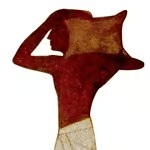
The making of sun-dried bricks was an important occupation in the Nile Valley in Bible times. Ancient monuments built from this material still stand in Egypt. A wall painting in the 15th-century B.C.E. tomb of Rekhmire in Thebes, almost contemporary with the events recounted in the book of Exodus, illustrates the process.
The International Standard Bible Encyclopedia describes the scene in this painting as follows: “Water is brought from a pool; mud is mixed with a hoe and then carried to a spot convenient for the brickmaker. This mud is pressed into a wooden mold which the brickmaker holds to the ground. The mold is then lifted off, leaving a newly shaped brick to dry in the sun. Rows and rows of bricks are molded and, when dry, stacked preparatory to use. This procedure is still followed in the Near East.”
Different papyrus documents from the second millennium B.C.E. also refer to the making of bricks by serfs, to the use of straw and brick-clay, and to the daily production quota of bricks that workers had to meet.
Detail of wall painting in tomb of Rekhmire; Erich Lessing/Art Resource, NY
http://www.academia.edu/2118834/Out_of_Egypt