


Herod’s Death, Jesus’ Birth and a Lunar Eclipse
Letters to the Editor debate dates of Herod’s death and Jesus’ birth
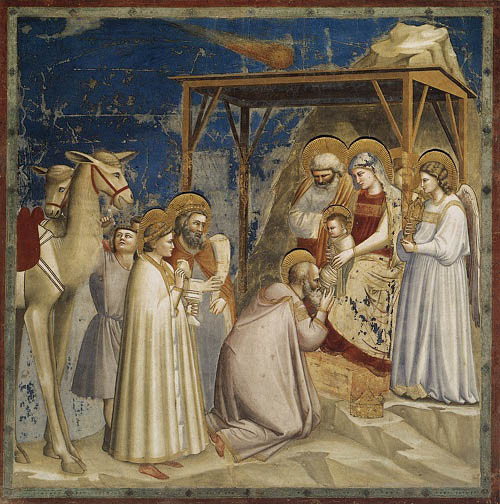
Giotto, Adoration of the Magi, c. 1306.
Both Luke and Matthew mention Jesus’ birth as occurring during Herod’s reign (Luke 1:5; Matthew 2:1). Josephus relates Herod’s death to a lunar eclipse. This is generally regarded as a reference to a lunar eclipse in 4 B.C. Therefore it is often said that Jesus was born in 4 B.C.
But physics professor John A. Cramer, in a letter to BAR, has pointed out that there was another lunar eclipse visible in Judea—in fact, two—in 1 B.C., which would place Herod’s death—and Jesus’ birth—at the turn of the era. Below, read letters published in the Q&C section of BAR debating the dates of Herod’s death, Jesus’ birth and to which lunar eclipse Josephus was referring.
When Was Jesus Born?
Let me add a footnote to Suzanne Singer’s report on the final journey of Herod the Great (Strata, BAR, March/April 2013): She gives the standard date of his death as 4 B.C. [Jesus’ birth is often dated to 4 B.C. based on the fact that both Luke and Matthew associate Jesus’ birth with Herod’s reign—Ed.] Readers may be interested to learn there is reason to reconsider the date of Herod’s death.
This date is based on Josephus’s remark in Antiquities 17.6.4 that there was a lunar eclipse shortly before Herod died. This is traditionally ascribed to the eclipse of March 13, 4 B.C.
Unfortunately, this eclipse was visible only very late that night in Judea and was additionally a minor and only partial eclipse.
There were no lunar eclipses visible in Judea thereafter until two occurred in the year 1 B.C. Of these two, the one on December 29, just two days before the change of eras, gets my vote since it was the one most likely to be seen and remembered. That then dates the death of Herod the Great into the first year of the current era, four years after the usual date.
Perhaps the much-maligned monk who calculated the change of era was not quite so far off as has been supposed.
John A. Cramer
Professor of Physics
Oglethorpe University
Atlanta, Georgia

FREE ebook: The First Christmas: The Story of Jesus’ Birth in History and Tradition. Download now.
When Was Jesus Born? When Did Herod Die?
Q&C, BAR, January/February 2014
Professor John A. Cramer argues that Herod the Great most likely died shortly after the lunar eclipse of December 29, 1 B.C., rather than that of March 13, 4 B.C., which, as Cramer points out, is the eclipse traditionally associated with Josephus’s description in Jewish Antiquities 17.6.4 (Queries & Comments, “When Was Jesus Born?” BAR, July/August 2013) and which is used as a basis to reckon Jesus’ birth shortly before 4 B.C. Professor Cramer’s argument was made in the 19th century by scholars such as Édouard Caspari and Florian Riess.
There are three principal reasons why the 4 B.C. date has prevailed over 1 B.C. These reasons were articulated by Emil Schürer in A History of the Jewish People in the Time of Jesus Christ, also published in the 19th century. First, Josephus informs us that Herod died shortly before a Passover (Antiquities 17.9.3, The Jewish War 2.1.3), making a lunar eclipse in March (the time of the 4 B.C. eclipse) much more likely than one in December.
Second, Josephus writes that Herod reigned for 37 years from the time of his appointment in 40 B.C. and 34 years from his conquest of Jerusalem in 37 B.C. (Antiquities 17.8.1, War 1.33.8). Using so-called inclusive counting, this, too, places Herod’s death in 4 B.C.
Become a BAS All-Access Member Now!
Read Biblical Archaeology Review online, explore 50 years of BAR, watch videos, attend talks, and more

Third, we know that the reign over Samaria and Judea of Herod’s son and successor Archelaus began in 4 B.C., based on the fact that he was deposed by Caesar in A.U.C. (Anno Urbis Conditae [in the year the city was founded]) 759, or A.D. 6, in the tenth year of his reign (Dio Cassius, Roman History 55.27.6; Josephus, Antiquities 17.13.2). Counting backward his reign began in 4 B.C. In addition, from Herod the Great’s son and successor Herod Antipas, who ruled over Galilee until 39 B.C., who ordered the execution of John the Baptist (Mark 6:14–29) and who had a supporting role in Jesus’ trial (Luke 23:7–12), we have coins that make reference to the 43rd year of his rule, placing its beginning in 4 B.C. at the latest (see Morten Hørning Jensen, “Antipas—The Herod Jesus Knew,” BAR, September/October 2012).
Thus, Schürer concluded that “Herod died at Jericho in B.C. 4, unwept by those of his own house, and hated by all the people.”
Jeroen H.C. Tempelman
New York, New York
John A. Cramer responds:
Trying to date the death of Herod the Great is attended by considerable uncertainty, and I do not mean to claim I know the right answer. Mr. Tempelman does a good job of pointing out arguments in favor of a 4 B.C. date following the arguments advanced long ago by Emil Schürer. The difficulty is that we have a fair amount of information, but it is equivocal.
The key information comes, of course, from Josephus who brackets the death by “a fast” and the Passover. He says that on the night of the fast there was a lunar eclipse—the only eclipse mentioned in the entire corpus of his work. Correlation of Josephus with the Talmud and Mishnah indicate the fast was probably Yom Kippur. Yom Kippur occurs on the tenth day of the seventh month (mid-September to mid-October) and Passover on the 15th day of the first month (March or April) of the religious calendar. Josephus does not indicate when within that time interval the death occurred.
Only four lunar eclipses occurred in the likely time frame: September 15, 5 B.C., March 12–13, 4 B.C., January 10, 1 B.C. and December 29, 1 B.C. The first eclipse fits Yom Kippur, almost too early, but possible. It was a total eclipse that became noticeable several hours after sundown, but it is widely regarded as too early to fit other information on the date. The favorite 4 B.C. eclipse seems too far from Yom Kippur and much too close to Passover. This was a partial eclipse that commenced after midnight. It hardly seems a candidate for being remembered and noted by Josephus. The 1 B.C. dates require either that the fast was not Yom Kippur or that the calendar was rejiggered for some reason. The January 10 eclipse was total but commenced shortly before midnight on a winter night. Lastly, in the December 29 eclipse the moon rose at 53 percent eclipse and its most visible aspect was over by 6 p.m. It is the most likely of the four to have been noted and commented on.
None of the four candidates fits perfectly to all the requirements. I like the earliest and the latest of them as the most likely. The most often preferred candidate, the 4 B.C. eclipse, is, in my view, far and away the least likely one.
A Different Fast
John Cramer responds to Mr. Tempelman’s letter to the editor (“Queries and Comments,” BAR, January/February 2014) that Herod’s death occurred between a “fast” and Passover. Mr. Cramer acknowledges that the fast of Yom Kippur fits the eclipse but doesn’t fit the time frame of occurring near Passover. There is, however, another fast that occurs exactly one month before Passover: the Fast of Esther! The day before Purim is a fast day commemorating Queen Esther’s command for all Jews to fast before she approached the king. Purim fell on March 12–13, 4 B.C. So there was an eclipse and a fast on March 12–13, 4 B.C., one month before Passover, which would fit Josephus’s statement bracketing Herod’s death by a fast and Passover.
Suzanne Nadaf
Brooklyn, New York
John A. Cramer responds:
This suggestion seems plausible and, if I recall correctly, someone has already raised it. The consensus, if such exists, seems, however, to be that the fast really should be the fast of Yom Kippur, but resolving that issue requires expertise to which I make no claim. Too many possibilities and too little hard information probably leave the precise date forever open.
Become a BAS All-Access Member Now!
Read Biblical Archaeology Review online, explore 50 years of BAR, watch videos, attend talks, and more
When Did Herod Die? And When Was Jesus Born?
Q&C, BAR, September/October 2014
Regarding the date of the death of Herod the Great, the question of which lunar eclipse and which Jewish fast the historian Josephus was referring to must be considered in light of other data that Josephus reported. Professor John Cramer’s suggestion that an eclipse in 1 B.C.E. would place Herod’s death in that year, rather than the generally accepted 4 B.C.E., cannot be reconciled with other historical facts recorded by Josephus.
As is well known, Herod’s son Archelaus succeeded him as the ruler of Judea, as reported by Josephus (Antiquities 8:459). Josephus also recorded that Archelaus reigned over Judea and Samaria for ten years, and that in his tenth year, due to complaints against him from both Jews and Samaritans, he was deposed by Caesar Augustus and banished to Vienna (Antiquities 8:531). Quirinius, the legate or governor of Syria, was assigned by the emperor to travel to Jerusalem and liquidate the estate of Archelaus, as well as to conduct a registration of persons and property in Archelaus’s former realm. This occurred immediately after Archelaus was deposed and was specifically dated by Josephus to the 37th year after Caesar’s victory over Mark Anthony at Actium (Antiquities 9:23). The Battle of Actium is a well-known event in Roman history that took place in the Ionian Sea off the shore of Greece on September 2 of the year 31 B.C.E. Counting 37 years forward from 31 B.C.E. yields a date of 6 C.E. for the tenth year of Archelaus, at which time he was deposed and Quirinus came to Judea. And counting back ten years from that event yields a date of 4 B.C.E. for the year in which Herod died. (The beginning and ending years are both included in this count, since regnal years for both Augustus and the Herodians were so figured.)
These reports, and the chronology derived from them, provide compelling evidence for the generally accepted date of Herod’s death in the spring of 4 B.C.E., shortly after the lunar eclipse of March 13, regardless of the fact that eclipses also occurred in other years.
Jeffrey R. Chadwick
Jerusalem Center Professor of Archaeology and Near Eastern Studies
Brigham Young University
Provo, Utah
Read Lawrence Mykytiuk’s BAR article “Did Jesus Exist? Searching for Evidence Beyond the Bible” >>
There’s More Evidence from Josephus
Q&C, BAR, January/February 2015
In the letter to the editor in BAR, September/October 2014, Jeffrey Chadwick gives the argument for the death of Herod in 4 B.C. [used for determining the date of Jesus’ birth]. For over a century, this has been part of the standard reasoning for the 4 B.C. of Jesus’ birth. However, it does not come to grips with all of the data from Josephus. Elsewhere I have written about this. [An excerpt by Professor Steinmann can be read below.—Ed.]
One cannot simply and positively assert that a few short statements by Josephus about the lengths of reigns of his sons can be used to prove that Herod died in 4 B.C. Instead, one needs critically to sift through all of the evidence embedded in Josephus’s discussion as well as evidence external to Josephus to make a case for the year of Herod’s death.
Andrew Steinmann
Distinguished Professor of Theology and Hebrew
University Marshal
Concordia University Chicago
Chicago, Illinois
Read an excerpt from Andrew E. Steinmann’s book From Abraham to Paul: A Biblical Chronology (St. Louis: Concordia, 2011), pp. 235–238 [footnotes removed]; see also his article “When Did Herod the Great Reign?” Novum Testamentum 51 (2009), pp. 1–29.
Originally Herod had named his son Antipater to be his heir and had groomed Antipater to take over upon his death. However, a little over two years before Herod’s death Antipater had his uncle, Herod’s younger brother Pheroras murdered. Pheroras had been tetrarch of Galilee under Herod. Antipater’s plot was discovered, and Archelaus was named Herod’s successor in place of Antipater. Seven months passed before Antipater, who was in Rome, was informed that he had been charged with murder. Late in the next year he would be placed on trial before Varus, governor of Syria. Eventually Herod received permission from Rome to execute Antipater. During his last year Herod wrote a will disinheriting Archelaus and granting the kingdom to Antipas. In a later will, however, he once again left the kingdom to Archelaus. Following his death his kingdom would eventually be split into three parts among Archelaus, Antipas, and Philip.
Josephus is careful to note that during his last year Herod was forbidden by Augustus from naming his sons as his successors. However, in several passages Josephus also notes that Herod bestowed royalty and its honors on his sons. At Antipater’s trial Josephus quotes Herod as testifying that he had yielded up royal authority to Antipater. He also quotes Antipater claiming that he was already a king because Herod had made him a king.
When Archelaus replaced Antipater as Herod’s heir apparent some two years before Herod’s death, Antipater may have been given the same prerogatives as Archelaus had previously enjoyed. After Herod’s death Archelaus went to Rome to have his authority confirmed by Augustus. His enemies charged him with seemingly contradictory indictments: that Archelaus had already exercised royal authority for some time and that Herod did not appoint Archelaus as his heir until he was demented and dying. These are not as contradictory as they seem, however. Herod initially named Archelaus his heir, and at this point Archelaus may have assumed royal authority under his father. Then Herod revoked his will, naming Antipas his heir. Ultimately, when he was ill and dying, Herod once again named Archelaus his heir. Thus, Archelaus may not have legally been king until after Herod’s death in early 1 B.C., but may have chosen to reckon his reign from a little over two years earlier in late 4 B.C. when he first replaced Antipater as Herod’s heir.
Since Antipas would eventually rule Galilee, it is entirely possible that under Herod he already had been given jurisdiction over Galilee in the wake of Pheroras’ death. This may explain why Herod briefly named Antipas as his heir in the year before his death. Since Antipas may have assumed the jurisdiction over Galilee upon Pheroras’ death sometime in 4 B.C., like Archelaus, he also may have reckoned his reign from that time, even though he was not officially named tetrarch of Galilee by the Romans until after Herod’s death.
Philip also appears to have exercised a measure of royal authority before Herod’s death in 1 B.C. Philip refounded the cities of Julias and Caesarea Philippi (Paneas). Julias was apparently named after Augustus’ daughter, who was arrested for adultery and treason in 2 B.C. Apparently Julias was refounded before that date. As for Caesarea Philippi, the date of its refounding was used to date an era, and the first year of the era was 3 B.C. Apparently Philip chose to antedate his reign to 4 B.C., which apparently was the time when Herod first entrusted him with supervision of Gaulanitis.
Additional support for Philip having been officially appointed tetrarch after the death of his father in 1 B.C. may be found in numismatics. A number of coins issued by Philip during his reign are known. The earliest bear the date “year 5,” which would correspond to A.D. 1. This fits well with Philip serving as administrator under his father from 4–1 B.C. He counted those as the first four years of his reign, but since he was not officially recognized by Rome as an independent client ruler, he had no authority to issue coins during those years. However, he was in position to issue coinage soon after being named tetrarch sometime in 1 B.C., and the first coins appear the next year, A.D. 1, antedating his reign to 4 B.C. While the numismatic evidence is not conclusive proof of Herod’s death in 1 B.C., it is highly suggestive.
Given the explicit statements of Josephus about the authority and honor Herod had granted his sons during the last years of his life, we can understand why all three of his successors decided to antedate their reigns to the time when they were granted a measure of royal authority while their father was still alive. Although they were not officially recognized by Rome as ethnarch or tetrarchs until after Herod’s death, they nevertheless appear to have reckoned their reigns from about 4 B.C.
This article was first published in Bible History Daily on January 7, 2015.
FREE ebook: The First Christmas: The Story of Jesus’ Birth in History and Tradition. Download now.
Related reading in Bible History Daily
All-Access members, read more in the BAS Library
Not a BAS Library or All-Access Member yet? Join today.
Related Posts




Must-Read Free eBooks

Want more Bible history?
Sign up to receive our email newsletter and never miss an update.
Unlock Unlimited Access to the Bible's Past

Unlock Unlimited Access to the Bible's Past
Become an All-Access Member to explore the Bible's rich history. Get Biblical Archaeology Review in print, full online access, and FREE online talks. Plus, enjoy special Travel/Study discounts. Don't miss out—begin your journey today!

I am so happy to see that there are scholars out there that have come to the same inescapable conclusion that I have held for years concerning the date of Herod’s death. It is so simple and straightforward to understand. I continue to think scholars intentionally ignore the scientifically provable facts because the public clamors for controversy on this issue, and controversy sells.
Before 1544, Herod’s death is ‘always’ cited as 1B.C. After 1544 his death is cited as 4B.C. No one can explain why the change in this date. But it was probably never contested as no one cared what years Herod died. However, today we can easily and scientifically conclude which date is correct. Any astronomy app clearly shows the the Star of Bethlehem was a conjunction of Venus and Jupiter on June 17th 2B.C. If we go forward six months, we now see Jupiter (the King planet) conducting three retrogrades in which it stops moving in one direction and moves in another. We see Jupiter complete its final retrograde on December 25th 2B.C. And it clearly stops over the Jerusalem/Bethlehem region. This then is when the Magi, who had been following Jupiter (a Wondering Star), arrive in Bethlehem. And this timeline helps explain why Matthew said they found the ‘young child’ living in a ‘house’. Scripture tells us that just days later (December 29th), Herod had the infants of Bethlehem murdered. Now fast forward one year to December 29th 1B.C. when our astronomy app clearly shows an eclipse of the moon as cited by Jewish historian Flavus Josephus. Thus, Herod died in excruciating pain on the one year anniversary of his order the kill the children during an eclipse of the moon on December 29th 1B.C.. There … that was easy!
As always, I’m happy to throw a monkey wrench into the scholarly fray.
I grew up in an Orthodox Jewish home. Every Pesakh (Passover) Eve, my (male) friends who were the first-born in their family had to fast from dawn until the Seder. This is an ancient tradition, and is called — yup, you guessed it — the Fast of the Firstborn (Hebrew: תענית בכורות, pronounced Ta’aneet B’chorot).
Jesus, naturally, and some of his disciples were First-Borns, so fasting prior to the Last Supper was not unusual.
But then again, it stirs the hornet nest when it comes to deciding the true time of Jesus’ Last Supper.
I believe that Christ was born in 4B.C. and that Herod died soon after the 1B.C. Judean lunar eclipse of 29 December. Christ was then “called out of Egypt” on the Jubilee anniversary of the Exodus in 1A.D. when He was four years old.
The northern winter solstice is either on the 21st or 22nd December – Christmas Day is three days later !
On the Dead Sea Scroll’s Biblical calendar, the Day of Atonement on our 28th September, is the most solemn, most holy day of the Biblical calendar – undoubtedly the day on which Jesus Christ, Yahshua our Messiah, was born !
Despite His birth, Joseph and Mary would have kept the Day of Atonement accordingly, and may even have wondered about the importance of the circumstances. Little did they all suspect then as they looked down on the manger, that that Child of God – the picture of innocence, pure as the driven snow, white as wool – would thirty three years later afflict their souls with His brutal, bloody Passover crucifixion:
Born to die for our crimson sins !
Is that why this is such a Solemn Day ?
We can eat but we cannot cook/work on the weekly Sabbath.
Why is the Day of Atonement a High Day Sabbath but is also without any cooking like the weekly Sabbath ?
It is because we have to fast on this day and so afflict our souls (see Leviticus 23:23–32).
Why ?
The second half of the year almost mirrors the first half of the year.
It is interesting to note that the 28th September Day of Atonement on the tenth day of the seventh Biblical month before the Feast of Tabernacles, corresponds to the same day that the Passover lamb is separated on the 30th March and the tenth day of the first Biblical month before the Feast of Unleavened Bread !
That is why we must afflict our souls by fasting on the Day of Atonement:
It is now actually in recognition of the atoning sacrifice that Christ determined to give us when “six days before the Passover” He arrived in Bethany on the 9th Abib (see John 12:1–15). There “where Lazarus was” Christ had supper after sunset starting the 10th Abib.
On a lowly donkey the next day, still the 10th Abib, thousands with palm fronds hailed Christ as “Hosanna” of Israel [Greek hoshia–na, of Hebrew nâ‛ yâsha‛, naw yaw–shah′ = Oh save ( savior )].
“Yahshua” finally entered Jerusalem, walked into the Temple and looked all around, before leaving at sunset (“eventide/even” between two successive days).
i.e. Hailed by thousands at Jerusalem, the Passover Sacrificial Lamb had gladly separated and presented Himself in the Temple:
on the 10th day of Abib ! (see Mark 11:1–11, Exodus 12:3–11)
Christ’s body was hurriedly laid in the tomb at eventide/even/sunset – four days later !
It is also interesting to note that the 50 year Jubilee is announced on the Day of Atonement on the tenth day of the seventh month before the Feast of Tabernacles (see Leviticus 25:9), corresponding to the same day that the Passover lamb is separated on the tenth day of the first month before the Feast of Unleavened Bread !
Abstaining from work and food on the Day of Atonement is the least we can do in appreciation of Christ’s atoning sacrifice for us !
Every little pang of hunger should remind us of the horrendous ordeal Christ went through for us.
In fact if we don’t show this appreciation for Christ’s sacrifice, His Father says:
“For whatsoever soul it be that shall not be afflicted in that same day, he shall be cut off from among his people.
And whatsoever soul it be that doeth any work in that same day, the same soul will I destroy from among his people.” (Leviticus 23:29–30)
This connection between the Day of Atonement and the Passover was recognised at the time of Christ. They had a “custom” of releasing a prisoner at the Passover, in parallel with the instructions of the Day of Atonement in Leviticus 16: to choose two goats for an atoning sin offering.
One was sacrificed and the other was chased into the wilderness:
Pilate saith unto him,
What is truth?
And when he had said this, he went out again unto the Jews, and saith unto them,
I find in him no fault at all.
( Pilate spoke the truth ! )
But ye have a custom, that I should release unto you one at the passover:
will ye therefore that I release unto you
the King of the Jews?
(John 18: 37–39)
Only by taking all the relevant Biblical quotes, into one compatible rationalisation, can we get to the truth !
Work Christ’s gestation BACKWARDS from the Day of Atonement birth on the 28th September, and you get to the 6th January Epiphany conception; and 12 days further back you get to December 25th !
Working another 12 days FORWARDS from the Day of Atonement birth, you get to the Feast of Tabernacle’s Last Great Day !
Strange that Christmas Day is 12 days BEFORE the Epiphany conception 265 day gestation and birth on the Day of Atonement, and then 12 days AFTER that is the Last Great Day – just like the “four and twenty elders” around the Throne of God in Revelations !
Are these the “Twelve Days of Christmas”🎶 around Christ in the womb ?
25th December was also never a part of the Roman festival of Saturnalia.
2+6+5=13
John the Baptist’s gestation was also 265 days and he was born on the 10th Abib – the same day the Lamb of God came down the Mount of Olives on a donkey proclaimed in Greek as “Oh Saviour” (“Hosannah”), with the way being prepared for him with palm fronds – on the birthday of John the Baptist who prepared the way for Him, and the same day the Passover lamb is selected.
i.e the 25th of December started Mary’s follicular phase and Christ was conceived on the 13th day Epiphany on the 6th of January and then born on the Day of Atonement on the 28th September !
12 disciples + Christ = 13
Don’t let pagans steal and demonise our Christmas Biblical “day of gladness” without an in depth investigation first. I also made that same mistake on this journey…..
What a relief to know that, in this confused world we now live in, we can rely on our universe to calmly and accurately tell us exactly when the Saviour of the world was born. All we have to do is purchase an astronomy app (not astrology) from the App Store. Then ask it to look up at the night sky over Israel from 10 B.C. to 10 A.D. And there it is, clear as day. We see that on June 17th of 2 B.C. Venus (love planet) and Jupiter (King Planet) came to within two degrees of each other. This conjunction produced the brightest object ever seen in the Judean night sky. This then was the Star of Bethlehem, the date Jesus was born. The Magi located to the west in Babylonia, saw this, studied the prophecies of Daniel once their “Chief of the Magi”, and planned a visit to Judah to see the new born “King of the Jews”.
They waited out the hot summer months and began their 900 mile journey east in October. At that time, Jupiter (referred to as a wondering star) performed an astounding triple retrograde. This was the star (planet) Scripture tells us led the Magi to Bethlehem. The first retrograde (stop and reverse course) occurred on October 28th, the second on November the 30th, and the third on December 25th. This is all a scientifically proven fact.
According to Matthew, the Magi arrived on Dec 25th (last retrograde that occurred over Bethlehem) and celebrated the birth of Jesus who was now “living in a house”. A day or two later they left for home and Joseph escaped with his family into Egypt 63 miles to the south of Bethlehem. Herod had the children murdered on December 29th 2 B.C. The famous Jewish historian Flavius Josephus wrote that Herod’s health began to fail and “he suffered greatly” the last year of his life. He died on December 29th 1 B.C. during an eclipse of the moon and the one year anniversary of his order to kill the children in the area of Bethlehem.
All manuscripts before 1544 state that Herod did in 1 B.C. All manuscripts after 1544 state he died in 4 B.C. We can now know that the older date was accurate. While an eclipse of the moon did occur in 4 B.C. it could not have been seen in Judah (Israel) according to modern astronomical software. This is the exact same software used by NASA and Space X to launch their space crafts.
Interestingly, since we know Jesus was born in June, He must have been conceived 9 months earlier in September of 3 B.C. This would have most likely occurred during the Feast of Yom Kipper, the most holy of all Jewish feast dates when the Jews pray to have their sins covered and to live another year.
So, God marked the birth of His Son using the planets in order that mankind could easily and forever know with absolute certainty when these remarkable events occurred!
Jesus was born on February 10, 8 BC, and died on the cross on April 1, 25 AD. This theory comes from mythology researcher Klaus L. Matefi.
More details here: https://www.klausmatefi.lima-city.de/6.html