


The “Original” Bible and the Dead Sea Scrolls
Can the scrolls help expose the original Bible language within the Masoretic Text and Septuagint?
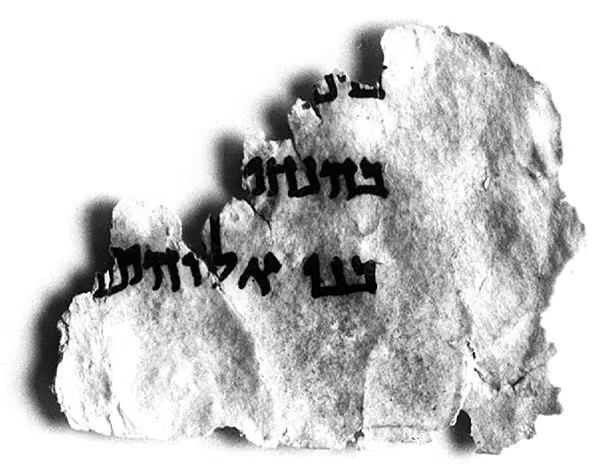
The Song of Moses (Deuteronomy 32:8) in the Masoretic Text describes the Most High dividing the nations according to number of “the sons [children?] of Israel.” This Dead Sea Scroll fragment (4QDeutj) and the third-century B.C.E. translation of the Hebrew Pentateuch into Greek (the Septuagint [LXX]), however, say the nations were divided according to the “sons of Elohim” (God). What did the original Bible text say? Photo: IAA.
Which is the “original” Bible? How do we decide which of these two ancient texts is more authoritative? In “Searching for the ‘Original’ Bible” in the July/August 2014 issue of Biblical Archaeology Review, Hebrew University of Jerusalem scholar and long-time editor-in-chief of the Dead Sea Scrolls publication team Emanuel Tov suggests we turn to the Dead Sea Scrolls to help us compare the Masoretic Text and the Septuagint.
The eBook, The Dead Sea Scrolls: Past, Present, and Future, brings together articles and interviews with the world’s leading experts on the scrolls. Receive your free copy today!
Some of the Dead Sea Scrolls actually have more in common with the Greek Septuagint than the traditional Hebrew Masoretic Text. This suggests that the Greek translators must have been translating from Hebrew texts that resembled the Dead Sea Scrolls. Are the Dead Sea Scroll texts as trustworthy as these other two sources? Are they as close to the text of the original Bible?
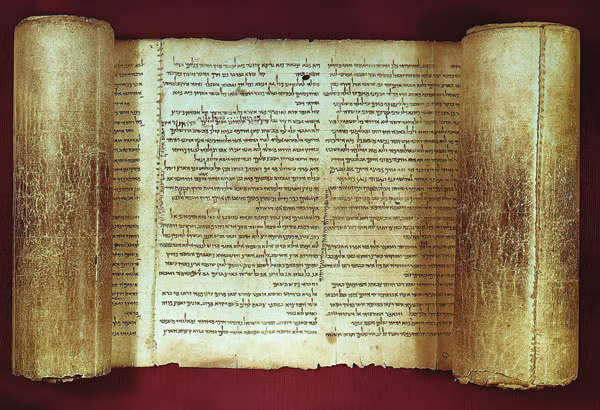
The Great Isaiah Scroll is one of the most iconic of the Dead Sea Scrolls, yet it does not reflect the original language of the Bible. Tov calls it “a classroom example of what an inferior text looks like, with its manifold contextual changes, harmonizations, grammatical adaptions, etc.” Photo: John C. Trevor, Ph.D. Digital Image: James E. Trevor.
Some turn to the Dead Sea Scrolls simply because they are older: 2,000-year-old texts were less likely to be subjected to scribal corruption; they should reflect a more original Bible language. Tov supplements this chronological reasoning with a logical—and admittedly subjective—approach: He examines which text makes the most sense in a given context. Tov examines a number of textual discrepancies between Bible versions (Did God finish work on the sixth or seventh day before resting on the seventh day? How were the nations divided according to the number of the sons of God?) in his search for the original Bible.
The Dead Sea Scrolls have been called the greatest manuscript find of all time. Explore the BAS Dead Sea Scrolls page for dozens of articles on the scrolls’ significance, discovery and scholarship.
As an example, Tov asks: Did Hannah bring one bull or three bulls as an offering at Shiloh? (1 Samuel 1:24):
When the infant Samuel had been weaned and his mother, Hannah, finally came to Shiloh with her son, she also brought with her an offering for the Lord that is described in two ways in our textual sources. According to the Masoretic Text, she brought “three bulls,” but according to the Septuagint and a Qumran scroll (4QSama from 50–25 B.C.E.) she brought one “three-year-old bull.”
I believe that Hannah probably offered only a single bull (as in the Septuagint and 4QSama); supporting this choice is the next verse in the Masoretic Text which speaks about “the bull.” I believe the Masoretic Text was textually corrupted when the continuous writing (without spaces between words) of the original words prm/shlshh (literally: “bulls three”) underlying the Septuagint was divided wrongly to pr mshlsh (“three-year-old bull”).*
The evidence of the Septuagint, being in Greek, always depends on a reconstruction into Hebrew, and consequently the Qumran scroll here helps us decide between the various options. Incidentally an offering of a “three-year-old bull” is mentioned in Genesis 15:9. It shows that a Hebrew text underlying the Septuagint once existed in which Hannah brought only one three-year-old bull.
Tov uses the Dead Sea Scrolls to elucidate the original language of the Bible not only because they are the oldest Bible manuscripts, but also because they provide additional logical clues. He concludes: “In finding our way in the labyrinth of textual sources of the Bible, we must slowly accumulate experience and intuition. When maneuvering among the sources, we will find much help in the Dead Sea Scrolls. But they must be used judiciously.”
Notes
* Many thanks to Joseph Lauer for a careful reading of the text, and to Emanuel Tov for clarification. The text:
“…of the original words prm/shlshh (literally: ‘bulls three’) underlying the Septuagint was divided wrongly to pr mshlsh (‘three-year-old bull’)”
Should read:
“…of the original words pr mshlsh (‘three-year-old bull’) underlying the Septuagint was divided wrongly to prm/shlshh (literally: ‘bulls three’)”
Subscribers: Continue on the search for the “original” Bible as Emanuel Tov explores different versions of important Biblical passages. Read the full article “Searching for the ‘Original’ Bible” by Emanuel Tov as it appeared in the July/August 2014 issue of Biblical Archaeology Review.
Not a BAS Library or All-Access Member yet? Join today.
This Bible History Daily article was originally published on June 27, 2014.
All-Access members, read more in the BAS Library
Dead Sea Scrolls Scandal—Israel’s Department of Antiquities Joins Conspiracy to Keep Scrolls Secret
Not a BAS Library or All-Access Member yet? Join today.
Related Posts





Must-Read Free eBooks
Want more Bible history?
Sign up to receive our email newsletter and never miss an update.
Unlock Unlimited Access to the Bible's Past

Unlock Unlimited Access to the Bible's Past
Become an All-Access Member to explore the Bible's rich history. Get Biblical Archaeology Review in print, full online access, and FREE online talks. Plus, enjoy special Travel/Study discounts. Don't miss out—begin your journey today!

Very interesting. I have assumed that this was already been done by scholars, but perhaps not. It was also news to me that the Torah was translated in the Greek before the rest of the LXX– as early as the third century BC.
The problem with this research is that it’s totally up to the interpretation of Tov. Additionally the text chosen for comparison in this article is kinda’ a red herring. Why not look at Isaiah 61 as it was quoted by Jesus Christ himself in Luke 4:18,19?
What we see is that the Dead Sea Scrolls are not consistent among themselves. In the Great Isaiah Scroll we do not have the language, “recovery of sight to the blind” as part of Isaiah 61, which matches the King James Version of Isaiah. While 4Q521 does have, “recovery of sight to the blind”, which is in harmony with Christ himself who quotes, “recovery of sight to the blind” as being part of Isaiah 61. Which would mean Christ read from the LXX, not any Hebrew or Aramaic text right?.
Shalom,
Rose
1) The LXX claims, “recovery of sight to the blind” is part of Isaiah 61.
2) Scroll 4Q521 does have , “recovery of sight to the blind”.
3) Luke claims, “recovery of sight to the blind” was part of Isaiah 61.
4) The Masoretic Text does not have, “recovery of sight to the blind” in Isaiah 61.
5) The Great Isaiah Scroll(s) do not have, “recovery of sight to the blind” in Isaiah 61.
LXX Esaias 61
1 The Spirit of the Lord is upon me, because he has anointed me; he has sent me to preach glad tidings to the poor, to heal the broken in heart, to proclaim liberty to the captives, and recovery of sight to the blind;
KJ Isaiah 61
1 The Spirit of the Lord GOD is upon me; because the LORD hath anointed me to preach good tidings unto the meek; he hath sent me to bind up the brokenhearted, to proclaim liberty to the captives, and the opening of the prison to them that are bound;
Great Isaiah Scroll Qumran
61
1 The Spirit of the Lord GOD is upon me; because YHWH has anointed me to preach good tidings to the weak; to bind up the brokenhearted, to call to the captives liberty, and to the imprisoned the opening of prison.
4Q521
Over the poor His spirit will hover and will renew the faithful with His power. And He will glorify the pious on the throne of the eternal Kingdom. He who liberates the captives, restores sight to the blind, straightens the b[ent]
Luke 4
17 And there was delivered unto him the book of the prophet Esaias. And when he had opened the book, he found the place where it was written,
18 The Spirit of the Lord is upon me, because he hath anointed me to preach the gospel to the poor; he hath sent me to heal the brokenhearted, to preach deliverance to the captives, and recovering of sight to the blind, to set at liberty them that are bruised,
19 To preach the acceptable year of the Lord.
I appreciate this detailed comment. I, however, see a difference between a statement that is either included/omitted in one text or another and statements that seem contradictory as Tov cited.
Very interesting–and contextually, very lame. The context of “the original Bible” is sadly misleading, since the original texts for the Torah were wriiten in Jerusalem, starting in the tenth century, BCE. And that’s the context most relevant to a Hebraic original, i.e. the context of the Jewish authorship.
Interesting article — and interesting discussion between Rose and Kelly.
Good point Kelly. On the other hand the inconsistency between the texts is in itself proof that the texts were inconsistent.
If we dissolve the axioms and assumptions like, “Jesus spoke Aramaic”, or “Greek was the lingua franca of Galilee and Judea”, and simply follow the texts, we come to a completely different conclusion. Josephus who was the Governor of Galilee between 64 CE and 66 CE says the people in Judea and Galilee only spoke Hebrew (not Aramaic or Greek) and Greek was only used by the Aristocrats and ruling class, never the Priesthood in Galilee and Jerusalem.
Josephus clearly differentiates between the Hebrew tongue and Syrian tongue (Aramaic).
Antiq. X, 1,
2. …….When Rabshakeh had made this speech in the Hebrew tongue, for he was skillful in that language, Eliakim was afraid lest the multitude that heard him should be disturbed; so he desired him to speak in the Syrian tongue.
Josephus says Greek was unaccustomed (i.e. not the lingua franca of the priesthood in Galilee and Jerusalem).
Antiq, Preface
2. Now I have undertaken the present work, as thinking it will appear to all the Greeks worthy of their study; for it will contain all our antiquities, and the constitution of our government, as interpreted out of the Hebrew Scriptures. …….. I grew weary and went on slowly, it being a large subject, and a difficult thing to translate our history into a foreign, and to us unaccustomed language.
Josephus had to go to great pains to learn Greek.
Antiq, XX, 11,
2. …. For those of my own nation freely acknowledge that I far exceed them in the learning belonging to Jews; I have also taken a great deal of pains to obtain the learning of the Greeks, and understand the elements of the Greek language, although I have so long accustomed myself to speak our own tongue, that I cannot pronounce Greek with sufficient exactness; for our nation does not encourage those that learn the languages of many nations, and so adorn their discourses with the smoothness of their periods;
However this was not the case in Alexandria as Philo is only aware of the Greek Old Testament. He describes the meaning of the changing of Abram to Abraham, and Sari to Sarah using the Greek spellings of the names, Philo is clueless to the Hebrew spellings.
Philo of Alexandria, “On the Change of Names”
VIII, ….. the letter rho, appears to have bestowed upon men a most marvellous and great benefit; for he has called the wife of Abram Sarrah instead of Sarah, doubling the Rho,” and connecting a number of similar arguments without drawing breath, and joking and mocking, he went through many instances.
After studying Philo and Josephus, it’s crystal clear that the Greek scriptures emanated from Alexandria, while the Hebrew Scriptures were from Judea/Galilee.
So why is Jesus reading from a Greek Bible at a Synagogue in Nazareth?
What language are Pilate and Jesus speaking in this image?
http://www.wikiart.org/en/nikolai-ge/what-is-truth-christ-and-pilate#supersized-artistPaintings-253042
As for Aramaic, it’s was the language that first recorded the Passover (Elephantine Texts), however if Josephus is to be believed (as well as the archeology), Aramaic was only in use by the Syrians according to the ancient writings themselves.
There was separation of letters between words far earlier that the writing of the Septuagint and the final version of the Masoretic text so I dont think that is the cause of the scribal error.. It is easy to see though, how the MEM might have moved to the end of PAR.
SOoooooo.
First written Text,? Records? Of Bible ?,and what Script? What Language?
Anybody can see the Elephantine texts.
The earliest language recording Bible verses would be Aramaic, as the Elephantine Papyrus is the oldest existing source. The Passover Papyrus is from 419 BCE during the reign of Darius II and follows the history and individuals names in both Ezra and Nehemiah.
https://cojs.org/the_passover_papyrus_from_elephantine-_419_bce/
Corresponding names are Delaiah, Sanaballatt, YHVH, Queen of Heaven, and Darius. Corresponding places are Judea, Bethel (Bethel being Elephantine in some of the texts) and the House of YHVH. Corresponding themes are the stoppage and rebuilding of the Temple, its walls and doors.
Meaning there is a record of Bible events going back at least to 419 BCE. The oldest language that records these events in existence today is Aramaic. While this may not fit one’s axiom(s), it’s never the less actuality.
Which comes back to the sources of the original Biblical texts. Why no mention of Elephantine? If the texts found at Elephantine were found in modern Jerusalem, Christians and Jews would be in everybody’s face about what it ‘proves’. Yet the texts are right there at the Hebrew Temple in Elephantine and Christianity and Judaism mostly brushes them under the carpet as if they were a red headed step child. Wonder why?
Interesting that Rose brought up the issue of the Jewish community in Elephantine being mostly ignored. Their prescence at Egpyt’s southern border to provide security fit in with their pastoralist lifestyle shared by the Cushite people, “for all shepherds are abhorent to the Egyptians” (Genesis 46:34). It also appears this community was in fullfillment of Isaiah 19:18; “On that day there shall be five cities in the land of Egypt speaking the language of Canaan and swearing by the Lord of Hosts; one shall be called ‘City of the Sun'” (New American Bible). The temple at Abu Simbel that was built in honor of Pharaoh Ramses was oriented toward the rising sun and was adorned with statues of baboons raising their hands in adoration of the rising sun; 22 of them, like the letters of the Hebrew/Aramaic alphabet.