


Akhenaten and Moses
Did the monotheism of Egyptian Pharaoh Akhenaten influence Moses?

On this stela from El-Amarna, Egyptian King Akhenaten is seen with his wife Nefertiti and their daughters bearing offerings to the sun-disk Aten. Public domain, via Wikimedia Commons
Defying centuries of traditional worship of the Egyptian pantheon, Egyptian Pharaoh Akhenaten decreed during his reign in the mid-14th century B.C.E. that his subjects were to worship only one god: the sun-disk Aten. Akhenaten is sometimes called the world’s first monotheist. Did his monotheism later influence Moses—and the birth of Israelite monotheism?
In “Did Akhenaten’s Monotheism Influence Moses?” in the July/August 2015 issue of Biblical Archaeology Review, University of California, Santa Barbara, emeritus professor of anthropology Brian Fagan discusses this tantalizing question.
Egyptian King Akhenaten, meaning “Effective for Aten”—his name was originally Amenhotep IV, reigned from about 1352 to 1336 B.C.E. In the fifth year of his reign, he moved the royal residence from Thebes to a new site in Middle Egypt, Akhetaten (“the horizon of Aten,” present-day Tell el-Amarna), and there ordered lavish temples to be built for Aten. Akhenaten claimed to be the only one who had access to Aten, thus making an interceding priesthood unnecessary.
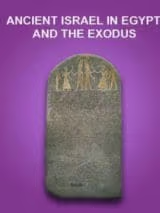
FREE ebook: Ancient Israel in Egypt and the Exodus.
In the BAR article “The Monotheism of the Heretic Pharaoh,” Donald B. Redford, who excavated Akhenaten’s earliest temple at Karnak (in modern Thebes), describes how Akhenaten instituted worship of Aten:
The cult of the Sun-Disk emerged from an iconoclastic “war” between the “Good God” (Akhenaten), and all the rest of the gods. The outcome of this “war” was the exaltation of the former and the annihilation of the latter. Akhenaten taxed and gradually closed the temples of the other gods; the images of their erstwhile occupants were occasionally destroyed. Cult, ritual and mythology were anathematized, literature edited to remove unwanted allusions. Names were changed to eliminate hateful divine elements; and cities where the old gods had been worshipped, were abandoned by court and government.
Akhenaten destroyed much, he created little. No mythology was devised for his new god. No symbolism was permitted in art or the cult, and the cult itself was reduced to the one simple act of offering upon the altar. Syncretism was no longer possible: Akhenaten’s god does not accept and absorb—he excludes and annihilates.
Did Egyptian Pharaoh Akhenaten’s adamant worship of one deity influence the Biblical Moses, leader of the Israelite Exodus? Was Akhenaten’s monotheism the progenitor of Israelite monotheism? According to BAR author Brian Fagan, we are talking about two different kinds of monothesisms:
“Israelite monotheism developed through centuries of discussion, declarations of faith and interactions with other societies and other beliefs,” Fagan writes. “In contrast, Akhenaten’s monotheism developed very largely at the behest of a single, absolute monarch presiding over an isolated land, where the pharaoh’s word was divine and secular law. It was an experiment that withered on the vine.”
The Biblical Archaeology Society FREE publication Aspects of Monotheism: How God Is One, edited by Hershel Shanks and Jack Meinhardt, presents an exciting, provocative and readily understandable discussion of the origins and evolution of monotheism within Judaism and Christianity. The book is free for BAS Library members.
Not a BAS Library or All-Access Member yet? Join today.
When Tutankhaten—the second son of Akhenaten; we know him as the famous King Tut—ascended to the throne, he, working with his advisers, restored worship of the traditional Egyptian pantheon and its chief god, Amun. Tutankhaten also changed his name to Tutankhamun, meaning “the living image of Amun.”
To learn more about the monotheism of Egyptian King Akhenaten, read the full article “Did Akhenaten’s Monotheism Influence Moses?” by Brian Fagan in the July/August 2015 issue of Biblical Archaeology Review.
Subscribers: Read the full article “Did Akhenaten’s Monotheism Influence Moses?” by Brian Fagan in the July/August 2015 issue of Biblical Archaeology Review.
Not a BAS Library or All-Access Member yet? Join today.
This Bible History Daily feature was originally published on June 8, 2015.
Related reading in Bible History Daily
Out of Egypt: Israel’s Exodus Between Text and Memory, History and Imagination
All-Access members, read more in the BAS Library
Not a BAS Library or All-Access Member yet? Join today.
Related Posts





Must-Read Free eBooks
Want more Bible history?
Sign up to receive our email newsletter and never miss an update.
Unlock Unlimited Access to the Bible's Past

Unlock Unlimited Access to the Bible's Past
Become an All-Access Member to explore the Bible's rich history. Get Biblical Archaeology Review in print, full online access, and FREE online talks. Plus, enjoy special Travel/Study discounts. Don't miss out—begin your journey today!

There’s a school of thought that believes the Both Moses and Akhnaten were one and the same person, entity if you will.
And I also happen to belong to that school of thought.
What in the world?!? This should be “Biblical” Archaeology.com. You need quotation marks if you’re going to say that the Israelites were influenced into monotheism. Try this out…
God sent plagues and freaked out the Egyptians into KNOWING that He alone is God! Read the book of Exodus. Then think about your own life, and whether you are ready to face God. If you’re going to have to pay for your sins you need a Savior. Jesus is the only one who can save you from your sins because He lived a perfect life, conquered death on the cross for YOUR/Our sins, and God rose Him from the dead. Put your faith in Him and live out that faith. Then come back and re-write your article.
Monotheism predated the Egyptians and their Pharaohs,Noah’s family was monotheistic.
Yes,believing in one god does back to Noah ans his family
Even i think that Jewish affected positively on Akhenaton to spend his one God cult and they supported him in his ideas, helped him to move to a new city and that remained in the mind of the Egyptians, so king Merenptah wrote his famous text about his victory against the Asians including the Israeli groups in his famous stela on the other side of a text goes back king Amonhoteb 3rd the father of Akhenaton to announce and refers to the end of what have started during the king Amonhoteb 3rd which is clearly the interference of the Jewish society while they were in Egypt in the kingdom affairs and what happened in Akhenaton’s life
Bob,
Reading the article, I did not get the same message you did, apparently. What I read was that this is a thought, but the concepts are mutually exclusive, as noted in the following quote:
According to BAR author Brian Fagan, we are talking about two different kinds of monothesisms:
“Israelite monotheism developed through centuries of discussion, declarations of faith and interactions with other societies and other beliefs,” Fagan writes. “In contrast, Akhenaten’s monotheism developed very largely at the behest of a single, absolute monarch presiding over an isolated land, where the pharaoh’s word was divine and secular law. It was an experiment that withered on the vine.”
5. Moses precedes Akhenaten in history. Therefore, if there was any influence, it was the other way around. The Pharaoh of the Exodus was actually Thotmose III who died at the Red Sea in 1453 BCE. Akhenaten reigns 1381 – 1364 BCE, some 70 years later.
– Dr. Saul Pressman
Even having an article such as this shows how liberal and how low on the scholarly shelf the Bible is as a guide to God and truth! Moses was’ influenced'(not by some pharaoh) by the God Himself at the burning bush! Exodus! Read Genesis and see one God is manifested all throughout that book!
I say go into another profession liberal unbelieving professors like Erhman who denies all of the historic Christian tenants of our faith. Why go into a profession he really believes in? Liberal archeology magazine editors/writers; If you don’t believe in the Bible find another line of work. Simple. Research Homer or Chinese history, but leave our beautiful Bible alone with your ridiculous, far out ,unbelieving theories and postulates which always over time prove to be untrue.
How well did the NT writers warn this would happen. As Jude said thy would ‘slip in to the church ‘ even’ denying the Lord that bought them.’
Stories like these led me to drop my subscription to BAR. They reflect an eye for disproving rather than any real support of the worship of God.
Moses was influenced by God and not Egypt. If he was influenced to monotheism by Egypt then god is no different than the Egyptian gods.
No way to edit! Meant to say ‘Why not go into a profession he and the other liberals really believe in?
Extremely disappointing article, with a strong anti-supernatural bias.
Using the acronym BCE ,instead of BC is what caused me to cancel my subscription to BAR.
What is the real definition of BCE, before Christ, you people are pathetically trying to rewrite history..