


Jesus’ Last Supper Still Wasn’t a Passover Seder Meal
An update to Jonathan Klawans’s Bible Review article “Was Jesus’ Last Supper a Seder?”
Many people still assume that Jesus’ Last Supper was a Seder, a ritual meal held in celebration of the Jewish holiday of Passover. In this exclusive guest post, Boston University Professor of Religion Jonathan Klawans provides an update to his popular Bible Review article questioning this common assumption. This post was originally published in Bible History Daily in 2016.—Ed.
Every spring, as the Boston snow begins to melt, the emails start coming in. Some are positive, others negative—but all exhibit continued curiosity and excitement about the Passover Seder meal and its relationship to Jesus’ Last Supper. And if they are writing to me about this, it’s because of the piece I wrote in Bible Review back in 2001.
And it’s a question I do revisit myself annually: part of the way I prepare myself for Passover each year is to read a few new articles that have appeared—and of course I read those emails too (though I don’t answer the nasty ones!).
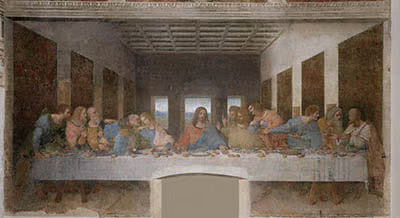
Was Jesus’ Last Supper a Passover Seder meal? Here, we see Leonardo Da Vinci’s famous painting The Last Supper, which was completed around 1498.
No, there will be no exciting turnarounds in this posting. Yes, readers have asked some good questions. And some scholars have offered vigorous defenses of the Last Supper/Seder connection. Nevertheless, I remain convinced that the Last Supper was not a Passover Seder meal.
First, very little, if anything, of the rabbinic Seder practices can be read back to the early part of the first century C.E. Second, Jesus’ Last Supper with his disciples did not take place on the first night of Passover. There is a real difference between John and the synoptics on this question, and John’s chronology continues to make much more sense to me: Jesus was tried and killed before the holiday began. By Seder time, he was buried.
Easter: Exploring the Resurrection of Jesus
In this free eBook, expert Bible scholars offer in-depth reflections on the resurrection.
Perhaps one of these years I’ll revise the piece from beginning to end. But in lieu of that, below are some bibliographic updates and a few additional points to ponder.
To my mind, the most important development in the last fifteen years has been the appearance of a number of resources to help readers of English understand better the history of the Passover Haggadah (the book that lays out the rituals practiced and passages recited over the course of a traditional Passover Seder meal):
- Joshua Kulp, “The Origins of the Seder and the Haggadah,” Currents in Biblical Research 4.1 (2005), pp. 109–134. This bibliographic essay provides helpful definitions of the key Hebrew terms (including Seder and Haggadah) and provides a sound history of scholarship, summarizing some of the key debates. [Disclaimer: I was the soliciting editor of this article during my ten-year stint as an editor for CBR.]
- Joshua Kulp and David Golinkin, The Schechter Haggadah: Art, History and Commentary (Jerusalem: The Schechter Institute of Jewish Studies, 2009). This beautifully illustrated volume includes a full Haggadah and a lengthy discussion of all the academic issues surrounding the history of the Haggadah and the celebration of the Passover Seder. [I had nothing to do with this one!]
- Shmuel Safrai and Ze’ev Safrai, Haggadah of the Sages (Jerusalem: Carta, 2007). This is the English edition of a modern Hebrew academic commentary on the Passover Seder (the 1998 fuller Hebrew edition is cited in my article in n. 11).
- Joseph Tabory, The JPS Commentary on the Haggadah: Historical Introduction, Translation, and Commentary (Philadelphia: The Jewish Publication Society, 2008). This too is a modern academic edition of the Haggadah with an English introduction and running commentary.
Readers who delve into these sources will find a great deal of information about all aspects of Passover and the Seder. Regarding our topic, most of what you will find in these sources will be in agreement with the approach that separates the Last Supper from the Passover Seder. This is because it remains the case that scholars of early rabbinic literature (and not just the most skeptical of them) have come to a general consensus that the rabbinic Seder ritual was developed after 70 C.E. (and therefore almost two generations after Jesus’ death in the early 30s C.E.). If the Seder didn’t really exist until after 70 C.E., it could not have been practiced whenever Jesus had his Last Supper, Passover or not.
Passover is the celebration of the Israelite exodus from Egypt. For more on the Exodus, check out the Bible History Daily Exodus page for dozens of free articles and video lectures on the flight of the Israelites from slavery in Egypt and their miraculous escape across the Red Sea.
For readers who want to consider an academic counter-argument, the most forceful one I know is by Joel Marcus of Duke University Divinity School: “Passover and Last Supper Revisited,” New Testament Studies 59.3 (2013), pp. 303–324. In this article Marcus does everything he can to take various parallels between Jewish and Christian traditions and turn them in favor of the argument that Jesus’ Last Supper was a Passover Seder meal. For instance, he calls attention to the so-called “ha lachma” (Aramaic for “This is the bread”), a brief passage traditionally recited at the opening of the Seder: “This is the bread of affliction that our ancestors ate in Egypt…” This statement does indeed parallel the Eucharistic words, grammatically (“This bread is…”). Is it possible that the ha lachma tradition (which can only be traced back to medieval manuscripts) is in fact an ancient tradition that sheds light on the Eucharistic words of Jesus? Yes—anything is possible. But it is much more likely, in my view, that a medieval Jewish tradition that parallels a Christian tradition is responding to Christianity.
This is what we need to remember: Judaism and Christianity continued to influence each other, long after the death of Jesus. Passover and Easter continued to influence each other too. The dialogue—and competition—between these holidays left imprints on the respective rituals, as well as on the traditional sources (such as the Gospels and the Haggadah) describing these practices. The “Passoverization” of Christian rituals and texts—as discussed in my BR article—continued long after Jesus’ death
Is it possible to identify the first-century man named Jesus behind the many stories and traditions about him that developed over 2,000 years in the Gospels and church teachings? Visit the Jesus/Historical Jesus study page to read free articles on Jesus in Bible History Daily.
But we can’t only think about influence—we must also remember difference. Joseph Tabory (for instance, to consider one of the writers listed above) says little about the Last Supper per se in his edition of the Haggadah. Nevertheless, he does point out one key difference: While the Last Supper traditions focus on the meaning of the wine (alongside the bread), the Passover traditions feature wine without offering any explanation for it even while other symbols are explained carefully (Tabory, JPS Commentary, pp. 13–14). This is a telling difference indeed!
When we find similarities, we must consider the possibility that influence has moved in either direction, even in periods long after Jesus’ death. When we find differences, we must remember that not everything in these two traditions necessarily has much to do with the other.

FREE ebook, Recipes from the BAR Test Kitchen Make your own food from recipes handed down from biblical times. Download now.
If we cannot figure out precisely how Christians and Jews may have influenced each other with regard to Passover and the Last Supper, it becomes all the more difficult to figure out what the earliest practices of each may have been. All this in turn limits our ability to know what Jesus would have done on Passover night (had he lived another day). And the likelihood that Jesus died before that partially-prepared-for Passover had begun also renders it most unlikely that his Last Supper was even a celebration of Passover, let alone a Seder.
But why should historical skepticism ruin anyone’s holiday? Happy Easter and Chag Sameach (Hebrew for “Happy Holiday”) to any and all who celebrate!
“Jesus’ Last Supper Still Wasn’t a Passover Seder Meal” by Jonathan Klawans was originally published in Bible History Daily on February 12, 2016.
 Jonathan Klawans is Professor of Religion at Boston University. He is the author of Josephus and the Theologies of Ancient Judaism (Oxford Univ. Press, 2012), Purity, Sacrifice, and the Temple: Symbolism and Supersessionism in the Study of Ancient Judaism (Oxford Univ. Press, 2005) and Impurity and Sin in Ancient Judaism (Oxford Univ. Press, 2000), which received the Salo Wittmayer Baron Prize for the best first book in Jewish studies.
Related reading in Bible History Daily
All-Access members, read more in the BAS Library
Not a BAS Library or All-Access Member yet? Join today.
Related Posts





Must-Read Free eBooks
Want more Bible history?
Sign up to receive our email newsletter and never miss an update.
Unlock Unlimited Access to the Bible's Past

Unlock Unlimited Access to the Bible's Past
Become an All-Access Member to explore the Bible's rich history. Get Biblical Archaeology Review in print, full online access, and FREE online talks. Plus, enjoy special Travel/Study discounts. Don't miss out—begin your journey today!

Jonathan,
I believe you are correct; the Last Supper was not a Passover Seder.
I am a Christian with little to no true undtanding of Jewish Laws and Customs. To me the New Testament accounts in light of the Torah and Prophets is pretty clear; the Seder is after Sundown on Passover after the Lamb is sacrificed.
Since Jesus was captured in the early morning hours on Passover, the meal the night before couldn’t be a Seder. Also, since Jesus was sacrificed on Passover, the meal the night before couldn’t be the Seder. These are just two examples that stand out to me in support of your conclusion.
To me, the worst thing to happen to Christianity over the last 2 millenia was Constantin. By me king Christianity the official religion of the Roman Empire and banning Christian and Jewish interaction we Christians have completely lost our Jewish/Israeli heritage. Thank the LORD for HIS Spirit opening the eyes of the Faithful in both religions. For the first time we see Jews and Christians coming together in Biblical Truth.
Thank you for your wonderful articles,
Dave
Why did you not mention (in your excellent UPDATE article …. above), the recent book by Dr Brant Pitre:- “Jesus & the Jewish roots of the Eucharist: unlocking the secrets of the Last Supper”, Feb 2016, 256pp pb, 0385531869 ?????
P.S. it was published in 2015 in HB
Alan Corrie
You say the rabbinic seder was not developed until after 70CE. Could there not have been pre-Mishnaic traditions or rituals that the authors drew upon?
So if not a seder, that what was the Last Supper? A “pre-seder” as I’ve read there might have been?
According to Jeremiah 31:31 – “The days are coming,” declares the Lord, “when I will make a new covenant with the people of Israel and with the people of Judah.”
Jesus, who was God walking the earth in the flesh, waited until the night of the Passover to make his new covenant. This is clearly seen in Matthew 26:17 – 28. The Last Supper was the Passover. Jesus was the reality of the Passover lamb. When establishing the new covenant, Jesus told his disciples that the Passover bread was his spiritual flesh and the Passover wine was is spiritual blood for the forgiveness of sins and the promise of eternal life.
Roman Emperor Constantine abolished God’s new covenant Passover in 325 AD, but it was restored in 1948 when Jesus (God) walked the earth a second time.
good morning david!
thank you for your article on the issue of what jesus had the night of 14th of abib. it was a blessing to find that i am not alone in my understanding of the issue and that you share my position of being open to additional information that helps to arrive at the correct understanding. and yet, until now you are still of the same position, which to me, is a further confirmation that your understanding and mine is correct.
i am not a biblical scholar so my conclusion so far is arrived at solely from scriptures using concordances and interlinear resources from the internet and prayers for correct understanding.
the assembly i join for services on sabbaths and holy days observe the “lord’s supper” on the 14th of abib but calls it the “passover”observance and observe the 15th of abib and calls it “the night to be much observed” observance.
after having read scriptures many times over, i became familiar enough with exodus 12, lev 23 and found our practice not quite according to what i found in scriptures. so, i wrote one of our elders the message below.
a most blessed sabbath to you,
really appreciate your pointing out in your sermonette three weeks ago that it is important for the body to understand the reason why we do things so when they are asked they can give scripturally grounded answers.
thank you for sharing with me that “artos” is used as a common term for bread, leavened or not. this is very good information. you are right. the use of “artos” in luke 24:30, 35 clearly show, beyond any doubt, that artos is used for unleavened bread as well.
however, my understanding of the scriptures below show that the passover lamb was eaten in the evening of the 15th, not in the evening of the 14th. the only way what the lord could then have on that day unleavened bread is if he moved the eating of the passover lamb to the 14th instead of the 15th.
the scriptures examined are from both the old and the new convenant writings. (i believe that this was erroneous move of those who compiled scriptures to divide it into new and old. this brought the wrong notion that jesus ushered a new religion (of god of love; not god of revenge, etc). god’s plan of salvation was hatched from the foundation of the world and its complete fulfillment still lies in the future; and, the whole scripture record shows salvation is of him, not of man’s work. the use of “testament” [attested statement of fact] instead of “covenant” [mutual agreement with each party having an obligation to fulfill] also has lead to erroneous belief that there is nothing for us now to do to remain in covenant with god; and the abrogation of the ten commandments. another issue ^_^)
present understanding and belief.
i believe that the jews at the time of jesus had the correct understanding of god’s command of which day and at what time of the day to kill the passover lamb. else, he would have pointed it out to the jewish leadership like he did with their major errors. the passover is a most important feast that there is provision for its observance on the second month if one could not do it on the first month. for them to have been observing this on the wrong day is too grave an error for jesus not to correct them. as he did not, i am confident to believe they were not in error on this one.
although the gospel accounts show that passover and the feast of unleavened bread were lumped together, the rest of scriptures show that the eating of the unleavened bread had irrefutably been done beginning on the 15th (end of 14th), not at the beginning of the 14th (end of 13th).
i also believe that jesus did not move the eating of the passover lamb to the 14th. i am convinced beyond any shadow of the doubt that jesus did indeed observe the passover day (the preparation day for the feast of unleavened bread) according to how it was observed in his days including having a last meal with his disciples away from his family as his disciples were not surprised at what they were going through the night except for the washing of the feet and the symbolism attached to the bread and wine. the meal on the night portion of the passover day did not include the lamb which was to be killed “beyn ha arbayim.” what my understanding of what this actually means is covered by scriptures cited below.
we also read in john’s account that he referred to what jesus had as “supper” (john 13:2) exactly how paul who discussed the feast meal in chapter 5 referred to the last meal jesus had with his disciples as “supper” way late into chapter 11.
both john and paul are very strong practicing jews. they could not possibly refer to the passover meal as plainly as “supper.”
on quartodeciman controversy.
this is an extra biblical history issue. the holy scriptures has enough verses to settle the matter really. and i would take clarification from scriptures as of prime importance above what humans are recorded to have practiced.
old covenant scriptures considered.
“exodus 12:6 And ye shall keep it (lamb) up until the fourteenth day of the same month: and the whole assembly of the congregation of Israel shall kill it in the evening.”
in which evening?
beginning of the 14th or ending of the 14th? i believe exodus 12:14-17 settles this. also, compare exodus 12:18 with lev 23:32. but first let us have the next verse, v.8, in view:
“Exodus 12:8 And they shall eat the flesh in that night, roast with fire, and unleavened bread; and with bitter herbs they shall eat it.”
which night?
again the answer will be clear if vv. 14-17 are considered with Lev 23:6 which clearly says that the feast of unleavened bread starts on the 15th with the command to eat unleavened bread for 7 days starting on this night which is the beginning of the 15th day of the month and at the same time the end of the 14th day of the month. so that night is the first day of unleavened bread, the night portion of the 15th day of the first month (abib).
“Exodus 12:11 And thus shall ye eat it; with your loins girded, your shoes on your feet, and your staff in your hand; and ye shall eat it in haste: it is the LORD’S passover.”
while attired to leave in haste, they were to eat in haste. i would imagine they would not be commanded to be attired as such for two nights only to leave the day after the second night. i say two nights if it is true that the passover lamb was eaten on the 14th while god said he brought the israelites out of egypt on the 15th of nisan (numbers 33:3).
“Exodus 12:12 For I will pass through the land of Egypt this night, and will smite all the firstborn in the land of Egypt, both man and beast; and against all the gods of Egypt I will execute judgment: I am the LORD.d…”
which night?
the night of the 14th or of the 15th? exodus 12:14 clearly shows this has to be the night of the 15th. the night the lord passes over the israelite homes with the blood of the lamb on the door post belongs to the day that the lord instructs to be memorialized. v15 then details that the seven-day eating of unleavened bread will start on this memorial day.
“Exodus 12:14And this day shall be unto you for a memorial; and ye shall keep it a feast to the LORD throughout your generations; ye shall keep it a feast by an ordinance for ever. 15 Seven days shall ye eat unleavened bread; even the first day ye shall put away leaven out of your houses…”
which day?
14th or 15th? verse 16 below that follows the command to eat unleavend bread for 7 days clearly indicates this day as the first day of the feast of unleavened bread. this day is the morning portion of the very day the lamb was eaten with unleavened bread in the evening portion of that same day.
“Exodus 12:15 Seven days shall ye eat unleavened bread; even the first day ye shall put away leaven out of your houses: for whosoever eateth leavened bread from the first day until the seventh day, that soul shall be cut off from Israel.16And in the first day there shall be an holy convocation, and in the seventh day there shall be an holy convocation to you…”
if “on the 14th … at even” means beginning of nisan 14 not towards its end, then unleavened bread will have to be eaten 8 days, not seven. the feast will have to be observed for 8 days starting on the 14th even when the command is to observe the feast starting on the 15th (lev 23:15).
the command for the day of atonement has similar wording of exodus 12:18. and so also that of the day of atonement. this will have to be observed for two days, not one day even when the command is to observe it on the 10th day of the seventh month:
“Lev 23:27Also on the tenth day of this seventh month there shall be a day of atonement: it shall be an holy convocation unto you; and ye shall afflict your souls, and offer an offering made by fire unto the LORD…Lev 23:32 It shall be unto you a sabbath of rest, and ye shall afflict your souls: in the ninth day of the month at even, from even unto even, shall ye celebrate your sabbath.”
which day did god bring the israelites out of egypt?
back to exodus 12:17
“Exodus 12:17 And ye shall observe the feast of unleavened bread; for in this selfsame day have I brought your armies out of the land of Egypt: therefore shall ye observe this day in your generations by an ordinance for ever.”
considering the flow and context of exodus 12, i can see that “this selfsame day” must refer to the 15th day of the month, not on the 14th.
apparent conflict.
you mentioned deut 16:1 vs exodus 12:22
Deuteronomy 16:1Observe the month of Abib, and keep the passover unto the LORD thy God: for in the month of Abib the LORD thy God brought thee forth out of Egypt by night.
searching scriptures for the use of night, here is what i found:
H3915 [e] lā·yə·lāh. לָֽיְלָה׃ by night Noun
as close of day, ׳עַדלֿ2
“Chronicles 35:1Moreover Josiah kept a passover unto the LORD in Jerusalem: and they killed the passover on the fourteenth day of the first month…14And afterward they made ready for themselves, and for the priests: because the priests the sons of Aaron were busied in offering of burnt offerings and the fat until night; therefore the Levites prepared for themselves, and for the priests the sons of Aaron.”
in v 14, “until night” is still accounted as belonging to the 14th day. this means that “at night” in exodus 12:22 could be of the same time period.
going back to exodus 12, the time then that the passover lamb was first commanded to be sacrificed was also around the time our Lord was sacrificed for our sins. not only was the day and time the passover lamb was sacrifice was not only symbolic but prophetic; and, fulfilled by our lord for dying on the very same day and perhaps even within the very hours the lambs were sacrificed. (matthew 27:46-50). again, scriptures indicate this is a common practice that jesus had no quarrel with the jews through all the passover observances that he was recorded to have been attending.
daily sacrifice clue on the meaning of “beyn ha arbahim.”
the timing of the lambs can be surmised from scriptures. researching on commands for sacrifices in the tanakh yielded the following scriptures:
“Exodus 29:38 Now this is that which thou shalt offer upon the altar; two lambs of the first year day by day continually. 39The one lamb thou shalt offer in the morning; and the other lamb thou shalt offer at even…”
“Numbers 28:3And thou shalt say unto them, This is the offering made by fire which ye shall offer unto the LORD; two lambs of the first year without spot day by day, for a continual burnt offering.a 4The one lamb shalt thou offer and the other lamb shalt thou offer at even…”
according to interlinear concordance the word “the one” h259 “hā·’e·ḥāḏ” in this construction found in numbers 28:3 is used as “the first” also in the following verses, evidently because it is talking of more than one of something in an ordinal sense:
“Genesis 2:11 The name of the first is Pison: that is it which compasseth the whole land of Havilah, where there is gold…”
“Exodus 28:17 And thou shalt set in it settings of stones, even four rows of stones: the first row shall be a sardius, a topaz, and a carbuncle: this shall be the first row.”
“Exodus 39:10 And they set in it four rows of stones: the first row was a sardius, a topaz, and a carbuncle: this was the first row.”
according to interlinear concordance the word “other” h8145 “hasseni” in the construction found in numbers 28:3 predominantly translated as “the second one”. the link below has the list of 72 verses involving h8145
h8145 hasseni https://www.bibletools.org/index.cfm/fuseaction/Lexicon.show/ID/H8145/sheniy.htm
therefore, the command is to make two offerings in the same day (day after day). the first was in the morning, the second “at even”. the use of “at even” here then means a time before the biblical “day” is over. this removes the seeming contradiction that might pose over exodus 12:22 (not to leave house before morning) and numbers 33:3 (god brought israelites out of egypt by night) as the first occurred early in the morning (before day break) of the 15th and the second in the late of the day of the 15th (even just before it ends and the 16th begins).
collecting the egyptian spoils.
how the israelites were able to “spoil” the egyptians between the time they left their house at day break to the time they left egypt towards the end of the 15th day of the month: and the egyptians could not wait to have them go and the Lord made the israelites in the good graces of the egyptians.
“Exodus 12:31 And he called for Moses and Aaron by night, and said, Rise up, and get you forth from among my people, both ye and the children of Israel; and go, serve the LORD, as ye have said. 32Also take your flocks and your herds, as ye have said, and be gone; and bless me also. 33And the Egyptians were urgent upon the people, that they might send them out of the land in haste; for they said, We be all dead men. 34And the people took their dough before it was leavened, their kneading troughs being bound up in their clothes upon their shoulders.i 35And the children of Israel did according to the word of Moses; and they borrowed of the Egyptians jewels of silver, and jewels of gold, and raiment: 36And the LORD gave the people favour in the sight of the Egyptians, so that they lent unto them such things as they required. And they spoiled the Egyptians.”
new covenant scriptures considered.
i read from scriptures passover used to refer to:
1. the meal
“Exodus 12:43 This is the ordinance of the passover: There shall no stranger eat thereof…”
2. the day
“Leviticus 23:5 In the fourteenth day of the first month at even is the LORD’S passover…”
3. the sacrificial lamb
“Exodus 12:21Then Moses called for all the elders of Israel, and said unto them, Draw out and take you a lamb according to your families, and kill the passover.”
4. lump up the 8-day back-to-back commanded observances:
“Mark 14:11Now the first day of the feast of unleavened bread the disciples came to Jesus, saying unto him, Where wilt thou that we prepare for thee to eat the passover?”
i then can understand that indeed jesus was observing the passover day with a meal which was to be his last before he becomes the passover sacrifice some 21 hours later.
in john 18:28 he records that the passover meal was not yet had while jesus was still being dragged around on the 14th. these are dismissed summarily or with mere suppositions that do not have any biblical or extra-biblical support.
“John 18:28 Then led they Jesus from Caiaphas unto the hall of judgment: and it was early; and they themselves went not into the judgment hall, lest they should be defiled; but that they might eat the passover.”
if this was an incorrect practice, john would have mentioned it as he normally did when something was misunderstood. moreover, jesus would have vehemently pointed this out during his ministry.
but why john did not is because he believed it was the correct practice. note what he recorded in chapter 13, five chapters earlier:
“John 13:1Now before the feast of the passover, when Jesus knew that his hour was come that he should depart out of this world unto the Father, having loved his own which were in the world, he loved them unto the end. 2 And supper being ended, the devil having now put into the heart of Judas Iscariot, Simon’s son, to betray him…”
and john added in verse 29:
“John 13:29 For some of them thought, because Judas had the bag, that Jesus had said unto him, Buy those things that we have need of against the feast; or, that he should give something to the poor.”
his disciples thought jesus was sending judas to buy what was needed for the feast. this must have reference to what is needed for the passover meal on the 15th.
frequency of observance
1 cor 11 this portion of paul’s epistle adds to my understanding that what jesus had that night was indeed what most christian denominations refer to as “the lord’s supper” and correctly understand that this is to be done “as often as.”
the whole paragraph talks about whenever believers assemble together:
“17Now in this that I declare unto you I praise you not, that ye come together not for the better, but f.or the worse.18 For first of all, when ye come together in the church, 20 When ye come together therefore into one place, this is not to eat the Lord’s supper. (sarcasm evident) 33 Wherefore, my brethren, when ye come together to eat, tarry one for another.”
this clearly speaks of something done with regularity and frequency. the passover is commanded done but once a year. also, eating of the passover lamb is such an important observance that it simply cannot be addressed as “come together to eat period” especially as there is no mention of the passover in the introduction of this section. i can understand this as this was a different meal, it was a commemorative meal of the lord’s death and keeping the blessed hope of his coming again ever alive in a believer’s consciousness. i can understand how beneficial it is to do this as frequently as we observe the weekly sabbath, that symbol of the goal of eternal rest with and in our creator.
so did jesus change the day, the nature, and the ritual of the passover meal? this is not my understanding. my understanding is that the passover memorial meal is a distinct and separate observance still to be observed on the night of the 15th of nisan as the lord’s supper be observed “as often” (sabbath services) perhaps appropriately also on the 14th of nisan.
difference between the lord’s supper and the passover meal
lord’s supper
observed on nisan 14
eaten with leavened bread; no lamb
commemoration of lord’s death and in anticipation of his coming
commanded by jesus to be observed as often
observed outside of home with disciples instead of with family
passover meal
observed on nisan 15
lamb eaten with unleavened bread
commemoration of israel’s liberation from egyptian bondage
commanded by the creator of heaven and earth to be observed once a year
commanded observed at home with family
scriptures record both commemorations were observed by believers long after jesus died, resurrected and ascended into heaven as evidenced by the first epistle of paul to the corinthians (1 cor 5-passover/unleavened bread;1 cor 11-lord’s supper; etc.).
conclusion
my understanding from scriptures is that jesus instituted a memorial over his death on the 14th with elements of bread and wine to as symbols of his broken body and shed blood. this is totally separate and different from the passover meal which was a memorial of the israelite freedom from egyptian bondage. this is an occasion for believers to come together as part of the new covenant.
the passover meal is to be eaten on the 15th of nisan with members of own family and perhaps believing neighbors commemorating the liberation by god’s hand of the israelite from the bondage in egypt and its spiritual symbolism of our liberation by god’s hand from the bondage of sin. this was part of the old covenant. observing these commemorations back-to-back highlights the difference between the two covenants also.
please let me know what i missed to consider or misunderstood.
Surely this should have been entitled “there is insufficient evidence outside Christian tradition to say definitely that Jesus last supper may have been equivalent to what is today accepted to be a Jewish passover seder.” And that has far fewer exclamation marks than the original article also.
I guess I’m wondering … beyond scholarly curiousity, does this matter if it was or was not a seder meal?
Although Jesus’ “last supper” may not have coincided chronologically with the local event, does this change the fact that it seems like it was intended to reference that event, as practiced in that era?
According to Matthew 28:6, “…He is risen. …”. This is inconsistent with the incompatibility of leavening with the Seder.
The Essenes celebrated the Passover the day before the rest of the nation. Therefore the Passover lambs were killed both days explaining the puzzling comment in John. There are hints that Jesus’s followers and the Essenes were not antagonists. They are never mentioned, not criticized in NT. The book on line at [Broken URL removed by site admin] suggests a solution for the upper room prepared for passover that was available. “The King Crowned” chapter 4. In Jerusalem packed tight for Passover any empty space is impossible to find. The traditional location had a large Essene community.
http://www.centuryone.org/apostles.html BARGIL PIXNER http://www.centuryone.org/pixner-q-a.html Scholars like to speculate, prove, how the scriptures are incorrect. Few try to speculate how they could reflect what did occur. They omit much that was known to the people at the time the authors wrote.
The Passover or any “Hebrew Holyday” always begins at sundown the night before, which would suggest that the event was the Seder or at least any ritual associated with Passover. My concern is, given all the past scholarship associated with this event , what makes this sudden revelation in terms of historical research more credible than any other prior study. However, we can agree with the indisputable fact that everything associated with Jesus until his death was by his own testimony “Hebrew” in nature and practice. It was Constantine who established “Christianity” as a national religion, thus creating the rift between Christianity and the faith of the Hebrew nation later known as Judaism, each struggling for survival and a need for supremacy. In the final analysis, we should limit our discussion to facts rather than theory, being that Jesus never intended by his own “living” ministry to create a new religion but rather a religious revival in the midst of his own community with the hope the entire world would benefit by his teaching.