


The Nun of the Rings
Byzantine grave reveals rare monastic practice
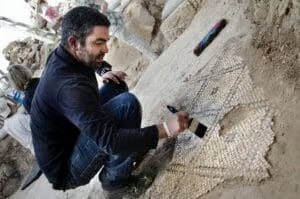
Excavator uncovering a mosaic at the Byzantine monastery. Courtesy Yoli Schwartz, IAA.
Editor’s Note: This blog article contains images of human skeletal remains.
Excavations near Jerusalem’s Old City have revealed the first known archaeological example of a nun participating in extreme asceticism. Primarily known through written records, this Christian practice involved abstaining from pleasure to the point of self-affliction. Although historical sources indicate that this was a predominantly male act undertaken by monks, the new archaeological discovery, and a few notable historical examples, show that it could also be performed by nuns.

Nuns and Byzantine Asceticism in Jerusalem
While excavating a Byzantine monastery, archaeologists with the Israel Antiquities Authority uncovered a grave under the church altar. Inside the grave, they discovered a poorly preserved skeleton, bound with nearly 30 iron rings around its arms, neck, and legs. These rings were then attached to plates on the abdomen that gave the whole skeleton the look of wearing armor. However, this was not a form of torture, but rather a type of self-affliction meant to restrict worldly pleasures. Such acts, known as extreme asceticism, were an unusual way in which some monastics would seek to reject their earthly existence and bring their souls closer to God.

Grave of the Nun of the Rings. Courtesy Yoli Schwartz, IAA.
After performing tests on the enamel of the skeleton’s teeth, the archaeologists were surprised to discover the individual was a woman. This makes the woman, dubbed the “Nun of the Rings,” the only known archaeological example of such a practice being performed by a woman, and one of only a handful of examples of the rare practice known anywhere.
Become a BAS All-Access Member Now!
Read Biblical Archaeology Review online, explore 50 years of BAR, watch videos, attend talks, and more

“The nun is an expression of a phenomenon that was widespread among Byzantine monks in antiquity, which was accompanied by excessive extremism,” said Zubair ʼAdawi and Kfir Arbiv, directors of the excavation. “The monks forced destructive acts and self-harm onto the body. Among the described forms of affliction were prolonged fasts; wrapping iron chains and various accessories around the body; tying the body to rocks; loading on heavy weights; tying the body and placing it in a device which forced it to stand and to deny sleep; self-imprisonment and contraction into a narrow and isolated living space—inside abandoned towers, caves or cells; in hanging cages; on the tops of pillars or even living in the treetops. In some cases, the monks threw themselves into a fire or in front of animals of prey.”

Close up of the nuns neck and arm rings. Courtesy Yoli Schwartz, IAA.
Extreme asceticism, especially wrapping the body in chains, is thought to have originated around modern Turkey and Syria before it spread to the rest of the Middle East and then to Europe. The excavators suggest the Nun of the Rings was likely either a nun who came to Jerusalem from Syria, or a local nun who adopted the custom after seeing travelers to the city. A similar individual, though a man, was previously discovered at the Mar Elias monastery between Bethlehem and Jerusalem.
This article was first published in Bible History Daily on March 14, 2025.
Related reading in Bible History Daily
All-Access members, read more in the BAS Library
Not a BAS Library or All-Access Member yet? Join today.
Related Posts






Must-Read Free eBooks


Want more Bible history?
Sign up to receive our email newsletter and never miss an update.
Unlock Unlimited Access to the Bible's Past

Unlock Unlimited Access to the Bible's Past
Become an All-Access Member to explore the Bible's rich history. Get Biblical Archaeology Review in print, full online access, and FREE online talks. Plus, enjoy special Travel/Study discounts. Don't miss out—begin your journey today!
