


Enslaved Scribes and the New Testament
Candida R. Moss on slavery, authorship, and inspiration
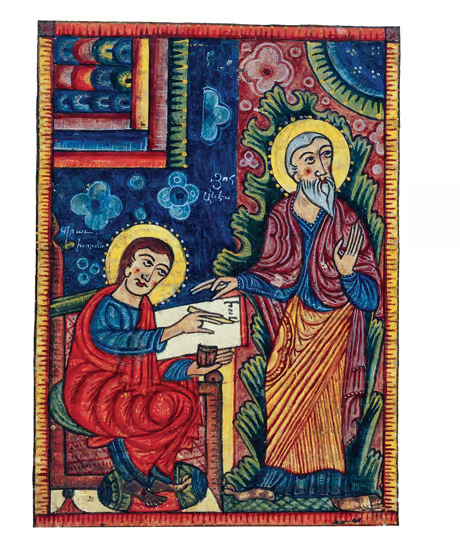
John dictating his Gospel (Armenian manuscript, 1495). CC-BY 4.0 International/Wellcomecollection.
Slavery is hard to sit with. It exposes grave horrors in how people have treated each other and challenges core beliefs about human worth and goodness. Confronting slavery means confronting the gap between professed ideals and historical realities, and asking how societies remember—or suppress—uncomfortable truths. That tension becomes intensified when slavery appears within texts that shape moral and theological formation, like the Bible.
Given the sensitivity of this topic, it is important to be clear: Examining the role of enslaved scribes in the composition of the New Testament is not meant to excuse or justify slavery in any form, but to provide historical context for the texts.
The New Testament Was Produced by Enslaved Labor
In her column “The Hidden Hands Behind the New Testament” in the Winter 2025 issue of Biblical Archaeology Review, Candida R. Moss points out that, when we imagine the authors of the New Testament, we picture apostles and evangelists—Paul dictating theology, Mark recording Peter’s memories, and scribes preserving sacred words. What we almost never picture, the University of Birmingham professor writes, are the enslaved persons whose labor made those texts possible. Yet without them, the New Testament would not exist. It’s a provocative claim.
In the free eBook Ancient Israel in Egypt and the Exodus, top scholars discuss the historical Israelites in Egypt and archaeological evidence for and against the historicity of the Exodus.
Early Christianity emerged within the Roman Empire, a society dependent on slavery. Literacy was rare, and advanced writing was typically handled by trained professionals, many of whom were enslaved. The early church, despite its message of spiritual equality, operated within this system.
Readers generally reckon with the presence of slavery in the New Testament in one of three ways: by treating slavery as historical context rather than moral endorsement; by acknowledging that the early church accommodated slavery and therefore reflects complicity; or by arguing that the gospel offers a program of human dignity that ultimately undermines slavery, even if it does not call for immediate abolition.
Evidence from Paul’s Letters
Paul’s letters explicitly acknowledge scribal involvement in the composition of what would later form part of the New Testament. Romans 16:22 names Tertius—Latin for “third”—as the one who wrote the letter. This fits a Roman convention for enslaved persons to be named a number. In several letters, Paul recounts writing “with his own hand” (Galatians 6:11; 1 Corinthians 16:21; Colossians 4:18). These notices would be unnecessary if Paul wrote all letters himself.

FREE ebook: Paul: Jewish Law and Early Christianity. Paul’s dual roles as a Christian missionary and a Pharisee.
Scribal Contributions
In antiquity, scribes did more than transcribe dictation. They interpreted those dictations and made editorial choices that shaped the final wording. Because ancient shorthand required interpretation when written out in full, scribes had to make judgment calls. Those choices could subtly affect emphasis, tone, or clarity, and therefore theological nuance. Once letters circulated, scribes copied them repeatedly, correcting perceived errors and repairing damaged texts. Even small changes—word substitutions, clarifications, marginal notes absorbed into the text—could influence how later communities understood doctrine.
Later Tradition Erased Enslaved Contributors
Moss argues that the contributions of enslaved individuals to early Christian texts have been minimized in later tradition. People like Mark and Onesimus—whose backgrounds suggest servile status—are later remembered as bishops or saints. Similarly, Mary’s self-identification as a doulē (“enslaved woman”) of the Lord is frequently rendered “servant” or “handmaid” in English translations. The New Testament also mentions numerous aides around Paul whose names and roles align with those of enslaved people. Yet, as Moss recounts, later tradition tends to recall them as “freeborn companions or enthusiastic volunteers.” These glosses obscure the social realities of slavery that shaped the earliest Christian communities.
“Slave” versus “Enslaved”
While “slave” reflects a legal category used in the ancient world, “enslaved” highlights that slavery was an imposed condition—not an inherent category of identity.
What This Means for Inspiration and Biblical Authority
Moss contends that modern literary traditions and assumptions about authorship lead us today to focus on named figures and overlook the labor of those who actually produced and transmitted the texts. Her argument gestures toward a dispersed understanding of inspiration: Theology emerged through a network of collaborators, rather than a single inspired man. Acknowledging this hidden labor, she suggests, enables a more historically grounded and ethically honest engagement with the Bible—one that does not evade uncomfortable truths. By highlighting the role of enslaved scribes, Moss deepens the question of what scripture reveals about human dignity and the treatment of those on the margins. In her framing, grappling with this history does not undermine biblical authority—it complicates and enriches our understanding of it.
For more on this topic, read the article “The Hidden Hands Behind the New Testament” in the Winter 2025 issue of Biblical Archaeology Review.
Not a BAS Library or All-Access Member yet? Join today.
Lauren K. McCormick is an assistant editor at Biblical Archaeology Review and a specialist in ancient Near Eastern religions, visual culture, and the Bible. She holds degrees in religion from Syracuse University, Duke University, New York University, and Rutgers University, and completed a postdoctoral fellowship on religion and the public conversation at Princeton University.
Become a BAS All-Access Member Now!
Read Biblical Archaeology Review online, explore 50 years of BAR, watch videos, attend talks, and more

Related reading in Bible History Daily
All-Access members, read more in the BAS Library
Enslaved in Egypt: What Genesis Suggests about Israelite Slavery
Biblical Views: Paul, the Python Girl, and Human Trafficking
Not a BAS Library or All-Access Member yet? Join today.
Related Posts



Must-Read Free eBooks
Want more Bible history?
Sign up to receive our email newsletter and never miss an update.
Unlock Unlimited Access to the Bible's Past

Unlock Unlimited Access to the Bible's Past
Become an All-Access Member to explore the Bible's rich history. Get Biblical Archaeology Review in print, full online access, and FREE online talks. Plus, enjoy special Travel/Study discounts. Don't miss out—begin your journey today!

Her article is overstating. This seems to imply that Christians ignored slavery and even used it. Ertius is Latin for “third.”
• In Greek it is simply a transliterated Latin name.
• Number-names were common among slaves, freedmen, and sometimes freeborn.
• There is no textual evidence that Tertius was a slave.
• The claim is a plausible sociological hypothesis, not a fact.
To think I thought the scribes were a well trained profession equivalent to lawyers today. Little did I know that scripture was transmitted through a vast pool of literate slaves who were allowed to make editorial and theological corrections without oversight. Tradition has scrubbed this truth which our author cast a light on!
I also thought scripture was considered holy, not to be added to or subtracted from. ” But know this first of all, that no prophecy of Scripture is a matter of one’s own interpretation, for no prophecy was ever made by an act of human will, but men moved by the Holy Spirit spoke from God.” (2 Peter 1:20,21)
Continuing my misunderstanding, I thought the authors of scripture, who gloried in their slavery, were speaking of Christ as their master, not their social status.
And you are proof that we’ll believe almost anything, regardless of the weaknesses of the argument and underlying assumptions, if it leads to our desired conclusion. Bravo!
So Moss seems to be suggesting two things: First, the New Testament was actually written by ghostwriters. This makes way more intelligent sense than the Apostles apparently waiting until they were either dying or already dead to write the books attributed to them. The second is that if I had a son and named him “… the Second” that would mean he was a slave!