


When Was Jesus Born—B.C. or A.D.?
How the divide between B.C. and A.D. was calculated
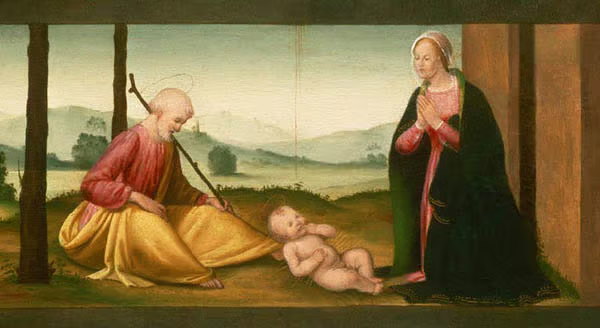
When was Jesus born? This predella panel from an altarpiece by Mariotto Albertinelli (1474–1515) depicts the newborn baby Jesus flanked by Joseph and Mary. In which year was Jesus born—B.C. or A.D.? The evidence suggests he was born in 4 B.C. or before. Photo: John G. Johnson Collection, 1917, courtesy of the Philadelphia Museum of Art.
In which year was Jesus born?
While this is sometimes debated, the majority of New Testament scholars place Jesus’ birth in 4 B.C. or before. This is because most date the death of King Herod the Great to 4 B.C. Since Herod played a major role in the narrative of Jesus’ birth (see Matthew 2), Jesus would have had to be born before Herod died.
This begs the question: How could Jesus have been born in B.C.—“before Christ”?
The terms B.C. and A.D. stand for “before Christ” and “anno Domini,” which means “in the year of the Lord.” These terms are used to mark years in the Gregorian and Julian calendars—with the birth of Jesus as the event that divides history. In theory, all the years before Jesus’ birth receive the label B.C., and all those after his birth get A.D. If Jesus had been born in 1 A.D., these designations would be completely accurate.
However, as mentioned above, it seems most likely that Jesus was born in 4 B.C. or earlier. How then did the current division between B.C. and A.D. come to be?

FREE ebook: The First Christmas: The Story of Jesus’ Birth in History and Tradition. Download now.
Ben Witherington III of Asbury Theological Seminary examines the calendar division in his Biblical Views column “The Turn of the Christian Era: The Tale of Dionysius Exiguus,” published in the November/December 2017 issue of Biblical Archaeology Review. He identifies the monk Dionysius Exiguus, who lived during the fifth and sixth centuries A.D., as the originator of the B.C. and A.D. calendar (based on when he calculated Jesus was born):
Dionysius was born in Scythia Minor, which means somewhere in Romania or Bulgaria, and he lived from about 470 to 544 A.D. He was a learned monk who moved to Rome and became well known for translating many ecclesiastical canons from Greek into Latin, including the famous decrees from the Councils of Nicaea and Chalcedon. Ironically, he also wrote a treatise on elementary mathematics. I say ironically because what he is most famous for is the “Anno Domini” calculations that were used to number the years of both the Gregorian and the adjusted Julian calendars.
Although we are not exactly sure how he came to this conclusion, Dionysius dated the consulship of Probius Junior, who was the Roman Consul at the time, to “525 years after ‘the incarnation of our Lord Jesus Christ’”—meaning 525 years after Jesus’ birth, that is, 525 A.D. Because of Dionysius’s calculations, a new calendar using B.C. and A.D. was born. The terms B.C.E (Before the Common Era) and C.E. (Common Era) also use this calendar.
Even though Dionysius Exiguus calculated his date for the year in which Jesus was born in the sixth century, it was not until the eighth century that it became widespread. This was thanks to the Venerable Bede of Durham, England, who used Dionysius’s date in his work Ecclesiastical History of the English People.
Learn more about when Jesus was born and Dionysius Exiguus’s calculations for B.C. and A.D. in Ben Witherington III’s Biblical Views column “The Turn of the Christian Era: The Tale of Dionysius Exiguus” in the November/December 2017 issue of Biblical Archaeology Review.
Subscribers: Read the full Biblical Views column “The Turn of the Christian Era: The Tale of Dionysius Exiguus” by Ben Witherington III in the November/December 2017 issue of Biblical Archaeology Review.
Not a BAS Library or All-Access Member yet? Join today.
This Bible History Daily feature was originally published on November 29, 2017.
Related reading in Bible History Daily
All-Access members, read more in the BAS Library
The Infancy Narratives in Matthew and Luke—Of History, Theology and Literature
Not a BAS Library or All-Access Member yet? Join today.
Related Posts



Must-Read Free eBooks


Want more Bible history?
Sign up to receive our email newsletter and never miss an update.
Unlock Unlimited Access to the Bible's Past

Unlock Unlimited Access to the Bible's Past
Become an All-Access Member to explore the Bible's rich history. Get Biblical Archaeology Review in print, full online access, and FREE online talks. Plus, enjoy special Travel/Study discounts. Don't miss out—begin your journey today!

While secularists will prefer Before Common Era (BCE) and Common Era (CE), I choose to consider BCE as Before Christian Era and CE as Christian Era. Perhpas they should have considered different initials (I don’t think they intended a dual meaning for the initials)!
Actually, they may have intended so the designations could be read as desired: Christians and non-Christians alike but kept it quiet.
This is ignorance, Jesus was not part of Herod , Herod killed his own children not children of Jewish family to kill the Messiah. You need to look into the history books.
The birth of the Messiah can be calculated two ways. First believe that God’s word is true then know that the monk Dennis the Small did not know Hebrew or understand that God’s Word was written to the Hebrews and His chosen had customs very foreign to the Romans. Dennis made his calculations on knowing the Messiah was 33 years old when crucified and the Sabbath was on the 7th day of the week. Therefore he said to us that Passover had to be on the sixth day of the week during 33 CE. Not knowing the Jewishness of God’s word Dennis did not realize when reading Mark, Luke and John in the Latin Vulgate that the “preparation day” God’s chosen was for the first day of Matzah (Feast of unleavened bread) which the Pharisees called a High Sabbath. However the Latin Vulgate in Leviticus 23 only calls two of God’s appointed times a Sabbath, the 7th day of the week a Sabbath for God and Yom Kippur (day of atonement) a Sabbath for us. Knowing this it becomes a matter of math and using the only consistent calendar in our history, the Hebrew Biblical calendar, starting with the birth in the year 3756 in the month of Etanim (Tishri in the Hebrew civil calendar or the seventh month) on the 15th day also known as the first day of Sukkot. Then the resurrection happened in the year 3790 (30 CE) during the month of Aviv which is also know as Nisan or the 1st month. Then the Talmud in Yoma 39B tells us that the sin sacrifice was not accepted on Yom Kippur by God forty times (note that Josephus also reference these forty years). Then approximately 10 months later on the 9th of Av in the year 3830 (70 CE) the temple was destroyed. You can also calculate this by using Luke 1 and starting with the year 3755, the beginning of the Messianic movement. By knowing the Jewishness of God’s Word you can tell what are certain days. This is a very simple explanation for a very complex problem. Most answers to our questions are in what is called today the “Old Testament”
abysmal ignorance of the Hebrew Calculated Calendar, as followed by the
Hebrew (Levite) priesthood in both First and Second temples at Jerusalem.
majority of such ignorance has prevailed in the Roman Catholic Church, though
certainly not all of it. the fact that traditionally Seth was the considered originator
of the Lunar-Solar calendar of the Hebrews should provide considerable insight
into the past, and how it is that the Jewish Year remains so far behind the actual
years since Adm and Eve. But far beyond that is the accuracy of the Hebrew Calculated Calendar…..it surpasses any other known calendar on the planet.
The idea that Herod died in 4BC and therefore Jesus was born before that comes from Josephus’ mention of a solar eclipse a little before Herod’s death and there was an eclipse early that year. However Josephus mentions a number of events between the eclipse and the Passover, far too many to fit the time available. On the other hand there was also an eclipse earlier in the year in 1BC which does provide time for those events. Moreover 2BC was the 25th anniversary of Caesar Augustus’ power-grab to de facto emperor and he DID call for a registration throughout the whole Roman Empire of those who had any claim to regal authority so that in registering they were accepting Augustus’ over-arching authority. Far from being a “taxation” it was a tax-free year as far as Empire taxes were concerned. This registration also explains the role of Quirinius in Syria in that year. So Jesus’ birth was in 2BC, Herod died in 1BC and “Luke” writing in 58-60AD was a brilliant historian. You’ll find full details in “The Star that Astonished the World” (which can be read online by the late Ernest L Martin at http://www.askelm.com/star/index.asp
The excuse by the secularists for using the term “Common Era” is that it is more inclusive and internationally acceptable than “Before Christ” and “Anno Domini” which refer to one specific religion, but this is hypocrisy. To which culture is the the dating common? Not to Jews, not to Muslims, not to Hindus, not to Buddhists, not to Taoists, not to Shintoists, in fact only to Christians who have given to the world a dating system divided by the most important event in history – the Incarnation, God dwelling in a human form.
So, far from respecting all peoples, these secularists are at one and the same time trying to remove Christ from world-wide consciousness and insulting all other religions, cultures, and peoples by imposing on them a Western system which they are expected to accept as “common.”
You’re wrong.
Julius Caesar died before the first Leap Day was supposed to be intercalated, the priests in Rome mistakenly adding it to the end of February after the 3rd year rather than the 4th year, and this mistake continued through a total of 36 years, during which 12 leap days — rather than just 9 — had been added. This was 3 too many, and so Augustus called for this mistake to be rectified by ceasing to add Leap Day for a number of years. He ought to have waited until 3 cycles of 4-year chunks of Time had transpired before re-activating the every-4th-year leap cycle again, however he jumped the gun by making the year AUC 757 the first one with a Leap Day after that hiatus of more than a decade. Caesar’s calendar — if it had been implemented properly — would have had the years AUC 712, 716, 720, 724, etc. all be 366-day Leap Years, all such years having numbers evenly divisible by 4, you’ll notice.
But the priests mistakenly made the years AUC 711, 714, 717, 720, 723, etc. into 366-day leap years, with AUC 744 being the last leap year when Augustus put a stop to it. He should have resumed it so that AUC 760 would be the first leap year after the hiatus, since ‘760’ is evenly divisible by ‘4’, as Caesar had intended.
But Augustus, instead, made AUC 757 the 1st leap year of what could be thought of as the 1st cycle of the ‘Augustan’ era, the 4th year counting from AUC 754.
It wasn’t until centuries later that ‘Little Dennis’ retro-calculated December 25 of the year AUC 753 as the day on which Jesus was born, the newly-styled ‘Christian’ era then starting with the year the Romans called AUC 754. It was renamed ‘AD 1’, of course, but the Leap Year cycle — resumed after a delay of 13 years — was the defining element insofar as calculating Leap Day was concerned. After the fact, of course, it became apparent that under the Christian re-numbering of the years, each Leap Year once again followed the rule that Leap Year numbers were evenly divisible by 4, as Caesar had originally intended.
The Roman priests botched it, with Caesar’s assassination preventing him from overseeing the proper implementation of his Leap Year rule. Augustus ‘fixed’ the problem — but only imperfectly, as his next ‘first’ leap year ought to have been in AUC 760, rather than AUC 757.
But all this calendrical confusion predated the Christian re-numbering of years by about 500 years. Your Christianity-centric views are due to an ignorance of how the Julian Calendar progressed from its creation in AUC 708-to-709 through the years of confusion culminating in the new ‘Augustan’ 4-year-cycle of AUC 754-to-757 . . . which was re-numbered 500 or so years later to be deemed AD 1-to-4.
Why won’t BAS print the truth? Yet, the drivel from these other posters is allowed. The Book of Luke and the calendar from the Dead Sea Scrolls (DSS) clearly state the month, day, day of the week, and year of Yochanan’s (John’s) conception as well as Yehoshu’a’s (Joshua’s) conception and birth. I provided the evidence how these two sources corroborate the following:
* Yochanan was conceived on the 22nd day of the twelfth month on the first day of the week in 4 CE.
* Yehoshu’a was conceived on the 22nd day of the sixth month on the first day of the week on the Feast of New Oil in 5 CE — exactly six months from Yochanan’s conception.
* Yehoshu’a was born during the census of Quirinius on the 15th day of the third month on the first day of the week on the Feast of Weeks (Shavuot) in 6 CE — exactly 38 weeks from His conception. Sidebar: This is when the “sect” called The Way (HaDerech) in Acts and the DSS made new covenants. Christ’s birth ushered in the ultimate New Covenant! Josephus, a self-described Pharisee (and we know what Christ thought of them in the Eight Woes of Matthew 23), coined the derogatory term “Essenes” (=pious ones).
Why is BAS afraid of the truth?
And, Peter, when we alleged “secularists” employ BCE/CE, it is because we refuse to perpetuate the lies of the RCC and especially that of Dionysius Exiguus, who created this bogus BC/AD year accounting as well as the Gregorian calendar and falsified Easter Tables. The Most High marks time through “weeks of years” or jubilees. Maybe you should research 4Q319 in addition to the calendrical documents in 4Q320 and 4Q321. Even the Samaritan vs. Masoretic versions of the Torah differ by a century by the time of Enoch — the seventh from Adam, so even Israelites don’t know with absolute certainty what the correct AM year is. Plus, they have followed the Babylonian calendar since the time of their captivity. Their fourth month is named after the Babylonian deity Tammuz (Du’uzu); that’s an abomination!
BTW, “Herod” was a dynastic title like Caesar and Pharaoh. The “Herod” at the time of Christ’s birth was Herod Archelaus; he was deposed that same year (after the “slaughter of the innocents” in Bet Lechem) and died in exile in 18 CE. When did the “holy family” return from Egypt after Herod [Archelaus] died? When Yehoshu’a was 12 years old (18 CE – 6 CE = 12 years). Herod the Great had nothing to do with Christ’s birth; he was long dead. I even verified what the “star of Bet Lechem” was with our local planetarium and provided a screenshot with my research. The “wise men from the East” of the “sect” called The Way (HaDerech) lived in the desert wilderness of Qumran — 15 miles away as the crow flies.
Yochanan studied there; see Luke 1:80. He wasn’t just roaming around aimlessly in the desert; he was “the voice crying out in the (desert) wilderness (of Qumran).” That phrase is employed in multiple DSS manuscripts as well as several verses in the Bible. Titus Flavius Josephus (né Yosef ben Matityahu), a self-described Pharisee, coined the derogatory term Essenes (=pious ones). He claimed to have studied at Qumran, but he lied!
There was also a documented solar eclipse in Jerusalem (which requires a new moon) when Christ was crucified on Pesach (Passover) in 36 CE — just as the Scriptures state. That event occurred on 14 Abib on the third day of the week. His ministry was NOT 3-1/2 years in duration; Biblical “scholars” fail to recognize Pesach Sheni (Second Passover) as is documented in Torah; see Numbers 9:10-14. He died incarnate at age 29.
BAS still refuses to approve my post containing my high-level research on this topic; it will forever be held hostage “awaiting moderation.” The truth is found in the Lucan account and corroborated with the calendar in the DSS. Readers will never get the whole truth from BAS (or their local church or synagogue). Elisheba (Elizabeth) was six months pregnant in the sixth month, and Tsekharya (Zecharias) was a Levite of the division of Abiyah (Abijah). Christ was born during the census of Quirinius in 6 CE — as is clearly stated in the Lucan account. Those three facts form the baseline; everything else is easy to deduce from 4Q319-4Q321.
Shema Yisrael!
Hmmm? Passover always occurs at full moon, not new moon. Nisan 14 is the meal then a week of celebration from the 15th of Nisan. Solar eclipses only occur at the start of a month.
Why is this site still using the out-dated BC and AD?
No reputable scholar has used these for at least 2 years.
BC and AD are how Christians – and pretty much ALL Western people – have named the two eras for centuries. Insisting on the now stylish usage is no different from demanding one’s pronouns!
Your response is the better of all the lengthy ones above it. Actually made me smile.