


Phoenician Scarab Discovered in Sardinia
Iron Age scarab evinces trade in the biblical world
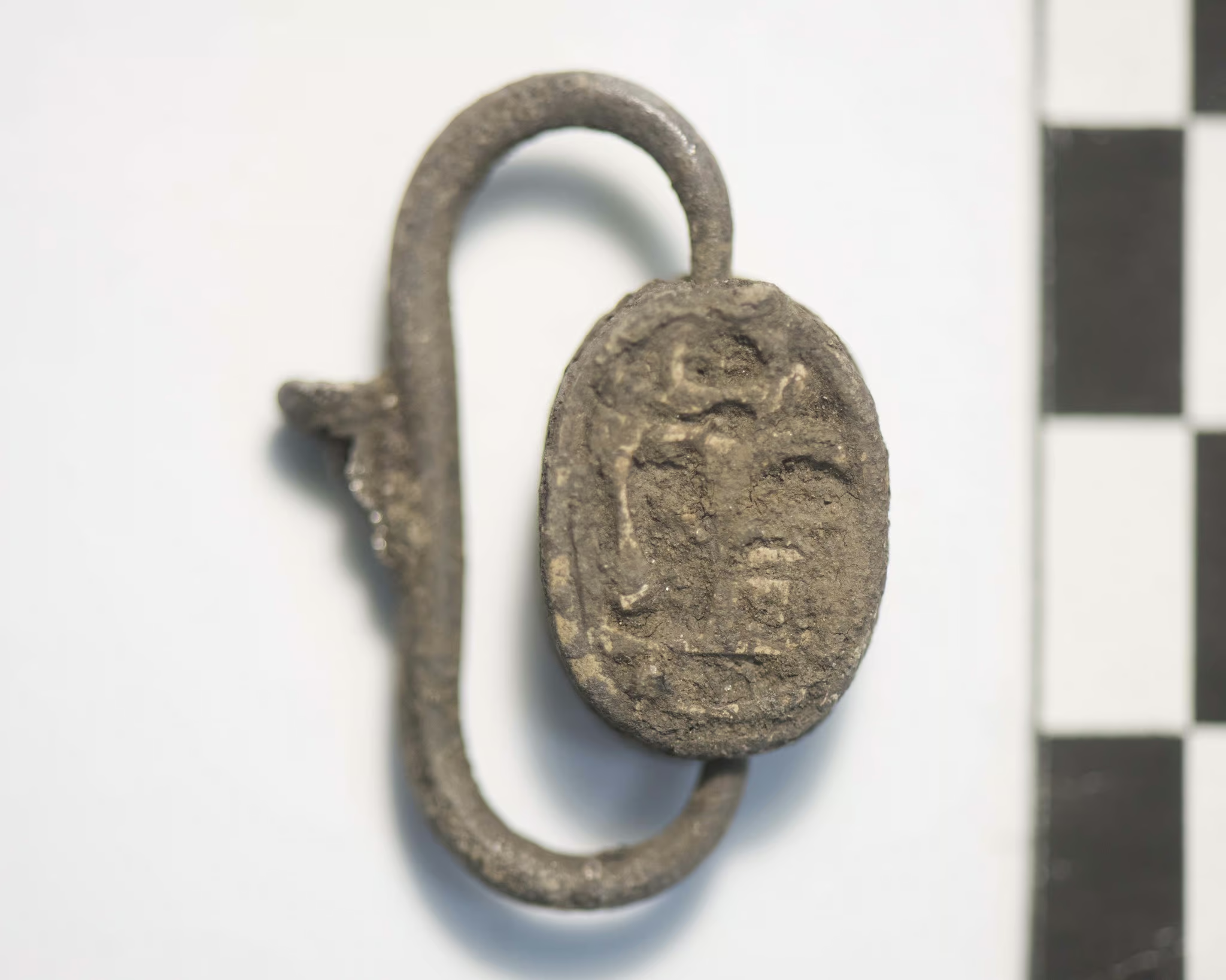
Base of Phoenician Iron Age steatite scarab seal found at Nuraghe Ruinas in Sardinia, Italy. Courtesy Soprintendenza Sassari e Nuoro.
A small object with a big story has emerged from the excavations at Nuraghe Ruinas in Sardinia, Italy. The Superintendency of Archaeology for the Sassari and Nuoro provinces in Sardinia reported on Facebook that, during recent archaeological work in the area, archaeologists uncovered a remarkable Iron Age artifact—a scarab seal. Likely originating from ancient Phoenicia (modern day Lebanon), this small but significant object provides tangible evidence of the commercial and cultural networks at work in the biblical world.
The scarab found at Nuraghe Ruinas is made of steatite and is engraved with hieroglyphic characters. The team has not yet described the inscription or iconography, but the hieroglyphs strongly suggest eastern Mediterranean craftsmanship or influence. Further, the discovery is not isolated. Similar scarabs have been found at S’Arcu ’e Is Forros, about 5 miles from Nuraghe Ruinas, and at Nuraghe Nurdole, between Orani and Nuoro. Taken together, these finds suggest sustained interaction between the ancient inhabitants of Sardinia (the Nuragic civilization) and Phoenician traders operating across the Mediterranean basin.
What Are Scarabs?
Scarabs are small ancient artifacts modeled after the dung beetle. These objects, which connoted status, were typically made of stone or faience. While sometimes worn as jewelry or amulets, scarabs primarily functioned as seals. The tops were carved to resemble a beetle and their flat undersides were often inscribed with symbols or names, pressed into clay to stamp documents and goods.
Sardinia at the Crossroads of the Mediterranean
Sardinia is a large island in the western Mediterranean Sea, situated about halfway between the Italian Peninsula and the coast of North Africa. In antiquity, Sardinia was strategically located along a major maritime trade route linking the eastern Mediterranean—including Phoenicia and the Levant—with North Africa and Iberia. Phoenician contact with Sardinia intensified from the ninth to eighth centuries BCE. In the Levant, this period overlaps with the era of the Israelite monarchy and the later divided kingdoms (c. 1000–586 BCE).
Trade in the Biblical World
Sardinia—rich in copper, lead, and silver—was an important partner in Iron Age Mediterranean exchange networks. Phoenician merchants were the most renowned seafarers of the ancient world. They established trade routes and settlements stretching from the Levant to North Africa and the western Mediterranean and are even credited with standardizing and disseminating the alphabet. The same networks that carried Egyptian-style scarabs to Sardinia also connected to Levantine cities like Tyre and Sidon, both of which play central roles in the Hebrew Bible, including the supply of cedar for Solomon’s Temple. Biblical figures participated in long-distance commerce, political alliances, and cultural exchange.
FREE ebook: Israel: An Archaeological Journey. Sift through the storied history of ancient Israel.
The Spread of Religious Symbols
Scarabs originated in Egypt but were widely adopted and adapted throughout the eastern Mediterranean. In Egyptian belief, the scarab symbolized rebirth, renewal, and divine protection. It was closely associated with the solar god Khepri, who represented the rising sun. Just as the dung beetle rolls a ball of dung—seemingly bringing life from decay—Khepri was understood to roll the sun across the sky each day, embodying the daily renewal of life. Both the beetle and the deity thus became powerful symbols of regeneration and cosmic order.
Over time, however, the scarab became more than a religious emblem, it was a portable cultural form. Phoenician artisans adopted and adapted Egyptian motifs, circulating Egyptianizing objects widely throughout the Mediterranean. Even without knowing the specific imagery of the Sardinian scarab, the scarab form invites discussions of Egyptian symbolism, Phoenician adaptation, and the presence of Egyptian-style artifacts in the Levant. Once conservation and study are complete, the iconography may offer more precise clues about its origin—whether Egyptian, Phoenician, or a hybrid Levantine style—further illuminating the interconnected world of the Iron Age Mediterranean.
This evidence reflects a larger reality of the ancient world: symbols migrated across cultures, often independently of the belief systems that first produced them. Cultural borrowing was normal in the Iron Age Mediterranean. Religious imagery traveled along the same routes as metals, textiles, and luxury goods. Ancient Israel existed within this shared symbolic ecosystem. During the centuries when biblical kingdoms rose and fell, long-distance trade networks connected distant coasts, moving not only commodities but also artistic forms, technologies, and ideas. A small carved scarab, carried across the sea millennia ago, is in that sense evidence of the Mediterranean system that shaped the world of the Bible.
Lauren K. McCormick is an assistant editor at Biblical Archaeology Review and a specialist in ancient Near Eastern religions, visual culture, and the Bible. She holds degrees in religion from Syracuse University, Duke University, New York University, and Rutgers University, and completed a postdoctoral fellowship on religion and the public conversation at Princeton University.
Become a BAS All-Access Member Now!
Read Biblical Archaeology Review online, explore 50 years of BAR, watch videos, attend talks, and more

Related reading in Bible History Daily
All-Access members, read more in the BAS Library
Not a BAS Library or All-Access Member yet? Join today.
Related Posts





Must-Read Free eBooks
Want more Bible history?
Sign up to receive our email newsletter and never miss an update.
Unlock Unlimited Access to the Bible's Past

Unlock Unlimited Access to the Bible's Past
Become an All-Access Member to explore the Bible's rich history. Get Biblical Archaeology Review in print, full online access, and FREE online talks. Plus, enjoy special Travel/Study discounts. Don't miss out—begin your journey today!
