


Ancient Fabric Dyed Biblical Blue?
Fabric found near the Dead Sea may be the color of tekhelet, God’s chosen color
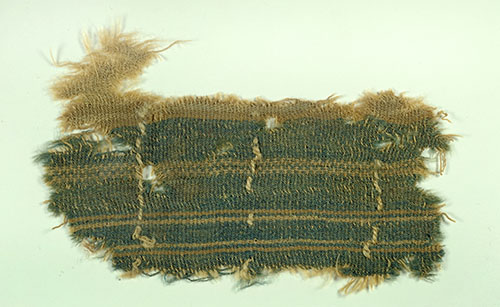
A 2,000-year-old indigo swatch of wool discovered near the Dead Sea was dyed with extracts from the Murex snail in a process that may be similar to what ancient dyers used to produce tekhelet, or Biblical blue. Photo: Courtesy Israel Antiquities Authority.
The Israel Antiquities Authority (IAA) has announced in a press release that 2,000-year-old indigo fabric found near the Dead Sea was dyed using a technique that may have also produced tekhelet, God’s chosen color in the Bible. The research was conducted by Dr. Na’ama Sukenik of the IAA.
The findings were announced at a recent conference in Jerusalem celebrating the 100th anniversary of the publication of Chief Rabbi Dr. Isaac Halevi Herzog’s doctoral dissertation on tekhelet.
Three swatches of fabric discovered in the 1950s in a cave at Wadi Murba’at near the Dead Sea were tested by Dr. Sukenik. Analysis indicated that the swatches were dyed with secretions from the Murex trunculus. Two of the swatches were purple, while the third swatch was indigo—demonstrating that the ancient dyers exposed the latter fabric to sunlight or heat once dyed to achieve this shade of blue. According to the IAA, this dye may have been made by the same process the ancient dyers used to produce tekhelet.
The free eBook Life in the Ancient World guides you through craft centers in ancient Jerusalem, family structure across Israel and ancient practices—from dining to makeup—throughout the Mediterranean world.
In the Bible, tzitzit—tassels tied to the corners of garments—were dyed a shade of blue called tekhelet, God’s chosen color (Numbers 15:38–39). Tekhelet was also the color of the robes worn by High Priests (Exodus 28:31).
Read the Israel Antiquities Authority press release here.
The actual color of tekhelet, whether it was sky-blue or purple—or somewhere in between—has been heavily disputed. Read the debate between Baruch and Judy Taubes Sterman of the Ptil Tekhelet Foundation and Professor Zvi C. Koren, director of the Edelstein Center for the Analysis of Ancient Artifacts, in Bible History Daily.
Related Posts



Must-Read Free eBooks



Want more Bible history?
Sign up to receive our email newsletter and never miss an update.
Unlock Unlimited Access to the Bible's Past

Unlock Unlimited Access to the Bible's Past
Become an All-Access Member to explore the Bible's rich history. Get Biblical Archaeology Review in print, full online access, and FREE online talks. Plus, enjoy special Travel/Study discounts. Don't miss out—begin your journey today!

Given the distance between cities and their dyers, variations among source material and skillsets, the discussion is really not about what colors were actually produced and displayed across the land and its People, but what color was the goal the dyers were trying to achieve. It’s not as though color-wheels from Ace Hardware were available. Consider that variations (rather than deviations) in color were similar to variations in regional dialects, true then as it is today.
Desert. Sun. Fading. Not hard to achieve. I left a red tee shirt on a branch for a summer, it turned pink with exposure. So this was possible, and desirable. Consider that it was a rare color, and took time to achieve, which added to its value. Was there not also a mollusk that dies blue?
Thank you for any other excellent post. Where else may anyone get that kind of information in such an ideal manner of writing?
I have a presentation next week, and I’m at the look for
such information.