


Does the Gospel of Mark Reveal Jesus’ Anger or His Compassion?
What the Codex Bezae reveals about Jesus’ temperament
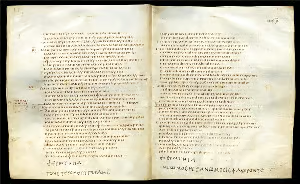
In the fifth-century C.E. Codex Bezae, an early edition of the New Testament written in Greek, the Gospel of Mark describes Jesus’ anger before healing a leper (Mark 1:41). While later scribes changed Jesus’ anger to compassion, it is likely that Codex Bezae preserves the original reading. Image: Cambridge University Library/ff.288v & 289r from Nn.2.41.
Textual variants among ancient manuscripts aren’t usually as controversial as chapter 1, verse 41 of the Gospel of Mark. Sometimes one scribe spelled a word differently on his manuscript, while another might have accidentally skipped or repeated some of the text he was copying. These cases are minor variants and don’t really change the meaning of the text. Other times, however, scribes added to or even changed text to clarify a passage or suit the theological preferences of their communities. That’s when things get interesting, and this passage in the Gospel of Mark offers an especially intriguing example.
In Mark 1:41, a leper has approached Jesus seeking to be healed. Most Greek manuscripts (the New Testament was originally written in Greek), as well as later translations, say that Jesus was moved with compassion and healed the man. A few manuscripts, however, say that Jesus’ anger was kindled before he healed him. So did the verse mean to convey Jesus’ anger or his compassion? If this were a popularity contest, the “compassion” reading would surely win. In 1998, the authoritative book Text und Textwert recorded only two Greek manuscripts (and a few early Latin ones) that contained the reading expressing Jesus’ anger. But, as Dr. Jeff Cate announced in The Folio,* the bulletin of the Ancient Biblical Manuscript Center at the Claremont School of Theology, close examination of one of those two Greek manuscripts has shown that it does not contain the word for either anger or compassion. Just as Matthew and Luke did when retelling Mark’s story in their gospels (cf. Matthew 8:2–4; Luke 5:12–16), the scribe of this Markan manuscript simply left it out.

FREE ebook, Who Was Jesus? Exploring the History of Jesus’ Life. Examine fundamental questions about Jesus of Nazareth.

Mark composes his account of the life of Jesus in this scene from a 12th-century manuscript from Constantinople.
This now leaves the other Greek manuscript, the fifth-century C.E. Codex Bezae, as the sole Greek witness to the reading expressing Jesus’ “anger.” Much like the cheese in “The Farmer in the Dell,” Codex Bezae stands alone.
But most interesting of all, the Codex Bezae may in fact have the better (i.e., original) reading. As New Testament scholar Bart Ehrman pointed out in a 2005 article in Bible Review, “one factor in favor of the ‘angry’ reading is that it sounds wrong.”** It is much easier to believe that early scribes were troubled by Jesus’ anger and changed it to his feeling compassion, rather than the other way around. Later scribes also would have preferred the easier “compassion” reading and copied it until it became the more popular reading. (As Ehrman explains, there are other passages in the Gospel of Mark that seem to support the reading conveying Jesus’ anger.) Thus does Codex Bezae now stand as a lonely witness to what is very likely the original Greek text of Mark 1:41.
Based on Strata, “Jesus’ Anger Rewritten as Compassion,” Biblical Archaeology Review, May/June 2012.
Not a BAS Library or All-Access Member yet? Join today.
Notes
* Jeff Cate, “The Unemotional Jesus in Manuscript 1358,” The Folio 28, no 2 (2011), p.1.
** Bart D. Ehrman, “Did Jesus Get Angry or Agonize?” Bible Review, Winter 2005.
Related reading in Bible History Daily
The “Strange” Ending of the Gospel of Mark and Why It Makes All the Difference
This Bible History Daily feature was originally published on May 24, 2012.
Related Posts



Must-Read Free eBooks




Want more Bible history?
Sign up to receive our email newsletter and never miss an update.
Unlock Unlimited Access to the Bible's Past

Unlock Unlimited Access to the Bible's Past
Become an All-Access Member to explore the Bible's rich history. Get Biblical Archaeology Review in print, full online access, and FREE online talks. Plus, enjoy special Travel/Study discounts. Don't miss out—begin your journey today!

Yes, Jesus got angry at those who would attempt to silence the blind man or keep him from coming to Jesus. This is similar to the anger he showed to those who didn’t want him to heal the man with the withered hand at the synagogue in Mark 3.
If Yahshua was angry, it was with the Priesthood as they are not doing their Spiritual duties or the man with leaper would have went to them! That’s why he told the man to go the Priest and ask for the offering according to Laws of Moses as a witness to THEM the priest! As the Priesthood under Herod were not good shepherds or healers!
Do not put too much into Ehrman’s reading or telling. For a long time, he has shown that he is not with Jesus but instead is against Him and the Gospel.
It is always interesting to me to read articles that are commenting on the translation of an ancient language into English. Without going into what each one is there are homonyms, homophones, and homographs in theEnglish language. Example: pray and prey. So if one hears that word, unless he has heard the context in which it has been given etc. he may interpret it incorrectly.
Additionally, if, at the time the scribe was writing and he used a word, the meaning of which could not be translated into another language, what did he use?
You tell me. Do I rely on someone who is “suppose” to be an expert to interpret the Bible?
We are to read the Bible and pray. God will give us the meaning. I heard a priest give a homily on vs 40-41 and he put it into this context. The leper ask Jesus “if you are willing”. In other words you (Jesus) are God, I know you can do it, so I (the leper) will accept the outcome. THAT, is what we need to do in our lives: to accept, when we pray, what God’s answer will be.
Jesus reached out to people who were lost, forgotten, sinful or hurting and to think that there was any other kind of emotion really needs to be investigated.
By the way, if the interpretation of how Jesus felt was so important how come in Matthew 8:1-4 (NIV) it doesn’t mention the word anger?
These modern interpretations are bogus.
If Jesus was a man whose soul was fully immortal and fully divine, and whose body was fully physical and fully animal and and fully human and fully mortal and fully divine, then I think he was just like all humans, and I think his mission was to show us this, even if it takes us 2,000 or more years to get it. If he asked us – all – to love one another as he had loved us, I do not think he was trying to set us up to fail, us being mere humans incapable of a love which only a child of God is capable of.
I find it surprising that stories pointing to Jesus ego have managed to survive in the canonical gospels handed down to us, at all. But they have.
Even though Jesus, of all people, knew that we ought to forgive one another endlessly for, after all, we know not what we do when we act less than fully lovingly, he himself appears to have fallen into the trap of not instantly forgiving others their lapses, especially when infected by their fear, their hardheartedness, and their disbelief.
Even after his resurrection, as a ghost with a body (as aren’t we all?), Jesus is said to rebuke the remaining apostles for their disbelief, before asking for food.
Apparently infected by Peter’s fear, he addresses him, “Get behind me, Satan!” Perhaps he was joking? If not, he seems to have been angry, or to have shown “indignation”,” which is surely a form of anger? Likewise in clearing the temple, in repeatedly rebuking his followers for their disbelief, their hardness of heart, their failure to have faith even as a mustard seed and to heal others accordingly, in cursing the fig tree, in asking his companions to steal – or “borrow” – an ass or colt for him, in asking that this cup pass and in asking his Father why he had forsaken him.
Jesus had an ego. We all do. Like everything else, it is a blessing. We can learn to use it more and more wisely but, as long as we live, we are unlikely to ever lose it completely, and that is okay. But, if we wish to be like him and greater than him, rather than being like his disappointing followers in the Bible, as recounted to us, we can try to remain calm when others rebuke or test us, show us fear or hatred, forget their Christitude, their own divinity, as Peter famously did, remembering that it may more likely have been an observation than a command, not a Hey, YOU! Love your neighbor as yourself! so much as a, “Hey, you love your neighbor as yourself, at any moment, for that is how we are all – ALL – created.
Much love.
Tom.
Be angry but do not sin.
I wonder if the text originally meant “He was filled with emotion” and then *later* the Greek came to mean “emotion of anger”.
Witness the change in meaning of the English word “awful”.
I would question the total validity of Greek text, due to the fact that the Israel of that day, among the common Jewish population, Aramaic Hebrew would have been the language of preference. The transcribing of Hebraic to Greek would have in itself presented problems if there were no written Hebraic documents from which to use in translation. It is also possible, via oral communication (mouth to ear to interpreter, to paper) that a Greek version could have been made but it would surly lack the fullness of Hebraic implications, given that some word in Hebrew will not translate to Greek. So the best that could be done here, is to use a Greek word silimalar which may or may not reveal the “Intent” of the speaker. I think the Mark question is one of those instances in which “intent” is lost due to translation. I would suggest a proper approach to Biblical studies would be: 1. Become a student of the Hebrew language 2. Become a student of the Torah of Moses 3. Understand the difference between the Torah of Moses and the Oral Rabbinic Laws (Talmud) 4 Don’t be quick to propound doctrine in defense of a demonimation, but secretly ponder things for yourself, you will not find the truth, the Truth will find you…
I have a different take on this. Having been in the ministry for over 45 years and having prayed for many seriously ill people I don’t find anger to be inappropriate. I is well within the area of the possible and may even be probable. Many times in ministering to the sick I have found an emotion of anger rise up within me, not anger at the person, but anger at the devil who brings the sickness to attack a persons body and in this case bind them for years with it. Acts 10:38 mentions Jesus going about healing all who were oppressed of the devil. This could be one of those events.