


Who Was Jesus’ Biological Father?
Examining the nativity stories in Matthew and Luke
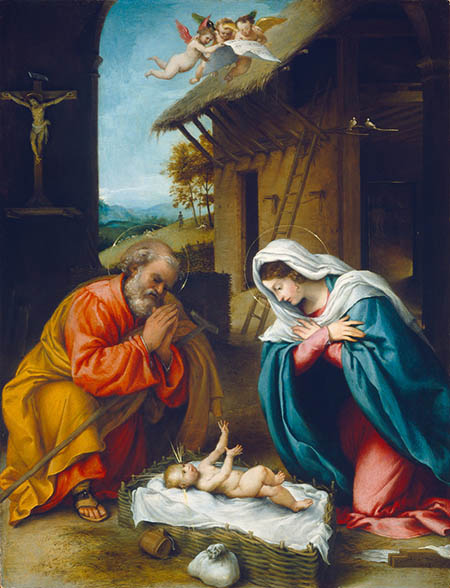
Was Joseph Jesus’ biological father or adoptive father? Joseph is a major figure in the nativity stories in Matthew and Luke. Along with Mary, he is depicted at Jesus’ birth in this 16th-century painting by Lorenzo Lotto. Photo: Courtesy National Gallery of Art, Washington, DC.
Was Joseph Jesus’ biological father? If not, who was Jesus’ biological father?
The annunciation stories in the Gospels of Matthew and Luke recount that Jesus was conceived without the participation of a human male. Ancient views on the biology of conception—based on Aristotelian theory—differed from our modern understanding of genetics and biology. For Jesus to have been considered fully human by our modern standards—and not a semi-divine or special being—he would have needed complete human DNA. While Mary would have supplied the X chromosome, who supplied the essential Y chromosome? God? Joseph?
Andrew Lincoln of the University of Gloucestershire tackles these questions in his article “How Babies Were Made in Jesus’ Time” in the November/December 2014 issue of BAR. Starting with the nativity stories in Matthew and Luke, he examines what early Christians thought about conception and explains how views about this subject have changed over time.
Who was Jesus’ biological father? As modern readers, we might wonder how the product of a virginal conception could truly be human—since the Y chromosome did not come from a human father. Andrew Lincoln explains that this issue would not have been troubling to an ancient audience or to the writers of the nativity stories in Matthew and Luke:
Their understanding of conception, shaped by a patriarchal culture, would have been some variation of the dominant Aristotelian theory. On this view, the male semen provides the formative principle for life. The female menstrual blood supplies the matter for the fetus, and the womb the medium for the semen’s nurture. The man’s seed transmits his logos (rational cause) and pneuma (vital heat/animating spirit), for which the woman’s body is the receptacle. In this way the male functions as the active, efficient cause of reproduction, and the female functions as the provider of the matter to which the male seed gives definition. In short, the bodily substance necessary for a human fetus comes from the mother, while the life force originates with the father.
Those who heard the nativity stories in Matthew and Luke would have considered Jesus to be fully human since his mother supplied all of his bodily substance. Lincoln clarifies: “In terms of ancient biology, even without a human father, Jesus would have been seen as fully human. His mother, Mary, provided his human substance, and in this case God, through the agency of the divine Spirit, supplied the animating principle instead of a human father.”

FREE ebook: The First Christmas: The Story of Jesus’ Birth in History and Tradition. Download now.
According to the New Testament, was Joseph Jesus’ biological father or just his adoptive father?
The annunciation stories in Matthew and Luke claim that Jesus was conceived without a human father, but later in the Gospel of Luke, Joseph is listed as Jesus’ parent and father (Luke 2:27, 33, 48; 4:22). Indeed, through Joseph’s lineage, Jesus is shown to have descended from King David (Luke 3:23–38). Do these accounts contradict the annunciation stories?
The traditional way of reconciling these seemingly incongruous accounts is that Joseph was Jesus’ adoptive father.
In his article, Lincoln offers another way: He posits that knowing the genre of the Gospels helps make sense of this apparent contradiction. As a subset of ancient Greco-Roman biography, the Gospels can be compared to other Greco-Roman biographies, such as Plutarch’s biographies of Theseus, Romulus and Alexander the Great. In these examples, the central character is given two conception stories, one natural and the other supernatural.
Read “Did Jesus Exist? Searching for Evidence Beyond the Bible” by Lawrence Mykytiuk from the January/February 2015 issue of BAR >>
Dual conception stories for the same figure was not uncommon in Greco-Roman biographies, and Lincoln suggests that this was a way of assigning significance and worth to those “who were perceived to have achieved greatness in their later lives.” In this genre, those who accomplished great things in their adult lives deserved an equally great—even supernatural—conception story.
Lincoln’s approach is certainly intriguing—especially when applied to the nativity stories in Matthew and Luke. To read Lincoln’s entire treatment of the matter and learn more about what early Christians thought about conception, read the full article “How Babies Were Made in Jesus’ Time” by Andrew Lincoln in the November/December 2014 issue of BAR.
All-Access Subscribers: Read the full article “How Babies Were Made in Jesus’ Time” by Andrew Lincoln in the November/December 2014 issue of Biblical Archaeology Review.
Not a BAS Library or All-Access Member yet? Join today.
This Bible History Daily feature was originally published on November 3, 2014.
Related reading in Bible History Daily
All-Access members, read more in the BAS Library
Not a BAS Library or All-Access Member yet? Join today.
Related Posts



Must-Read Free eBooks
Want more Bible history?
Sign up to receive our email newsletter and never miss an update.
Unlock Unlimited Access to the Bible's Past

Unlock Unlimited Access to the Bible's Past
Become an All-Access Member to explore the Bible's rich history. Get Biblical Archaeology Review in print, full online access, and FREE online talks. Plus, enjoy special Travel/Study discounts. Don't miss out—begin your journey today!

Read Ron Wyatt’s test results from the dried blood on the Arc of the Covenant…..it’s pretty interesting. When he took it to a lab in Israel they said that the blood was to old to test but Ron insisted…..they went ahead and did the testing and the blood “came alive”…further testing showed that it only had the mothers chromosome. I believed what the Bible said, that Joseph was not Jesus’s biological father…..but he was his Dad, meaning that he raised him as his own but knew the truth. Ron Wyatt’s findings were just another piece of proof for the world to see..
Yah, I saw that Ron Wyatt’s documentary, Only the X chromosomes were present on the tests..
I am not in a position to comment on Ron Wyatt’s findings. However, I wonder about the relevance of any of these alleged discoveries – finding Noah’s ark; the Shroud of Turin; finding the Ark of the Covenant; etc.
When the resurrected Jesus made His first appearance to the disciples (John 20:19), Thomas was not with them. He was informed, later, and responded that without ‘concrete’, material proof, he would not believe!
Eight days later, Thomas was with the others, and Jesus appeared again. He invited Thomas to check out the evidence as he had wanted. Of course, brought face-to-face with the risen Saviour of the world, and King of the universe, Thomas could only fall to his knees in worship. (v.28).
Jesus’ following words are very enlightening: “Jesus said to him, ‘Have you believed because you have seen Me? Blessed are those who have not seen and yet believe.'” (v.29). I would respectfully suggest that those words could be interpreted as, “Blessed are those who have no material evidence, but who still believe”!
In other words, whatever alleged material evidence is produced, real faith does not require it. Rom.3:4!
Blessings, and shalom.
it was tradition that should a daughter of a Lord held at court become pregnant by the king she would still be classed as a virgin – as the King was divine. She would then be married off to a son of any other Lord who was also held at court (in effect to ransom) and that child – should it be a male would inherit the Lords wealth – even though he was not the Lords son.
Jesus father could have been Herod the Great – hence the question that Pilot put to him which sealed his fate – ‘are you the true King of the Jews?’
I like BAR Facebook articles because in a way the articles attempt to bring science face to face with Biblical passages. A trend that I have noted is that when faced with a real constraint such as X and Y chromosomes, BAR lowers the standard for input. Relying on the myths of dual conceptions isn’t an explanation; it’s an aggravation to and an amalgamation of questionable rationales to finding the truth about Jesus presence on Earth. It begs the concept that some writer speaks for God.
Question: When God put into place the process of reproduction through X and Y chromosomes as a standard process, why would that process be suspended and avoided for Christ’s coming?
This article brings into play the consideration of license in explaining how things happened during Christ’s time. This article explains how Christ’s existence was wrapped into literary devices of the time to maintain a mystical aura around Jesus. It falls sadly and miserably short of explaining how Christ received an X chromosome.
I hope BAR reloads its archeological search effort to address this XY conundrum. Repeating 2,000 year old stories to avoid the truth doesn’t meet the test of the article’s title. A shift has occurred in the last 2,000 years. Faith is the basis for discovery of real evidence, and real evidence divides faith from false explanations, literary devices, stories and myths resulting from ignorance of the real world at that time.
I’d recommend that BAR avoid article titles that uses “teasers” that fail to represent the article itself. This article had nothing to do with a factual explanation of Jesus’ biological father.
CB, I enjoyed and agree wholeheartedly with your post and reply. My viewpoint is that of a believer that all scripture was divinely inspired. Regarding biology, God, who established life and all of the genetic components certainly had no difficulty making Jesus fully man, without the need of a physical, biological father.
The article makes this fundamental hermeneutical error: EISAGESIS (reading into the text what isn’t in there originally (in this case, the cultural and literary background).
The article errs in alleging that the Gospel writers possessed “Greco-Roman” worldviews.
The FACT is, the Gospel writers were 2nd Temple “JEWS”, NOT Greeks, Romans or Greco-Romans. These people thought and live according to the 2nd Temple LAW (not the Greco-Roman). they observed “Jewish” Halakah, based on MOSAIC LAW and GOD’S “10”.
Conclusion: These people obviously wrote from a “JEWISH” perspective, and NOT a Greco-Roman perspective.
That dose of error poisons the entire article.
No sense in discussing any of the other points the writer makes.
There is a new theory going around now that prior to marrying Joseph, Mary was a temple virgin and that when the Bible says that Jesus was “born of a virgin”, that is what it is referring to and not that Mary was a literal virgin at the time that Jesus was born.
Where does the information that the Jews of that time had either temple virgins or prostitutes come from?
Go back to sleep Jürgen.