


Everyday Eves
What Biblical womanhood looked like
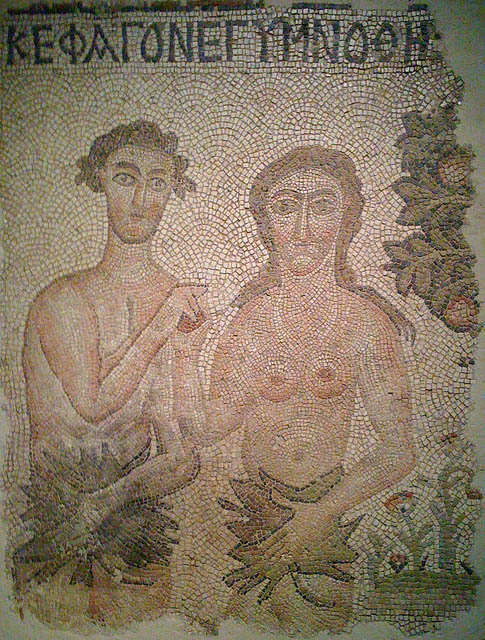
When it comes to Biblical interpretation and emulation, the figure of Eve has been controversial, misunderstood and used for various purposes. The life of the Everyday Eve was very different from those presented in the Biblical narrative. This late fifth–early sixth-century marble and stone mosaic is inscribed in Greek: “And he ate, and they were made naked” (Genesis 3:7). The mosaic fragment, which comes from a church floor in northern Syria, is now in the Cleveland Museum of Art. Photo: Courtesy Scazon/Flickr under CC by 2.0.
People of faith have long wanted to lead Biblically based lives. This naturally flows into an attempt to determine what it means to be an “Everyday Eve.” There are a plethora of interpretations and understandings regarding what Biblical womanhood is and what it looks like. Rachel Held Evans recently spent a whole year trying to live by the rules that governed Biblical womanhood and wrote a book about the experience. The Council on Biblical Manhood and Womanhood maintains an active website and attempts to provide definitive definitions of these phrases. However, what one notices even between these two examples is a vastly difference understanding of the phrase Biblical womanhood. Those who wish to gain insight into Biblical womanhood often begin with the Bible and with the character Eve, as she is the first woman, wife and mother.
While most turn to Scripture to find Biblical womanhood, this is not an easy task. As Carol L. Meyers points out in “‘Eves’ of Everyday Ancient Israel” in the November/December 2014 issue of Biblical Archaeology Review, women are significantly underrepresented in the Bible, and thus very little of their lives can be gleaned from the material.
Beyond the sheer lack of literary material, the other challenge that people face when trying to gain a Biblical understanding of womanhood is one of hermeneutics, or, simply put, the strategy one uses for interpreting a text. It has become clear that the readers’ presuppositions affect the meanings that they derive from the narratives. For example, through many periods of history, male superiority was an understood norm. Thus interpreters from this period argued that women should be seen as subordinate to men because the first woman was created out of the first man. However, Phyllis Trible famously demonstrated the fallacy inherent in this logic when she pointed out that the first man was made from dirt and thus would be subordinate to mud (see “If the Bible’s So Patriarchal, How Come I love It?” in Bible Review, October 1992).

FREE eBook: Life in the Ancient World.
Craft centers in Jerusalem, family structure across Israel and ancient practices—from dining to makeup—through the Mediterranean world.
Perhaps even more challenging for the average reader is the translation effect that occurs within the Biblical text. Most often in North America the Bible is being read in translation and the readers do not know Biblical Hebrew, Aramaic or Greek. This has also come into play when trying to understand how to be an Everyday Eve. In Genesis 2, God says that Eve is to be a “helper” to Adam. In English, “helper” tends to be subsidiary or even subordinate. Yet the Hebrew word—ozr—contains none of that connotation—and in fact, the word is used mostly of God. If one were to assign a subordinate role to Biblical womanhood because of this designation as a “helper,” that person would actually be adding something to the text that is not there and at the same time would be missing the important attribute that is present.
Does this mean that attempting to determine the Biblical approach to something is fruitless? No. It does mean that one needs to have a certain amount of self-awareness and an eye for the details within the text. In addition, there are other avenues of exploration available. We have texts from other ancient cultures that can help round out a reader’s view of the ancient world, and we also have the archaeological record, which is particularly important when trying to better understand daily life in ancient Israel. The women that do appear in the Biblical text are the extraordinary and the exceptional (not always for a good reason), and because of this, they might not provide the best insight into the Everyday Eve.
For more on what daily life would have been like for the average Israelite woman, read the full article “‘Eves’ of Everyday Ancient Israel” by Carol L. Meyers in the November/December 2014 issue of Biblical Archaeology Review.
BAS Library Members: Read “‘Eves’ of Everyday Ancient Israel” by Carol L. Meyers as it appeared in the November/December 2014 issue of Biblical Archaeology Review.
Not a BAS Library member yet? Join the BAS Library today.
This Bible History Daily feature was originally published on October 20, 2014.
 Ellen White, Ph.D. (Hebrew Bible, University of St. Michael’s College), is senior editor at the Biblical Archaeology Society. She has taught at five universities across the U.S. and Canada and spent research leaves in Germany and Romania. She has also been actively involved in digs at various sites in Israel.
Related reading in Bible History Daily:
The Creation of Woman in the Bible
Gender in Archaeology at Abel Beth Maacah
Examining the Lives of Ancient Egyptian Women
Related reading in the BAS Library:
Ingrid D. Rowland, “Etruscan Women—Dignified, Charming, Literate and Free,” Archaeology Odyssey, May/June 2004.
Tal Ilan, “How Women Differed,” Biblical Archaeology Review, March/April 1998.
Related Posts



Must-Read Free eBooks


Want more Bible history?
Sign up to receive our email newsletter and never miss an update.
Unlock Unlimited Access to the Bible's Past

Unlock Unlimited Access to the Bible's Past
Become an All-Access Member to explore the Bible's rich history. Get Biblical Archaeology Review in print, full online access, and FREE online talks. Plus, enjoy special Travel/Study discounts. Don't miss out—begin your journey today!

Maybe feminist Ellen (G?) White should read Rabbi Saul’s “hermeneutic” on the matter … even in the English translation:
“But I do not allow a woman to teach or exercise authority over a man, but to remain quiet. For it was Adam who was first created, and then Eve. And it was not Adam who was deceived, but the woman being quite deceived, fell into transgression.” (1Timothy 2:12-14 NAS)
Doesn’t appear to be any room for equivocation there!
The 2nd Temple Jew, Simon/Peter, has this to say about people who attempt to redefine words to the end of redefining Biblical morality and social institutions:
“… in their greed they will exploit you with false words; their judgment from long ago is not idle, and their destruction is not asleep. … speaking out arrogant words of vanity they entice by fleshly desires, by sensuality, those who barely escape from the ones who live in error, promising them freedom while they themselves are slaves of corruption; for by what a man is overcome, by this he is enslaved.” (2 Peter 2:3, 18-19 NAS)
Peddling a PhD is not reason to “Trust Us, We’re the Experts” …
Ah yes, now we must fire all the female teachers at all levels and not allow them to participate in the church service in anything that lets them talk out loud. For this is the literal Biblical reading. Or, you could actually read the passage, the surrounding chapters, and indeed the entire book, and see easily that this same author gives guidance to women in prophesying publicly and praises women for teaching men (Priscilla and Aquila teaching Paul himself). When we try to prove a point with this verse, it proves too much.
I note three things in the Bible: One, that Jesus Christ spent his 33 years on this earth raising up women and enlarging their lives. Two, that spiritual gifts are never listed with a gender requirement–nor is the Great Commission. Three, that while we have a number of verses telling wives to submit and respect their husbands, we have exactly zero verses commanding men (or even advising them) to take headship, authority, or any type of position *over* their wives. Look at the commands to husbands. They are consistently about love, sacrifice and understanding.
Amazing how we’ve built a whole theology of marital headship around zero direct commands to husbands to be “over” their wives in any way. If we give weight to the direct commands to women to submit and respect, then we must give *equal weight*–EQUAL–to the commands to husbands. And those say nothing, ever, about taking charge. They say plenty about unselfishness and giving oneself for one’s wife.
The verses that commentator Chris quoted from 1 Timothy contradicts another statement attributed to the apostle Paul from Galatians 3:27-28, which states that there is no longer male and female for all are equal in Christ. Bart Ehrman in “Misquoting Jesus” (pp. 178-186), exposes how alterations were made to scripture regarding women’s status in the 2nd century.
The above article makes reference to the October 1992 issue of Bible Review, but Phyllis Trible’s interpretation about Adam comes from another article from the same issue, “Feminist Interpretations of the Bible: Then and Now,” by Pamela J.Milne, and on page 42 she writes:
“Thus, Trible translates ha-‘adam not as ‘Adam’ or even ‘man,’ but as ‘earth creature.’ ‘Ha-‘adam should be translated, she says, in relation to ha-‘adamah (the earth) from which he was taken. ‘Earth creature,’ Trible concludes, is neither male nor female when first created by God. Only after the woman is created in Genesis 2:22-23 can ha-‘adam be thought of as male.”
When I read this passage it reminded me of what Carlos Suarez wrote in “Genesis Cipher,” in that the “adamah” which is translated as “ground” (Genesis 2:7), contains the remains of previous cultures (which is odd since this author was writing about the numerical letter-code of the kabbalah, not archaeology). Now we have this insightful article in the current issue of BAR by Carol Meyers which discusses how early archaeological excavations centered on major cities dominated by male elites and not the surrounding settlements like the small farming communities where women lived and worked. The dust of the adamah is the archaeological record, that in the words of Meyers is “the kind of data necessary to reconstruct household life and thus women’s daily lives” (BAR, Nov./Dec. 2014, p.52).
Actually (to the first 2 commenters), isn’t the article, and certainly Meyers’s work, mostly about women across the Hebrew Testament? I met Meyers in her book /i/Discovering Eve/-i/, where she proposed what for me was a watershed interpretation of God’s reported words to “Eve” as the couple left the garden.
It also seems to me, from my training as a sociologist, highly unlikely that women could have been nearly as neglected, let alone repressed, in the everyday societies of Bible times because subsistence is too difficult to waste half the energy of your household or waste your own energy on repressing them.
Because I understand the women of the times depicted in the Hebrew Bible as the primary tellers of stories and preservers of cultural history, I figure that the women’s stories that did make it into the canon are probably those that the women would have kept on telling, even if the men attempted to cut them out.
Does God Really Care About Women?
According to the Bible, find out how God views women and how Jesus treated women.
“Sin began with a woman, and thanks to her we must all die.”—ECCLESIASTICUS, SECOND CENTURY B.C.E.
“You are the devil’s gateway: you are the unsealer of that forbidden tree: you are the first deserter of the divine law . . . You destroyed so easily God’s image, man.”—TERTULLIAN, ON THE APPAREL OF WOMEN, SECOND CENTURY C.E.
THOSE ancient verses are not from the Bible. For centuries, they have been used to justify discrimination against women. Even today, some extremists still cite religious texts to legitimize the domination of women, claiming that women are to blame for mankind’s ills. Did God really purpose for women to be scorned and abused by men? What does the Bible say? Let us see.
Have women been cursed by God?
No. Instead, it is “the original serpent, the one called Devil,” who has been “cursed” by God. (Revelation 12:9; Genesis 3:14) When God said that Adam would “dominate” his wife, God was not indicating his approval of the subjugation of woman by man. (Genesis 3:16) He was simply foretelling the sad consequences of sin on the first couple.
Thus, the abuse of women is a direct outcome of the sinful nature of humans, not of God’s will. The Bible does not support the idea that women must be subjugated to men in order to atone for the original sin.—Romans 5:12.Read more:
http://www.jw.org/en/publications/magazines/wp20120901/
Very interesting replies to my initial comment on this feminist’s propaganda.
Will someone please provide proof that Paul’s writings were changed after he wrote them?
Please ensure that the evidence is material, not ‘theoretical’ … and not circumstantial.
One of the primary principles of hermeneutics is not to inject one’s cultural bias into the primary source author. Which one of the feminist comments above does not violate that hermeneutical rule?
Please note that Paul’s words relate to authority in social structure, not personhood. Those with adequate background in sociology and politics would know that. Apparently the new sociology has become corrupted, as everything else has in this Canaanite world.
Why not take Paul and Peter at their words, and view their message in terms of politics and law, not psychology and emotionalized ‘religion’.
In that vane, what would you feminists say now?
Paul expressed the tone of the day, which involved generally despairing treatment of women. But he seemed to have no qualms with Priscilla teaching Apollos. He said that he would not have women to exercise authority over men within a church setting, but this in context seems to be his preference rather than a theological need. He possibly took this position because of the likelihood that a woman in a legitimate teaching role at that time would not have been heeded, and probably would have been rejected and condemned.
The idea that a society would arbitrarily structure itself around ideas of “male superiority” just isn’t plausible to me. Perhaps a term like “male dominated” or “male oriented” would have been a more accurate way of expressing that kind of theme…
But even so the whole thing still echoes the broader academic, political, and popular obsession with searching out opportunities to vilify western culture based on mostly negative historical interpretations and seemingly endless delineations of demographic identity and experience.
I agree with Barbara’s comment. Surely a lot of stuff related to “gender” in antiquity grew out of simple matters of survivability and expedience. We have the luxury of being able to think about the fairness of it all, but surely a society that coerced people to abandon ideas of gender differentiation and homogenize occupationally would have had a much tougher time surviving the rough and tumble of the ancient world
Chris — you may wish to invest in the Stagg’s book: Women in the World of Jesus. It may open your eyes as to how God sees women.
Furthermore, Paul is addressing a disciple who was going to work the “Greek street” not the Roman or Galatian street. In places like Corinth where we read a similar condition, understand that women in the Greek world were sequestered. They were at home, not in the market. If they were in the market, they were “spoiled goods.”
With that mindset in his forethoughts, Paul cautions that women are not the focus — Jesus crucified and risen is the focus. In other words, don’t get “crucified” over women’s freedom. Be persecuted for the sake of Christ Jesus.
This is why Paul does not mention women’s silence to the Romans. In Rome, women were part of the scene as a whole and not sequestered as in Greece.
Paul is first a Jewish rabbi, second a pastor trying to meet the needs of his flocks scattered over Asia Minor and Greece. To understand him, you need to understand the mindset of a first century Jewish rabbi as well as the various social customs of the ethnic groups to whom he preached, taught, and ministered.
His pastoral epistles are NOT limited to Timothy and Titus. All of Paul is a pastoral epistle to someone somewhere in a cultural context.
In response to commentator Chris #6; it wasn’t the the verses from 1 Timothy 2:12-14 you quoted in your first comment that was altered (though commentator Helen #9 did a good job in explaining the disparity between Paul’s views), but rather it was a similar statement from 1 Corinthians 14:33-34 that was placed there out of context (compared with the verses before and after) that forbids women to speak at church, contrary to what Paul wrote in 1 Corinthians 11:2-16, confirming that women did in fact speak at church. Bart Ehrman writes that in the case of 1 Corinthians 14, there are 3 Greek manuscripts and 2 Latin witnesses in which these verses in question (33-34) were placed after verse 40 that was possibly inserted there by a scribe who was influenced by 1 Timothy 2 that was intended as a marginal note (apparently some men were afraid of women speaking publicly).