


The Archaeological Quest for the Earliest Christians
Part one of a two-part examination
This is the first of two posts written by Dr. Douglas Boin on new archaeological and historical research in the study of early Christianity, drawn from his book Coming Out Christian in the Roman World: How the Followers of Jesus Made a Place in Caesar’s Empire (Bloomsbury Press, 2015). Click here to read part two.
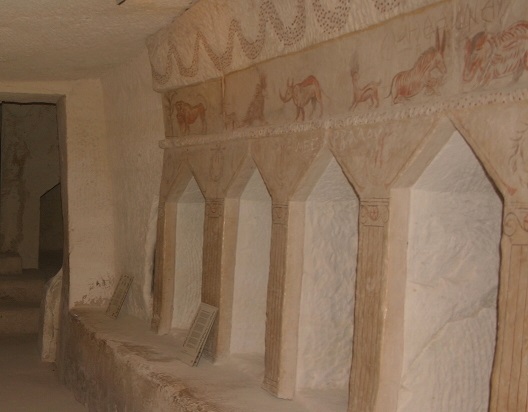
A melange of animals—some real, others exotic—populate the upper registers of a tomb at the Hellenistic city of Maresha. The paintings on site are restored versions of the originals, which dated to the third and second centuries B.C. Photo: Douglas Boin.
The race for the next spectacular artifact is on. Ancient bone boxes, lost manuscripts encoded with secret messages about Jesus, even fragments of crumbled papyrus—some no bigger than the receipts we stuff in our pockets—promise hope of a brave new world in Biblical studies. The assumption seems to be that if we just look a little harder, if we just dig a little bit deeper, one day we’ll find the one piece of evidence that will take us back to the earliest age of Jesus and his followers. To many, it’s an urgent archaeological mission with profound implications for the history of faith.
Just don’t hold your breath. For almost two hundred years after the crucifixion, Roman cities are entirely devoid of any trace of early Christians; to date, no one has ever found any object that’s been plausibly connected to them. As an archaeologist and a historian, I think it’s time we start taking this silence seriously and stop trying to fill it with any more sensational “discoveries.” Many of Jesus’ followers—men and women who lived in the first, second and even third century Roman Mediterranean—simply didn’t want to be found.
That’s not exactly the first thing that usually comes to mind when we think about early Christians, but the evidence is insurmountable at this point. For almost four hundred years, there were no manger scenes anywhere in the Roman world. There were no crucifixes displayed in homes or schools. There weren’t even any bound Bibles tucked into church pews. In fact, we actually don’t even know what “churches” looked like, at least, not until the middle of the third century. For a community that would later come to remember its earliest history as a time of vicious persecution, answered with outspoken acts of martyrdom, this archaeological silence poses a slight problem. Where are these people?
There are two assumptions people usually rely upon to explain the silence. The first is that Scripture, which is to say, the Second Commandment of the Hebrew Bible, prohibited Jesus’ followers from dabbling in anything artistic. The second is that early Christians were too poor and disenfranchised to leave anything noticeable behind. New archaeological and historical research suggests that neither of these traditional explanations are adequate. This post is the first in a two-part series that will explore each of these issues, charting some new directions in the study of early Christianity.
In the free eBook Paul: Jewish Law and Early Christianity, learn about the cultural contexts for the theology of Paul and how Jewish traditions and law extended into early Christianity through Paul’s dual roles as a Christian missionary and a Pharisee.
So let’s tackle the first question. Did the Mosaic commandment forbidding the creation of graven images (Deuteronomy 5:8) really prohibit Jesus’ earliest followers from pursuing their own artistic talents? Recent work on Jewish material culture during the late Second Temple period has shed new light on this topic. At the center of this picture is a twenty-year-old boy, Alexander the Great, and the legacy he left behind in the eastern Mediterranean in the third, second and first centuries B.C.
By the time of Alexander’s successors—the Seleucid family in Asia Minor and the northern Levant, the Ptolemies in Egypt and the southern Levant—sounds of Hellenistic art and craftsmanship were beginning to echo on the shores of the eastern Mediterranean. A visit to two cities makes that clear. At the city of Hellenistic Marisa (today known as Maresha, a site near Bethlehem), archaeologists found tomb chambers with paintings of animals and landscapes that are stylistically similar to those seen at sites like Vergina, Greece, an important site for the Macedonian kings. The animals depicted at Maresha may even have been inspired by a famous Hellenistic zoo, organized by the Ptolemies at Alexandria. The paintings at Maresha have been dated to the third and second centuries B.C. (see image above).
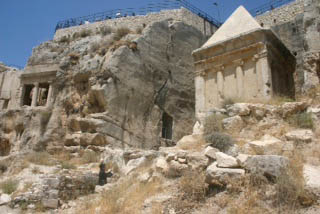
Doric and Ionic columns, friezes, even an Egyptian pyramid shape provided the architectural vocabulary for these two tombs in Jerusalem in the late Second Temple period. These are located east of the Temple Platform, in the Kidron Valley of Jerusalem. Photo: Douglas Boin.
Evidence in Jerusalem reveals similar examples of cultural exchange during this time.
Representations of ships and anchors appear in many Jerusalem tombs during the late Second Temple period. Some monumental tombs built in the Kidron Valley, in the shadow of the Second Temple, incorporate architectural styles that were also widely popular. Both the tomb of the sons of Hezir, dated to the second century B.C, and the so-called Tomb of Absalom, dated to the first century A.D., draw upon Greek columns, capitals, friezes—even Egyptian pyramid forms (see image right).
Jewish individuals and groups during the late Second Temple period may have been waging fierce debates amongst themselves about the role of Hellenistic customs in the formation of their Jewish identity—debates we pick up in our textual sources, like 2 Maccabees—but the archaeological evidence is clear: The Second Commandment given to Moses did not prevent Jews from making images. It prevented them from making idols. Appreciating this nuance in the history of Jewish art and archaeology is an important first step to seeing early Christian archaeology in a new light, too.
In sum, how have we ever come to believe that Christians harbored an innate artistic hostility of their own, taught to them in the Second Commandment, when Jews who read their own Scripture came to entirely opposite ideas? To understand why we haven’t been able to find Jesus’ earliest followers means setting aside long-held assumptions like these. In my second post, I’ll tackle another one: Were early Christians so poor that they were never able to afford nice things? The answer to that question, too, is not the one we may think we know.
This Bible History Daily feature was originally published on December 1, 2014.

Photo by Jerod Quinn
Douglas Boin is assistant professor of ancient and Late Antique Mediterranean history at Saint Louis University. He is the author of Coming Out Christian in the Roman World: How the Followers of Jesus Made a Place in Caesar’s Empire (Bloomsbury Press, 2015), from which this post is adapted. This post has been adapted from it.
Follow him on Twitter @douglasboin and on his blog Religious Dirt.
Related reading in Bible History Daily:
Who Tells the Truth—the Bible or Archaeology?
William G. Dever attempts to marry archaeology and the Bible
Roman Emperor Nerva’s Reform of the Jewish Tax by Nathan T. Elkins
When Did Christianity Begin to Spread?
Alternative Facts: Domitian’s Persecution of Christians by Mark Wilson
Related Posts





Must-Read Free eBooks

Want more Bible history?
Sign up to receive our email newsletter and never miss an update.
Unlock Unlimited Access to the Bible's Past

Unlock Unlimited Access to the Bible's Past
Become an All-Access Member to explore the Bible's rich history. Get Biblical Archaeology Review in print, full online access, and FREE online talks. Plus, enjoy special Travel/Study discounts. Don't miss out—begin your journey today!

It wasn’t because they were poor. Actually they gathered many things from land to possessions to food. They also contributed talents such as helping figure out taxes and doctor visits and general abilities. If you read the Acts of the Apostles you will see an example of a couple holding back what they promised. They had much yet claimed nothing. They said to never parade their deeds just as Christ told many to say nothing about his miracles. They were not liked. As is it now those who have do not like when others pay the bills of the poor. They wanted everything the poor had from land to possessions. As it was for the Christ many who received miracles rejoiced and told many. That is how it spread. Word of mouth like we do now if you find a great restaurant. The Christ and the apostles tried very hard to keep it spirit knowing that temples, churches and books had a chance of becoming chains, which they have. Personal teaching was most important. Spirit on spirit. It was never meant to replace good education, but to add to it. He is The Lord of the Spirit.
Or possibly they were virtually indistinguishable from “Jews” because there were “Jews” doing Jewish things in a Jewish land, living Jewish lives….I use quotes, because I feel we can’t paint everybody of Israelitish origin as Jews simply because it brings in all our pre-conceived notions that we hold. The book of Acts seems to show this. Y’shua called his followers to follow Torah, so they lived what we see as “Jewish” lives. It is only in later years as the numbers of Gentiles increased as followers of the Way combined with Roman persecution and the Fiscus Judaiacus that we begin to see the distancing of what would become the “church” from what was simply a Jewish Assembly that recognized Y’shua as the promised Messiah. If so, would it not be possible that the Archaeological evidence would not be able to distinguish Y’shua’s followers from other sects?
Thank you for your article, it is very thought provoking.
The archaeological silence at the beginnings of Christianity seems to me to reinforce the thesis that Christianity began as an astral mystery cult fusing Hellenistic-Jewish with other (pagan) traditions. The Pauline Epistles, the parables in the Gospels, and the recently vindicated Secret Gospel of Mark all point to an esoteric beginnning for Christianity. It seems likely that it was some time in the second century CE that the cult abandoned its esoteric secrecy and the documents explicating it, went public, and published the exoteric documents we now know as the New Testament and NT apocrypha. Archaeologically, one would expect to find little remaining from such a mystery cult that could be clearly identified as Christian.
Very thought provoking comment Joshua.
I quite agree with Joshua. Too many amateurs or those on a quest to disprove even the existence of Yeshua point to a lack of “evidence” yet Jews remained true to Judaism where they believed in the Messiah or not and evidence would remain Jewish. This has been my conclusion for some time.
Interesting article! When will archaeology produce early day copies of the New Testament writings, like copies of Paul’s letters? We have writings like the Qumran Scrolls: why not findings of portions of the letter to the Romans, or some of the other letters? Let’s keep digging!!
“Roman cities are entirely devoid of any trace of early Christians… no one has ever found any object that’s been plausibly connected to them… I think it’s time we start taking this silence seriously and stop trying to fill it with any more sensational ‘discoveries’.”
I like the comment about filling historical gaps with sensational discoveries, even though whether we like it or not there are occasions where the material reality and the sensational overlap (the Dead Sea Scrolls being an example). The idea that the two are always and necessarily exclusive is misleading.
But Indiana Jones notwithstanding, even if you rigorously filter for the sensational, there is still generally way too much material of archeological significance associated with formative Christianity that would make the broader suggestion that archeology can provide little that’s “plausibly connected” to it sound like quite an overreach.
Not too mention that we have written sources that are anything but silent and can tell us much that would explain why most early followers of Jesus in the Roman world kept a low profile. But minus an archeological object of some kind to validate that, the written sources are often considered too unreliable and otherwise meaningless to the conversation. Consequently, despite the fact that some of the “sensational” phenomenon is fed by popular appetite, it would almost seem that it’s also unwittingly created by some of the academics themselves.
When Pilate said to the Jews, ‘here is your king’, ‘away with him, ‘ they yelled, ‘we have no King but Caesar, crucify him.’
The Jews had their chance, so when they told Pilate (away with him, away with him, crucify him) the mantle was handed down to Paul.
Paul then went to the Gentiles and they received what the Jews refused, the all powerful, wonderful love of Jesus Christ.
Nothing has been found? Seriously? How about the graffiti found at Pompeii I believe, in the first century. Or the hundreds found in the catacombs of Rome some dating early 2nd century? It is not difficult to understand why in the first few centuries very little is found…because they were being persecuted! Keeping a very low profile would definitely be needed to extend ones life.
Great article and comments above, but I wonder if, as Ron commented above, that persecution of the earliest Christians was a major factor here as Prof. Boin also suggested.
Early Messianic Jews (ethnically-Jewish Christians) and Gentiles (ethnically non-Jewish Christians) shared something in common: they were both rejected by the dominant religious establishment of their respective cultures, Jewish and Roman.
But how can this be proven archaeologically? I think it is difficult, but the challenge of archaeology of this period. Interesting discussion for sure.
Peter Hagyo-Kovacs
Dayton, OH