


Lilith in the Bible and Mythology
Connections between Lilith, Adam’s first wife, and Jadis, the White Witch of Narnia

C.S. Lewis’s character Jadis, the White Witch of Narnia, in his The Chronicles of Narnia novels is said to have descended from Lilith, Adam’s first wife. Pictured here is Tilda Swinton as Jadis, the White Witch of Narnia, in the film adaptation The Chronicles of Narnia: The Lion, the Witch and the Wardrobe (2005).
C.S. Lewis, one of the most beloved authors of the 20th century, created a magical, fictional world called Narnia. The primary villain of the first book of this series, The Lion, the Witch, and the Wardrobe, is Jadis, the White Witch. Below is the character Edmund’s description of the White Witch when he first meets her:
A great lady, taller than any woman that Edmund had ever seen. She also was covered in white fur up to her throat and held a long straight golden wand in her right hand and wore a golden crown on her head. Her face was white—not merely pale, but white like snow or paper or icing-sugar, except for her very red mouth. It was a beautiful face in other respects, but proud and cold and stern.
(The Lion, the Witch, and the Wardrobe)
Jadis, the White Witch, is beautiful—and terrifying. Although she looks like a human, she is not. According to the character Mr. Beaver, the White Witch was descended from Lilith, Adam’s first wife, on one side and from giants on the other.
Who is Lilith? Is there any warrant for calling Lilith Adam’s first wife, or is this just the baseless chatter of woodland creatures? Are there appearances of Lilith in the Bible?
Dan Ben-Amos, Professor of Folklore and Asian and Middle Eastern Studies at the University of Pennsylvania, explores the figure of Lilith in the Bible and mythology in his article “From Eden to Ednah—Lilith in the Garden” in the May/June 2016 issue of Biblical Archaeology Review. His analysis shows that Lilith is an intriguing figure who has taken on many shapes over the millennia. From this, we see that Jadis, the White Witch, shares more than just lineage with her supposed ancestor.
FREE ebook: Exploring Genesis: The Bible’s Ancient Traditions in Context Mesopotamian creation myths, Joseph’s relationship with Egyptian temple practices and 3 tales of Ur, the birthplace of Abraham.
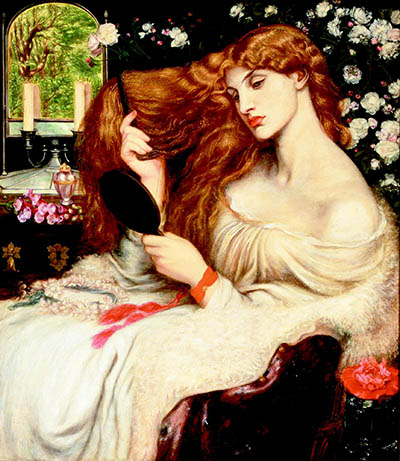
Who is Lilith: Beauty or horror? English painter Dante Gabriel Rossetti’s Lady Lilith (1866–68; altered 1872–73) depicts Lilith, Adam’s first wife, as a beautiful woman. Who is Lilith? According to Rossetti’s interpretation, she was a beauty. Photo: Delaware Art Museum
Lilith is first mentioned in ancient Babylonian texts as a class of winged female demons that attacks pregnant women and infants. From Babylonia, the legend of “the lilith” spread to ancient Anatolia, Syria, Israel, Egypt and Greece. In this guise—as a wilderness demoness—she appears in Isaiah 34:14 among a list of nocturnal creatures who will haunt the destroyed Kingdom of Edom. This is her only mention in the Bible, but her legend continued to grow in ancient Judaism.
During the Middle Ages, Jewish sources began to claim her as Adam’s first—and terrifying—wife. How did Lilith evolve from being a wilderness demoness to Adam’s first wife?
Interestingly enough, this story begins at the beginning—in Genesis 1.
The creation of humans is described in Genesis 1 and in Genesis 2. The first account is fairly straightforward: “So God created humankind in his image, in the image of God he created them; male and female he created them” (Genesis 1:27). The second account describes how God formed man out of the dust of the ground and then creates woman from the man: “Then the Lord God formed man from the dust of the ground, and breathed into his nostrils the breath of life; and the man became a living being. … So the Lord God caused a deep sleep to fall upon the man, and he slept; then he took one of his ribs and closed up its place with flesh. And the rib that the Lord God had taken from the man he made into a woman and brought her to the man” (Genesis 2:7, 21–22).
In the post-Biblical period, some ancient Jewish scholars took the stance that Genesis 1:27 and Genesis 2:21–22 must describe two separate events, since it appears that woman is created differently in these accounts. In her Bible Review article “Lilith” in the October 2001 issue, Professor Janet Howe Gaines explains this reasoning: “Considering every word of the Bible to be accurate and sacred, commentators needed a midrash or story to explain the disparity in the creation narratives of Genesis 1 and 2. God creates woman twice—once with man, once from man’s rib—so there must have been two women. The Bible names the second woman Eve; Lilith was identified as the first in order to complete the story.” Accordingly, Genesis 1:27 describes the creation of Adam and an unnamed woman (Lilith); Genesis 2:7 gives more details of Adam’s creation; and Genesis 2:21–22 describes the creation of Eve from Adam.
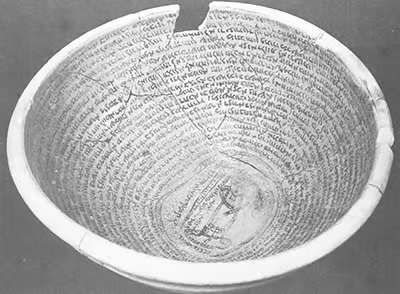
Who is Lilith: Beauty or horror? This Aramaic incantation bowl depicts Lilith as a demoness. A text that mentions Lilith and other evil spirits is written on the inside of the bowl in spiral concentric circles. Incantation bowls were meant to both capture and repel evil spirits. Who is Lilith? According to this representation, which is more consistent with the appearance of “the lilith” in the Bible, she was a horror. Photo: Courtesy V. Klagsbald, Jerusalem
Lilith’s creation is recounted in The Tales of Ben Sira, an apocryphal work from the tenth century C.E. Dan Ben-Amos explains that although this is the first extant text that records the legend of Lilith, her story probably existed earlier:
[Lilith’s] story seems to hover at the edges of literacy with sporadic references. … [I]n the post-Biblical period, the sages identify the lilith several times, not by name, but as “the First Eve,” indicating that her full story was well known in oral tradition, yet barred from the canonized Biblical text. Finally, in the tenth century C.E. in Babylon, an anonymous writer, who was not bound by normative traditional principles and who included in his book some other sexually explicit tales, spelled out the lilith’s adventures in paradise.
The Tales of Ben Sira relates that God created Lilith from the earth, just as he had created Adam. They immediately began fighting because neither would submit to the other. Recognizing that Adam would not listen to her, Lilith “pronounced the Ineffable Name and flew away into the air” (The Tales of Ben Sira). The angels Snvi, Snsvi and Smnglof were sent to pursue Lilith, but when they reached her, she refused to return with them to the Garden of Eden. “‘Leave me!’ she said. ‘I was created only to cause sickness to infants. If the infant is male, I have dominion over him for eight days after his birth, and if female, for twenty days’” (The Tales of Ben Sira). As a compromise, she promised that whenever she saw the angels’ names or forms on amulets, she would leave the child alone. She also agreed that 100 of her children—demons—would die every day.
Our website, blog and email newsletter are a crucial part of Biblical Archaeology Society's nonprofit educational mission
This costs substantial money and resources, but we don't charge a cent to you to cover any of those expenses.
If you'd like to help make it possible for us to continue Bible History Daily, BiblicalArchaeology.org, and our email newsletter please donate. Even $5 helps:

Janet Howe Gaines expounds the severity of Lilith’s sin and its consequences as described in the The Tales of Ben Sira:
Lilith sins by impudently uttering the sacred syllables, thereby demonstrating to a medieval audience her unworthiness to reside in Paradise. So Lilith flies away, having gained power to do so by pronouncing God’s avowed name. Though made of the earth, she is not earthbound. Her dramatic departure reestablishes for a new generation Lilith’s supernatural character as a winged devil.
Gaines also explains Lilith’s hatred for human babies: “Ben Sira’s story suggests that Lilith is driven to kill babies in retaliation for Adam’s mistreatment and God’s insistence on slaying 100 of her progeny daily.”
To learn more about Biblical women with slighted traditions, take a look at the Bible History Daily feature Scandalous Women in the Bible, which includes articles on Lilith, Mary Magdalene and Jezebel.
The Lilith legend continued to grow and change over the following centuries, which is reflected in various artistic depictions of her. While some portrayed Lilith as a beautiful woman, others showed her in a more sinister light. Some even depicted her as the serpent in the Garden of Eden who convinced Eve to eat the forbidden fruit.
Jadis, the White Witch of Narnia, shares similarities with Lilith. Not only are both of them strong, terrifying women, but they also seem bent on destroying human life. Both wield dark magic and are immortal beings. As revealed in C.S. Lewis’s The Magician’s Nephew, Jadis gains immortality by eating a silver apple inside a walled garden in Narnia. This episode has some obvious connections to the account of the Garden of Eden in the Bible. Additionally, both pronounce an ineffable word and suffer dire consequences as a result. The Magician’s Nephew tells how Jadis—before she became the White Witch—pronounced the Deplorable Word, which killed every living thing in her world, Charn, except for herself. So great was her desire for power and her refusal to submit, she spoke the Deplorable Word—knowing full well that it would kill every living person and thing in her world—rather than surrender her claim to the throne of Charn. These examples demonstrate that the character Jadis bears both the blood and the character of her foremother Lilith.
From demoness to Adam’s first wife, Lilith is a terrifying force. To learn more about Lilith in the Bible and mythology, read Dan Ben-Amos’s full article—“From Eden to Ednah—Lilith in the Garden”—in the May/June 2016 issue of Biblical Archaeology Review.
BAS Library Members: Read the full article “From Eden to Ednah—Lilith in the Garden” by Dan Ben-Amos in the May/June 2016 issue of Biblical Archaeology Review.
Not a BAS Library or All-Access Member yet? Join today.
This Bible History Daily feature was originally published on May 2, 2016.
Related reading in Bible History Daily
All-Access members, read more in the BAS Library
Not a BAS Library or All-Access Member yet? Join today.
Related Posts



Must-Read Free eBooks
Want more Bible history?
Sign up to receive our email newsletter and never miss an update.
Unlock Unlimited Access to the Bible's Past

Unlock Unlimited Access to the Bible's Past
Become an All-Access Member to explore the Bible's rich history. Get Biblical Archaeology Review in print, full online access, and FREE online talks. Plus, enjoy special Travel/Study discounts. Don't miss out—begin your journey today!

There is only one act of God’s creating the woman, the second mention in Genesis 2 just gives the details to the simple statement of fact in Genesis 1. Similar to the way a newspaper article unfolds, the first paragraph is a highly simplified summary and subsequent paragraphs provide additional details. There is no need to postulate a narrative of God creating two women for Adam, except perhaps for the contemporary writer to have something sensational to write in order to get published; or, to somehow make a twisted case to justify polygamy.
i agree with this. because in Genesis 2 God created Adam and Eve from his body. if the idea is that there was 2 different creations then logic says there must have been 2 Adams as well
I agree, Gen. chapter 1 tells that God created man and woman, Gen. chapter 2 tells how that came about.
Adam was married to an unnamed woman who was represented by Virgo / Ishtar. When Ishtar’s stock went down, her name was struck from the record. Ishtar worship was blamed for the destruction of two cities, and Nahrum-Sin’s love for her was not very popular. She appeared as a demoness in the form of Lilith, Adam’s first wife. Now the bible states the man was expelled from Eden, not the woman. Adam then took a second wife, most likely the same place Cain and Noah got their unnamed wives. However, the goddess became popular again, so they gave her a name after the Hittite goddess Heva, Their Ishtar, also posed with a lion like Ishtar (Leo=Adam). Adam’s first wife remained behind to be the consort of YHWH, the moon god, same as in Babylon.
The reason why the rib is because Leo was a larger constellation and the head of Virgo was in the rib, hence “Eve” came from the rib. When the Greeks broke up the constellations, Leo was as it is today and Virgo (Eve) head is part of the tail. At this point, the rabbis who were also astrologers, decided to update the story, but the only way they could do this was outside of the text, so they created a midrash where Adam had a tail and Eve came from it.
The Bible cosmic myth starts out with Ishtar as Adam’s wife and ends with David (named for Davinka a form of Ishtar) as a cosmic form of Narhum-Sin who is in love with Bethseba who represents Ishtar at the autumnal equinox. Her giving birth to Solomon at the Southern Crown concludes the cosmic myth as one big circle starting and ending with the goddess.
The bible is layered to hide the fact these are Bronze Age stories and not Iron Age texts. Tigay’s work on Gilgamesh describes the techniques used to create this layered text. It is just a matter of working the text backwards. Not to hard to do, even for a layman.
I thought Lilith was the wife of a Lilliputin 😀
The Jewish manuscripts tell of God, making man to his type and women to her type, on the 6th day! He told them to go and replenish the world. On the 8th day God created Adam, the H’Adam to tend the garden, and created Eve from his DNA to be his help mate. That was on the 8th day. Lilith is a feeble attempt by “scholars” to explain the different races. there was no Lilith, at least in Adam of the 8th days world. Pure mythology. God created all the races on the 6th day. there is no way two people of ruddy complexion can birth black, Asian , native American, and sweedish from the same DNA. give us a break. O.K.
Sorry, Kevin, but any good geneticist will tell you that there would have been plenty of gene variation built into the first genetically perfect humans, with no mutation. Over the generations, you would begin to see the dominant and recessive genes present themselves ,slowly, with pigment changes, as the different shades of melanin would show up among the tribes.
After the Noahic flood, the migration of Noah’s sons and wives to different parts of the new world would create some genetic isolation, creating actual “races”. Even today, there are occasional surprises where 2 white parents have a black baby–we still have that much genetic variation within us today!!
Jews I know are avowedly secular and now practicing, cultural. Maybe this is because I’m in San Francisco, I don’t know. Same with Christians in a way. I know a few people who say they’re Christian but when pressed seem more new age. E.g., not a literal personal trascedant God but one who’s just umm king of everything. Etc. My point being, I’ve gotten to the point where I assume scholars readers and writers of this journal are like me and my friends. Hence the preceding comments about Lilith kin of shock me with their sound of having a literal faith. Which to me would be just totally crazy.
Jewish sources of the Middle Ages wouldn’t have made that error if they had been aware of the documentary hypothesis.
The Babylonians did not believe in or believed God so why would any person think their accounts of the beginning would even be close to the truth?
C.S. Lewis was not inspired of God so why bring his crap into the discussion on Adam and Eve?
Lilith is not a terrifying source, Where do these authors come up with this stuff?
If you want the truth, d not go to supposed biblical scholars, archaeologists or those inferior writers at BAS
The Bible simply states that God created male and female in His image and breathed life in to them and they began to breathe and live. Speculating on anything wider than that gets us no-where really. We do, as the New Testament states see ‘as through a glass darkly’, we cannot see the whole picture yet because our human brains cannot comprehend the full glory, majesty and extent of God’s superior knowledge. He chooses to show us what He will for the present, and the day will dawn when we will be shown everything and it will all make sense. God does this in His own time, not our version of time.
What are you people talking about?????