


Water from a Walking Rock
What does Paul mean in 1 Corinthians 10:4?
“… For they drank from the spiritual rock that followed them, and the rock was Christ.”
—1 Corinthians 10:4
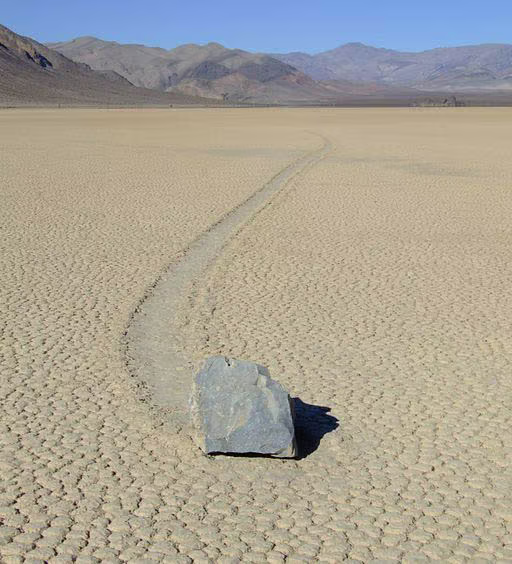
A WALKING ROCK IN THE DESERT. A walking rock, sailing stone, moving rock or sliding rock are all names for a rock that moves along a smooth valley floor without the assistance of humans or animals. What does Paul mean in the Bible when he talks about the “spiritual rock that followed” the Israelites during their wanderings in the wilderness? Is he talking about a walking rock? No—the natural phenomenon of a walking rock is very different than the miraculous water-giving rock mentioned in 1 Corinthians 10:4. Photo: Lgcharlot’s is licensed under CC-by-SA-4.0
What does Paul mean in the Bible when he says that the Israelites drank “from the spiritual rock that followed them” during their wanderings in the wilderness?
Paul makes this claim—in 1 Corinthians 10:4—while recounting how the Israelites were sustained in the wilderness after their dramatic Exodus from Egypt before they entered the Promised Land. They “all ate the same spiritual food” and “drank the same spiritual drink” (1 Corinthians 10:3–4).
Those familiar with the Hebrew Bible (Old Testament) might stop and wonder: What does Paul mean? In the Bible, it says that the Israelites miraculously received water from a rock two times (Exodus 17:1–7 and Numbers 20:1–14). Both times Moses hit the rock, which then produced water, but the text never claims that the Israelites were followed by a water-giving rock. Therefore, what does Paul mean in 1 Corinthians 10:4?
John Byron examines this passage in his Biblical Views column “Paul, Jesus and the Rolling Stone” in the September/October 2015 issue of BAR.
Byron notes that, interestingly, Paul is not the only person to suggest that the Israelites were followed by a water source during their wilderness wanderings. A first-century C.E. source called Pseudo-Philo’s Biblical Antiquities makes a similar claim: “But as for his own people, he led them forth into the wilderness: Forty years did he rain bread from heaven for them, and he brought them quails from the sea, and a well of water following them” (10.7).
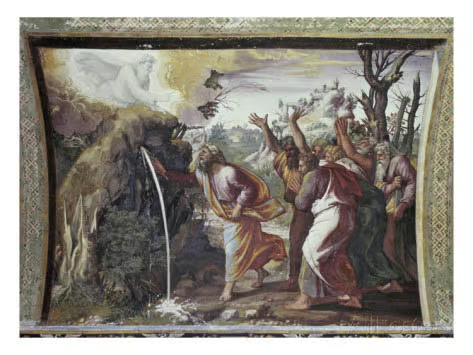
MOSES HIT THE ROCK, and water gushed forth—as depicted in this fresco by Raphael Sanzio. Did a water-giving rock follow the Israelites through the wilderness? If not, what does Paul mean in 1 Corinthians 10:4?
Pseudo-Philo claims that a well of water followed the Israelites through the wilderness, whereas in 1 Corinthians 10:4, Paul says that it was a rock that followed them. How did these two ancient interpreters come to their conclusions?
“What they seem to have concluded,” Byron explains, “is that since Moses named both the rock at Rephidim (Exodus 17:7) and the one at Kadesh (Numbers 20:13) ‘Meribah,’ the logical conclusion was that both were one and the same rock and that it, therefore, must have accompanied Israel on their journey.”
1 Corinthians 10:4 reflects a common ancient interpretation—that the Israelites were followed by a water source during their wilderness wanderings, which is demonstrated by Paul’s casual reference and supported by Pseudo-Philo.
FREE ebook: Paul: Jewish Law and Early Christianity. Paul’s dual roles as a Christian missionary and a Pharisee.
In the passage, Paul makes a second unusual claim: The rock that followed the Israelites through the wilderness was Christ.
How should we respond to these two claims? Was Paul speaking literally or figuratively?
“At the end of the day it’s unclear whether Paul really thought the rock followed Israel in the desert,” Byron says. “Most ancient and modern commentators assume that Paul is reading Israel’s story typologically rather than suggesting that Jesus was present with Israel in the wilderness in the form of a movable water source.”
To see John Byron’s full explanation of 1 Corinthians 10:4, read his column “Paul, Jesus and the Rolling Stone” in the September/October 2015 issue of BAR.
BAS Library Members: Read the full Biblical Views column “Paul, Jesus and the Rolling Stone” by John Byron in the September/October 2015 issue of Biblical Archaeology Review.
Not a BAS Library or All-Access Member yet? Join today.
This Bible History Daily feature was originally published on September 7, 2015.
Related reading in Bible History Daily
Out of Egypt: Israel’s Exodus Between Text and Memory, History and Imagination
Related Posts


Must-Read Free eBooks
Want more Bible history?
Sign up to receive our email newsletter and never miss an update.
Unlock Unlimited Access to the Bible's Past

Unlock Unlimited Access to the Bible's Past
Become an All-Access Member to explore the Bible's rich history. Get Biblical Archaeology Review in print, full online access, and FREE online talks. Plus, enjoy special Travel/Study discounts. Don't miss out—begin your journey today!

On at least two occasions and in two different locations the Israelites received a miraculous provision of water from a rock-mass. (Ex 17:5-7; Nu 20:1-11) Therefore, the rock-mass as a source of water, in effect, followed them. The rock-mass itself was evidently a pictorial, or symbolic, type of Christ Jesus, who said to the Jews: “If anyone is thirsty, let him come to me and drink.”—Joh 7:37.
hthttp://wol.jw.org/en/wol/d/r1/lp-e/1200003753
http://wol.jw.org/en/wol/d/r1/lp-e/1200003753
Sorry.
similarly, the apostle Paul wrote: “For they [the Israelites] used to drink from the spiritual rock-mass that followed them, and that rock-mass meant the Christ.” (1Co 10:4)
Commentator Kurt just hit the nail on the head with the reference to John chapter 7 which is set against the backdrop of the Festival of Booths that is celebrated as a continuation of the wilderness traditions and were still in use among the Dead Sea sect as we see in the scrolls a reference to the font of wisdom, the spiritual source which is emanated from God’s hidden attribute of infinite wisdom that is revealed through the words of scripture:
“But you, God, placed morning rain in my mouth,
for all seasons,
and living waters which will not fail.
When they burst open, they never go dry
but rise like a torrent over its banks.”
(Thanksgiving Psalm 14, “The Other Bible,” by Willis Barnstone, p.263)
This tradition continues in “The Odes of Solomon,” a Jewish Pseudepigrapha and Jewish Christian work from the 2nd century and five of Solomon’s odes were found in the Gnostic work, “Pistis Sophia,” found among the texts at Nag Hammadi:
“Actually, the odes are as poetic, profound, and astonishing as the most compelling psalms of the Old Testament. So we read ‘The dew of the Lord rinsed me with silence/ and a cloud of peace rose over my head’ (Ode 35); or, with typical chariot imagery of Jewish mysticism: ‘I went up to the light of truth as into a chariot/ and the truth took me/ across canyons and ravines’ (Ode 38). The words are graceful in ‘My heart was cloven and there appeared a flower/ and grace sprang up (Ode 11), and the thought of three prevailing traditions, Jewish, Christian, Gnostic, is suggested in Ode 7:
The father of knowledge
is the word of knowledge.
He who created wisdom
is wiser than his works.”
(“The Other Bible,” p.267)
Good morning from Indonesia. Let me copy a footnote from The New American Bible related to 1 Cor 10:4 : “A spiritual rock that followed them: the Torah speaks only about a rock from which water issued, but rabbinic legend amplified this into a spring that followed the Israelites throughout their migration. Paul uses this legend as a literary type: he makes the rock itself accompany the Israelites, and he gives it a spiritual sense. The rock was the Christ: in the Old Testament, Yahweh is the Rock of his people (cf Deut 32, Moses’ song to Yahweh the Rock). Paul now applies this image to the Christ, the source of the living water, the true Rock that accompanied Israel, guiding their experiences in the desert.”
This appears to be related to the legend of well which followed the Israelites through the wilderness according to rabbinic Jewish midrash in the merit of Moshe’s sister, Miriam (cf. T Sukkah 3:11, M Avot 5:6) and which disappeared following her death (in Numbers 20).
There are two different words in Hebrew for ‘rock’.
The first ‘tsur’ (Ex 17) is a hard massive basalt rock which typifies Christ during His life on earth, this rock must be slain.
The second ‘tsela’ (Num 20) is a high rock formation with sediment layers (jult like the Rocky Mountains), this typifies Christ glorified in heaven. This rock should not be slain, but you have to speak to this rock (prayer).
“Jehovah is my crag (“tzur” in Exodus 17:6) and my stronghold and the provider of escape for me.
My God is my rock (“sela” in Number 20:8)…”..
2 Samuel 22:2
The song that is attributed to King David in 2 Samuel 22 with its parallel in Psalm 18 may have affinities with an Egyptian royal ritual of assuming the role of priest in a purification rite. In the book “Sacred Science; The King of Pharaonic Theocracy” by R. A. Schwaller de Lubicz (p.145), there was an official of the royal court of the 3rd dynasty king Djoser who was the chief of dentists and physicians named Hesy-Ra, whose wooden stela was found in Djoser’s pyramid. The hieiroglyph of the name Hesy signified 2 vases of a type used in ritual purifications:
“This elegant oblong vase is used, for example, in the purificcation of the king when he officiates as priest before entering the sanctuary. In the most typical of these rituals, (lunar) Thoth and (solar) Horus, with each one of these vases, pour ‘benediction’ in two streams crisscrossing above the king’s head. This purification is to be made four times, once toward each of tfe four cardinal points, and this ritual gesture is performed while declaring:
‘Thy purification is my purification and my purification is thy purification…'”
“Hesy, whose name (written with the dual form of the purification-vase ‘hs’) means ‘twice blessed,’ represents ‘he who has recieved the double benediction.'” (“Sacred Science,” p.143)
Hesy-Ra is shown with a scribal kit in his left hand and in his right hand is a staff:
https://commons.wikimedia.org/wiki/File:Hesy_Ra_physician.jpg